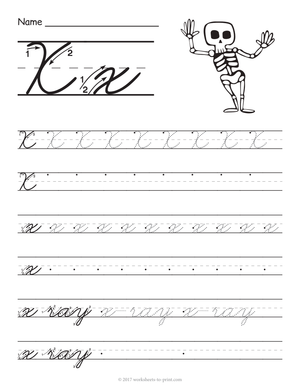
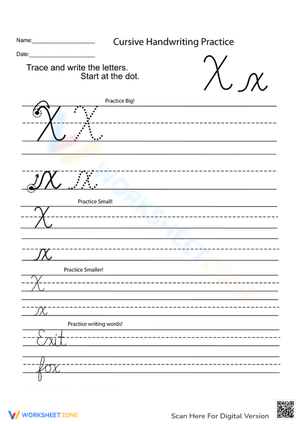
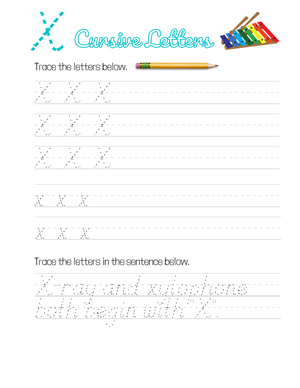
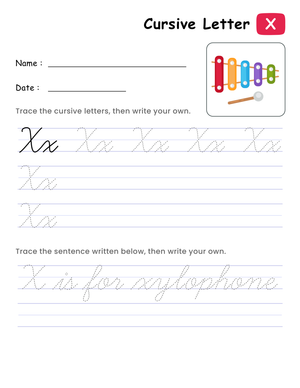
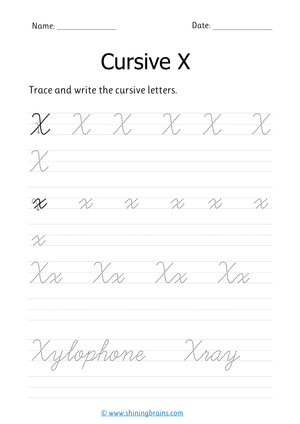
These 3rd grade cursive x handwriting worksheets give teachers a focused resource for one of the genuinely unusual letters in the cursive alphabet — a character that requires a deliberate pencil lift mid-formation, which runs counter to the continuous-flow rule students have just spent weeks internalizing. The set covers lowercase and uppercase x formation, cross-stroke accuracy, exit tail technique, and short in-word practice built around familiar Grade 3 vocabulary.
The Specific Skills Each Worksheet Targets
The lowercase x gets the most practice space. Students trace and then independently form the body stroke — a slanted curve that launches from the baseline, crests near the midline, and returns to the baseline with a small exit tail. That stroke establishes the letter's height and slant before the cross enters the picture. Each worksheet then moves from guided tracing rows into independent rows, and from there into short words — fox, box, exit, extra — so the letter gets practiced inside real spelling vocabulary rather than treated as an isolated drill. Seeing the x function inside a word is what shifts a student's understanding from "here is how I draw this letter" to "here is how this letter works."
The uppercase X has its own section in the set. It spans from the baseline to the cap line, opens with a rounded entry stroke that distinguishes it from print, and requires the same lifted cross as the lowercase version. Because the uppercase X does not connect to the following letter in most standard cursive curricula, it gives students a natural reset point mid-word — worth naming explicitly so they understand the lift is intentional, not a lapse. The set includes a stroke model reference on each worksheet, which matters when students may have had prior exposure to Zaner-Bloser, D'Nealian, or another style before entering the room.
Student Error Patterns Worth Watching For and Addressing
The most consistent mistake is a misplaced cross-stroke. When students cross too high — near the top of the letter — the x reads as a cramped, top-heavy shape. When they cross too low, near the baseline, it collapses into something resembling a cursive v with a stray line through it. The error usually comes from students trying to replicate the print letter's two equal diagonals. In cursive, the body stroke does most of the structural work, and the cross is a short, centered addition — not a second diagonal of equal weight. Showing students a side-by-side comparison of correctly and incorrectly placed crosses before they begin a practice session takes about thirty seconds and prevents that particular mistake from hardening across an entire row.
The exit tail is the other persistent issue. Students who stop the letter at the baseline rather than extending a forward curve produce an x that cannot connect to the next letter. In isolation, the letter may look passable. But when a student writes fox or axle at any real pace, the missing exit tail creates a visible gap that interrupts the word's flow. A short cue before practice — "finish with a forward wave, not a hard stop" — paired with a visual reference printed on the worksheet keeps the expectation in view without requiring a full re-explanation every session.
Building These Worksheets Into Your Weekly Routine
The format works best as a short daily warm-up rather than one extended block. Five minutes as students settle in — one row of lowercase, one row of uppercase — builds the kind of distributed repetition that actually moves a skill past conscious effort. Teachers who compress all the practice into a single longer session tend to find that by the following Monday, the formation has reverted. Spacing it across the week is what converts the letter from deliberate to automatic, which is the real instructional goal.
The in-word rows on each worksheet connect naturally to the spelling block. When a unit brings in x-words, pairing the 3rd grade cursive x handwriting worksheets with word-work time means students are handling spelling pattern recognition and letter formation in the same sitting. That overlap reduces the third-grade perception that handwriting is a separate subject layered on top of language arts rather than part of it — a perception that, once formed, is surprisingly stubborn.
Standard Alignment
CCSS.ELA-LITERACY.L.3.2 addresses language conventions in Grade 3 writing and provides the standards backdrop for handwriting instruction at this level. The standard does not specify a cursive style, but it establishes that students should write with enough mechanical control to produce legible, purposeful work. Many state frameworks that build on CCSS — including those in California, Texas, and Louisiana — have added explicit cursive requirements at Grade 3, making the 3rd grade cursive x handwriting worksheets a direct match for those mandated practice sequences. The instructional logic also supports the standard more broadly: when letter formation is automatic, students direct cognitive attention toward word choice and sentence structure instead of stroke mechanics, which strengthens performance across all writing standards at this grade level.
Adjusting the Set for a Range of Learners
Students still building fine motor strength should focus on the traced rows rather than pushing toward independent production. Those students benefit from fewer total repetitions with closer teacher observation — ending a practice session early when grip fatigue is visible is more useful than completing an entire worksheet with deteriorating form. Folding the worksheet so only one or two rows show at a time reduces visual load for students who lose focus quickly; they see one task rather than an entire worksheet of lines stretching to the bottom.
Students who have the basic form under control can move toward speed and consistency. A clean worksheet with no tracing guide and a two-minute timer — write as many x-words as possible while keeping them legible — surfaces the difference between a skill that is truly automatic and one that is still effortful under mild pressure. For the most advanced writers, the target shifts from letter-level accuracy to fluent in-sentence use: writing a full sentence containing at least one x-word in connected cursive while maintaining consistent slant and spacing throughout.
Frequently Asked Questions
How do you properly cross a lowercase cursive x?
Finish the body stroke first — from the baseline up near the midline, then curve back down to the baseline with the exit tail intact. Then lift the pencil and draw a short diagonal from upper-right to lower-left, crossing the body stroke near its center. The cross should not extend far beyond either edge of the body stroke. Students who try to place the cross first tend to misjudge where the body stroke will land, so the sequence matters for accurate placement.
Does the uppercase cursive X connect to the next letter?
In standard cursive curricula — Zaner-Bloser and D'Nealian among them — the uppercase X does not connect forward. The cross-stroke completes the letter, and the next letter begins independently. Tell students this explicitly, especially early in the year when they are primed to connect everything they write. Without that explanation, they will assume the disconnection is an error and try to force a connection that does not belong there.
What words work best for practicing the cursive x?
Short words with x in the final position — fox, box, mix, six — are the most useful starting point because the incoming connection from a familiar letter like o or i is manageable. Words where x appears at the front, like exit or extra, introduce the letter in a less familiar connection role and work well once students are solid on the basic form. The 3rd grade cursive x handwriting worksheets in this set move roughly in that order, so students meet the easier connections before the more complex ones.
Is cursive instruction required in Grade 3?
The original CCSS did not mandate a specific handwriting style, but the Grade 3 writing production standards assume enough mechanical fluency for legible communication. A growing number of states have since added explicit cursive requirements at or before Grade 3 — Georgia, Louisiana, and Texas are frequently cited examples. Even where there is no formal mandate, most Grade 3 curricula include cursive because the fine motor demands and the cognitive work of forming connected letters support writing development more broadly through the upper elementary years.