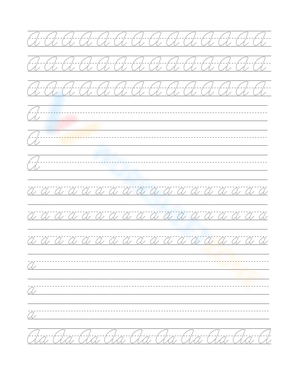
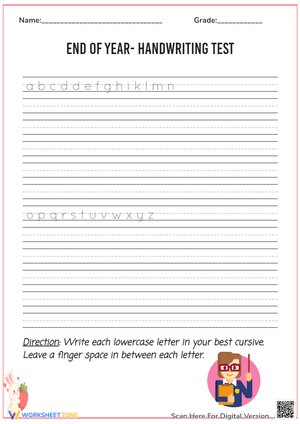
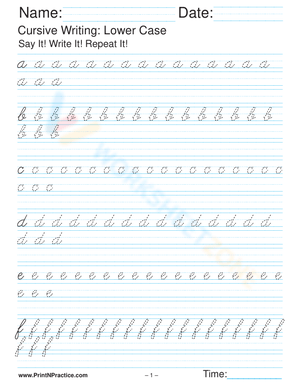
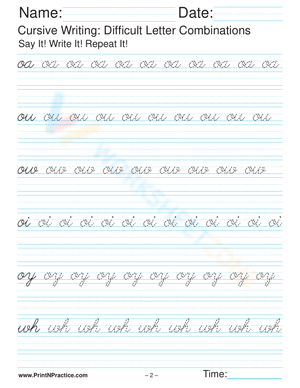
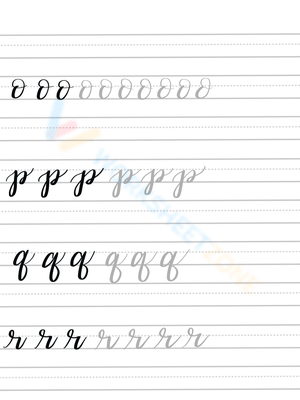
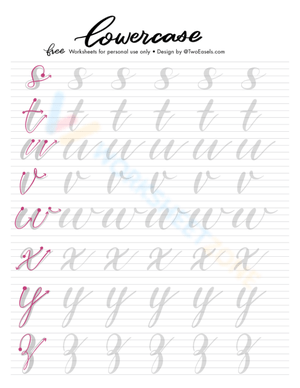
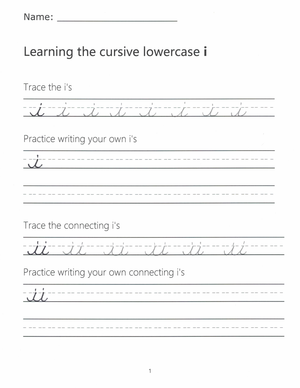
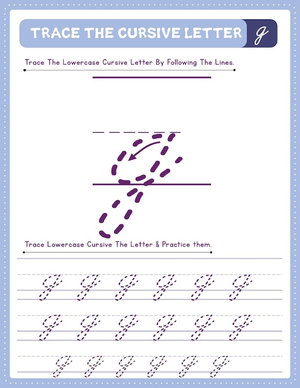
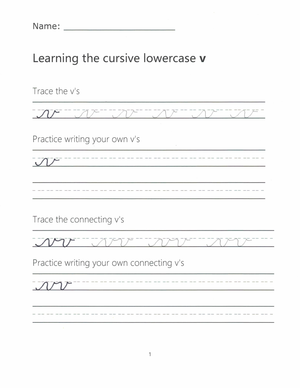
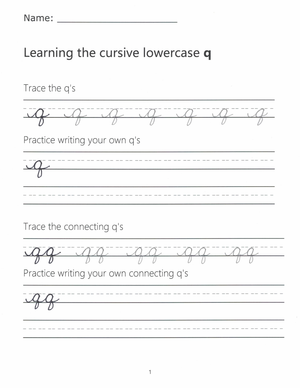
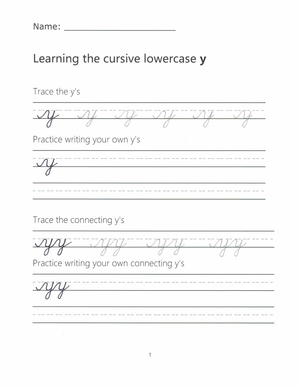
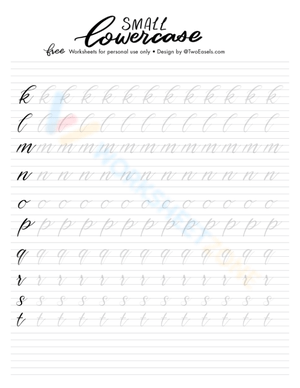
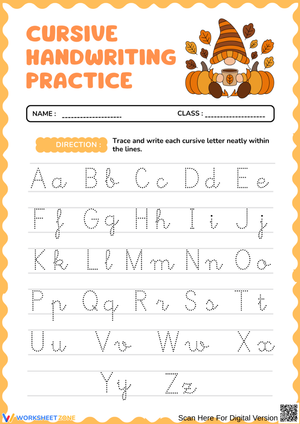
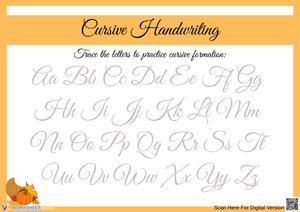
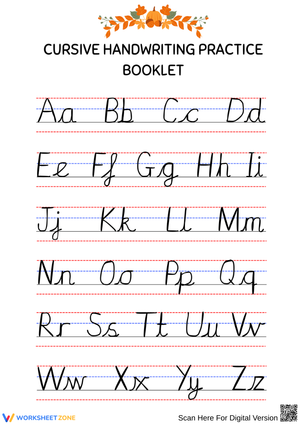
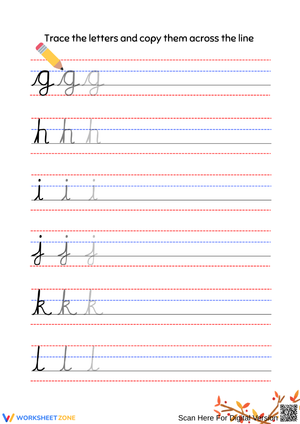
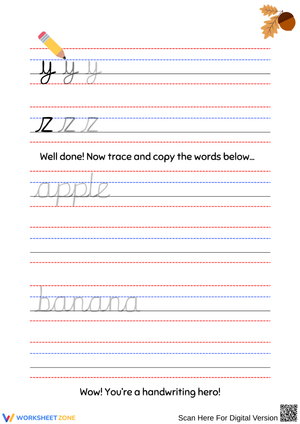
These 3rd grade lowercase cursive letters handwriting printable worksheets give teachers a focused, ready-to-use set built around how third graders actually learn a new motor skill — by repeating the same stroke pattern across several letters before moving to anything structurally different. Eight- and nine-year-olds sit in a genuine developmental window for this work: fine motor control has matured enough to handle continuous, looping motion, but the skill is still new enough that daily repetition determines whether formation becomes automatic or stays effortful. Each worksheet moves students from guided tracing to independent letter writing, and the progression across the set mirrors what effective cursive instruction actually looks like in third grade.
Why the Set Starts With Lowercase
Lowercase letters account for the overwhelming majority of written English — well over ninety percent of the letters that appear in any sentence a third grader reads or writes. Starting here means students can form real words within the first few weeks, which keeps practice feeling purposeful rather than abstract. Uppercase letters carry their own structural quirks — many don't connect naturally to the letters that follow them — so introducing them too early adds complexity before students have the baseline fluency to handle it. The lowercase letter set also aligns more consistently with the writing baseline, giving students a visual anchor they can use to self-monitor letter size and position from the very first worksheet.
Letter Groups, Not Alphabetical Order
The most effective cursive instruction doesn't march through the alphabet from A to Z. It groups letters by the initial stroke they share, so students build motor memory through targeted repetition rather than trying to memorize twenty-six unrelated shapes at once. These worksheets organize lowercase letters into four core stroke families:
- Counter-clockwise curve letters — a, c, d, g, q. All begin with the same looping motion used in manuscript "c," which most third graders already know well. That overlap reduces the unfamiliarity of the stroke significantly.
- Upward loop letters — b, e, f, h, k, l. The stroke rises from the baseline and curves back down. A student who masters the loop in "l" has already handled the hardest part of "h" and "k."
- Over-curve letters — m, n, v, x, y. These begin with a shallow hill-shaped stroke from the baseline. Because "m" and "n" share so much structure, teaching one effectively teaches the other.
- Sharp-top letters — i, j, r, s, t, u, w. These rise to a point rather than a loop and require a deliberate change of direction at the top of each stroke.
When a student masters the upward loop, they have already worked through the most demanding part of five letters. That is the practical payoff of teaching by stroke family — students finish a group feeling competent, not overwhelmed. A third grader who completes the counter-clockwise curve family can write "can," "dad," and "cog" in cursive before the second week is over, which matters for motivation.
Recommended Lesson-Planning Strategies for These Worksheets
The 3rd grade lowercase cursive letters handwriting printable worksheets work best in short daily blocks rather than longer weekly sessions. Ten to twelve minutes at the start of class — before students have settled into other tasks — produces better formation habits than a thirty-minute Friday block. The tracing exercises make a solid morning warm-up or transition activity between morning meeting and reading instruction. For literacy centers, one rotation can focus on the independent writing portion of the current stroke family while the teacher pulls a small group for guided reading. Teachers who use the set this way report that pairing the independent writing worksheet with a partner check for baseline alignment gives students real-time feedback without pulling teacher attention away from elsewhere in the room.
Paper angle matters more than most teachers realize. Right-handed students should tilt the top of the worksheet to the left; left-handed students tilt to the right. Both positions allow the writing arm to follow its natural arc, which keeps letter slant consistent and reduces hand fatigue over the course of a session. A relaxed tripod grip — thumb, index, and middle finger, pencil resting against the side of the ring finger — is worth spending the first few minutes on at the start of any new stroke family before students pick up their pencils and begin.
Frequent Student Errors Worth Watching For
The most common formation problem in third grade cursive is the collapsed loop — specifically, students who form upward loop letters (l, h, k) too tightly, turning the loop into a pointed spike or a nearly straight line. On first glance the letter looks acceptable, but when students try to connect it to the next letter, the exit point is wrong and the resulting word becomes illegible. Catching this during the tracing phase, before it becomes a habit, is considerably easier than correcting it once students are writing sentences and moving quickly.
A second pattern involves the over-curve family: students who learned manuscript printing carefully tend to lift their pencil after the first hump of an "m" or "n," because that lift was the correct movement in second grade. Unlearning it takes conscious effort. Verbal cues help — saying "stay on the paper, keep going" aloud during modeling makes the no-lift rule concrete in a way that written instruction alone doesn't. Students who still lift after several days of practice often do better if asked to trace the full letter with their finger while narrating the stroke before picking up the pencil at all.
Differentiating the Set Across Ability Levels
For students still building fine motor strength, the larger tracing guides give enough writing space to form letters deliberately without the crowding that happens on standard dotted-line paper. Students who write very large often succeed more readily on the wider-format worksheets, where the line spacing doesn't pressure them to shrink their letters before they're physically ready. For students who move quickly through the material, the independent writing portion of each worksheet can be extended by having them write each new letter only in words made up of letters they've already mastered — a constraint that is harder than it sounds and genuinely tests whether formation is automatic rather than labored. Students who have already moved to connected writing can use the 3rd grade lowercase cursive letters handwriting printable worksheets as targeted review tools, concentrating on whichever stroke families still produce broken or malformed connections in their day-to-day writing.
Left-handed students need a few consistent adjustments beyond paper angle. Holding the pencil slightly farther up the barrel — roughly an inch higher than the standard grip point — prevents the writing hand from dragging through pencil marks as it moves across the worksheet. Some left-handed students also benefit from practicing the over-curve and counter-clockwise families last, since those strokes move into the hand's natural path of motion rather than away from it, making them easier once a basic fluency exists.
Frequently Asked Questions
Is it realistic to teach all 26 lowercase cursive letters within a single school year?
Yes, though pace depends heavily on practice frequency. Teachers who use short daily sessions — rather than skipping days and doubling up — typically finish the full lowercase set within one semester and spend the remainder of the year on letter connections, word-level writing, and sizing consistency. The stroke family structure helps because students aren't starting from scratch with every new letter; they carry over movements they already know.
What should I do when a student's cursive letters look legible but the stroke direction is wrong?
Correct stroke direction while the letters still look acceptable — not after they become unreadable. A student who forms "d" by starting at the top rather than beginning with the counter-clockwise curve may produce a passable-looking letter in isolation, but the exit stroke will be in the wrong position to connect cleanly to the next letter. The tracing portion of each worksheet is the right moment to address direction; have the student trace with a finger while narrating the stroke aloud before touching a pencil to the paper.
How do I help students who resist learning cursive?
Get to actual words as quickly as possible. Once a student can form five or six letters within the same stroke family, have them write their own name, a friend's name, or a single word they choose. Forming abstract letter shapes loses its appeal quickly — the engagement comes from writing something that carries meaning. The 3rd grade lowercase cursive letters handwriting printable worksheets build the letter-level foundation students need, but teachers should bridge to word-level writing earlier than feels comfortable with students whose motivation depends on seeing a practical result.
How do I know when a student is ready to begin connecting letters?
Look for three things: the letter rests consistently on the baseline, the stroke direction is correct from start to finish, and the student can produce it at a natural pace without pausing mid-stroke. When all three hold across a full stroke family, the student is ready to connect those letters to each other. Starting with two-letter combinations within the same family — ac, ca, da — keeps the connection demand low while introducing the concept of continuous motion across letter boundaries.