


























0
Views
0
Downloads

0.0
0
Save
0 Likes
Share
Verb Tense Practice: Make a Splash!
0 Views
0 Downloads
Paste this activity's link or code into your existing LMS (Google Classroom, Canvas, Teams, Schoology, Moodle, etc.).
Students can open and work on the activity right away, with no student login required.
You'll still be able to track student progress and results from your teacher account.
Information
Description
What It Is:
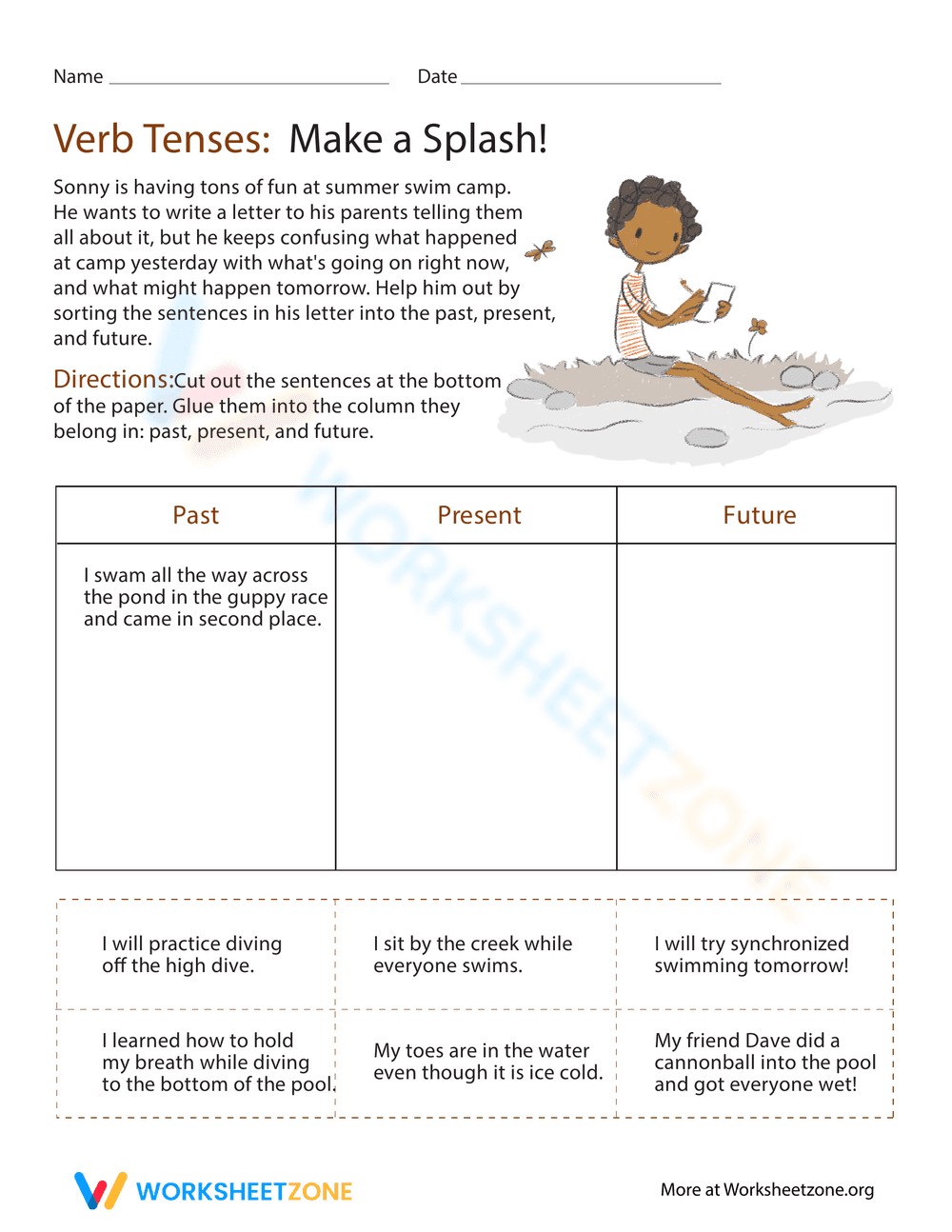
This is a grammar worksheet focused on verb tenses. The worksheet features a scenario where a child named Sonny is writing a letter about his summer camp experiences and needs help sorting his sentences into past, present, and future tenses. The worksheet includes a table with columns for 'Past,' 'Present,' and 'Future.' Students are instructed to cut out sentences provided at the bottom of the worksheet and glue them into the appropriate column based on the verb tense used. Example sentences include 'I swam all the way across the pond in the guppy race and came in second place' and 'My toes are in the water even though it is ice cold.'
Grade Level Suitability:
This worksheet is suitable for grades 2-4. The concept of past, present, and future tenses is typically introduced and reinforced in these grades. The vocabulary and sentence structure are relatively simple, making it accessible for this age group. The cut and paste activity also provides a hands-on element that can be engaging for younger learners.
Why Use It:
This worksheet helps students practice identifying and categorizing verbs based on their tense. It reinforces the understanding of how verbs change to indicate when an action occurred (past), is occurring (present), or will occur (future). The summer camp theme makes it relatable and engaging for students, and the sorting activity provides a practical application of verb tense knowledge.
How to Use It:
First, students should read the introductory text to understand the context. Then, they should carefully cut out the sentences provided at the bottom of the worksheet. Next, they should read each sentence and determine whether the verb is in the past, present, or future tense. Finally, they should glue each sentence into the corresponding column in the table.
Target Users:
This worksheet is designed for elementary school students in grades 2-4 who are learning about verb tenses. It is particularly useful for students who need extra practice identifying and categorizing verbs based on when the action takes place. It can be used in the classroom as a supplemental activity or at home for additional reinforcement.
This is a grammar worksheet focused on verb tenses. The worksheet features a scenario where a child named Sonny is writing a letter about his summer camp experiences and needs help sorting his sentences into past, present, and future tenses. The worksheet includes a table with columns for 'Past,' 'Present,' and 'Future.' Students are instructed to cut out sentences provided at the bottom of the worksheet and glue them into the appropriate column based on the verb tense used. Example sentences include 'I swam all the way across the pond in the guppy race and came in second place' and 'My toes are in the water even though it is ice cold.'
Grade Level Suitability:
This worksheet is suitable for grades 2-4. The concept of past, present, and future tenses is typically introduced and reinforced in these grades. The vocabulary and sentence structure are relatively simple, making it accessible for this age group. The cut and paste activity also provides a hands-on element that can be engaging for younger learners.
Why Use It:
This worksheet helps students practice identifying and categorizing verbs based on their tense. It reinforces the understanding of how verbs change to indicate when an action occurred (past), is occurring (present), or will occur (future). The summer camp theme makes it relatable and engaging for students, and the sorting activity provides a practical application of verb tense knowledge.
How to Use It:
First, students should read the introductory text to understand the context. Then, they should carefully cut out the sentences provided at the bottom of the worksheet. Next, they should read each sentence and determine whether the verb is in the past, present, or future tense. Finally, they should glue each sentence into the corresponding column in the table.
Target Users:
This worksheet is designed for elementary school students in grades 2-4 who are learning about verb tenses. It is particularly useful for students who need extra practice identifying and categorizing verbs based on when the action takes place. It can be used in the classroom as a supplemental activity or at home for additional reinforcement.


