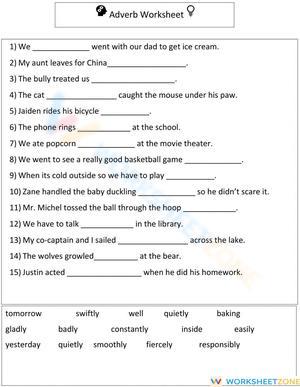
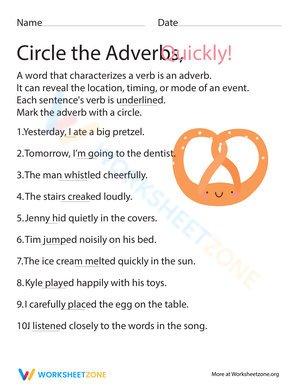
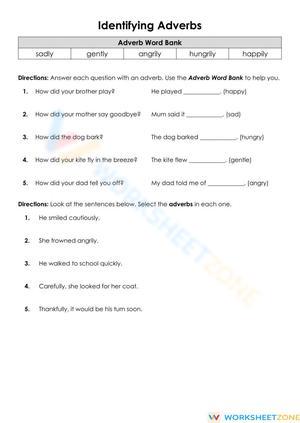
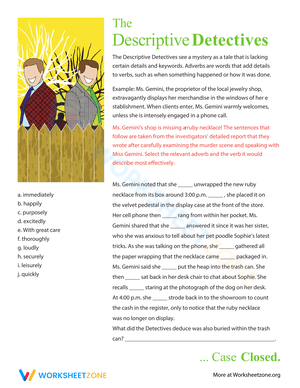
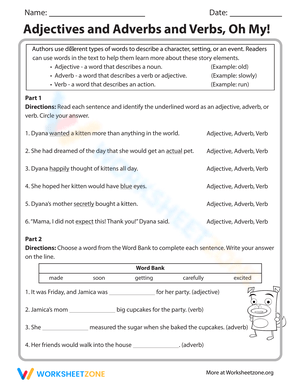
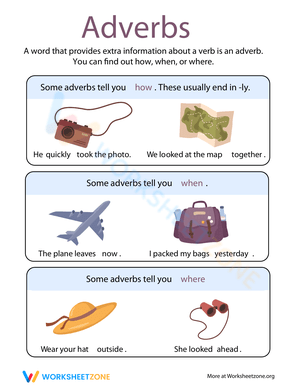
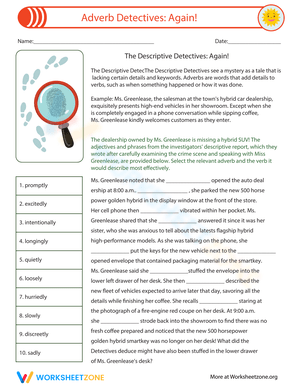
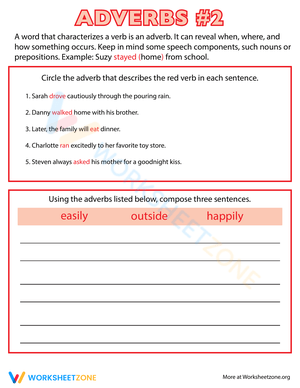
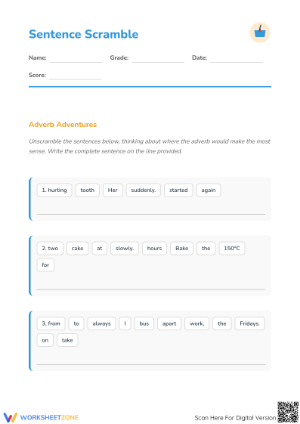
These adverbs worksheets for 3rd grade target the specific moment in grammar instruction when students stop naming parts of speech and start explaining what those words actually do in a sentence. Each worksheet addresses one discrete skill — identifying adverb type, transforming adjectives into adverbs, distinguishing adverbs from adjectives in context — so teachers can place them where the lesson calls for them rather than working through a predetermined sequence.
Skills These Worksheets Build
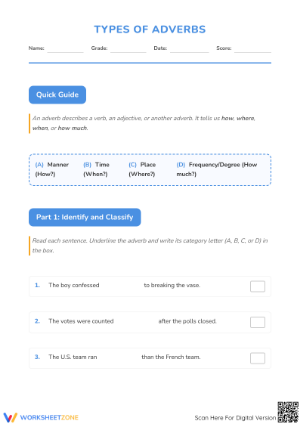
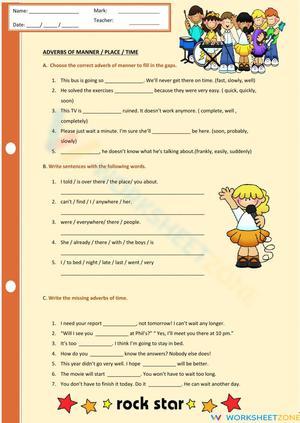
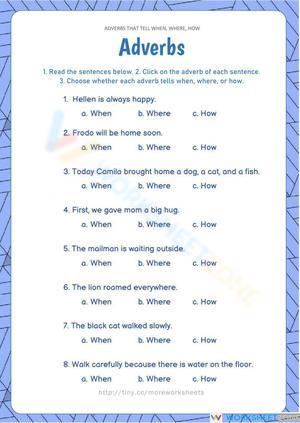
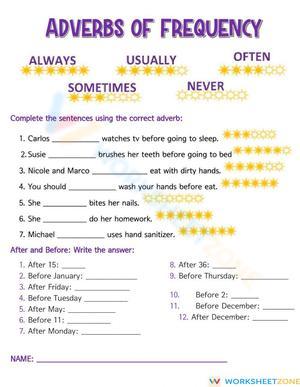
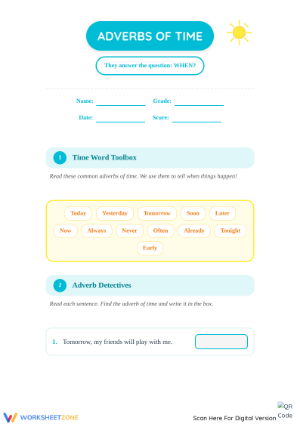
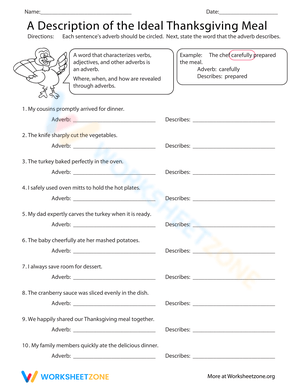
The adverbs worksheets for 3rd grade in this collection divide practice across three core categories: manner, time, and place. Manner adverbs get the most coverage because the -ly pattern gives students a reliable entry point and because this is where narrative writing and grammar instruction overlap most naturally. Time adverbs — yesterday, soon, always, never — connect directly to the sequencing work students are doing in their own writing, so the context feels less isolated than typical grammar drill. Place adverbs like here, outside, and everywhere need dedicated attention precisely because they rarely carry the -ly signal students have learned to look for.
Across the set, students move from recognition to production through a range of exercise types:
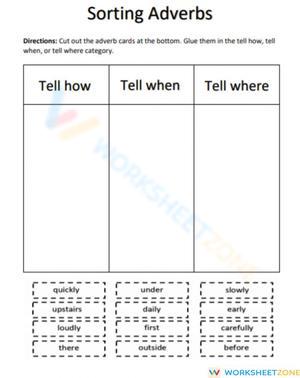
- Sort words by adverb category before writing them into original sentences
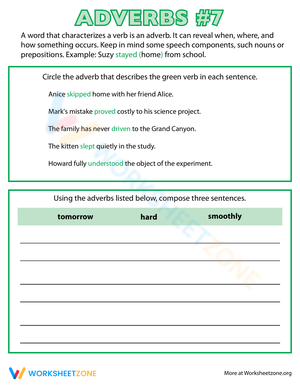
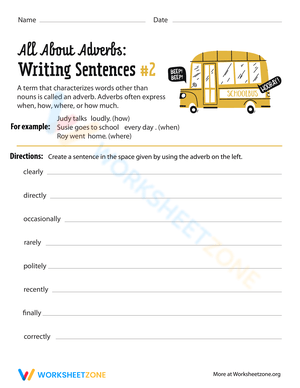
- Rewrite bare-bones sentences — "The girl laughed," "The car moved" — by adding a specified adverb type
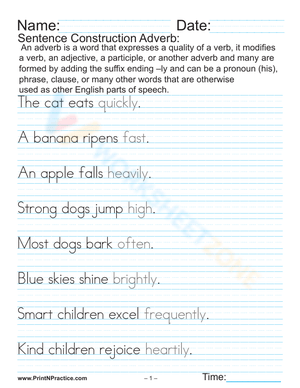
- Transform a column of adjectives into adverbs, including the tricky spelling cases
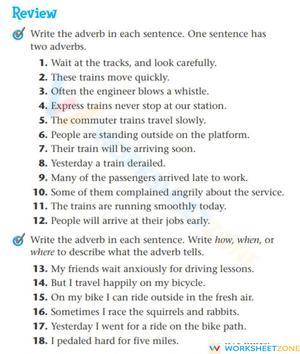
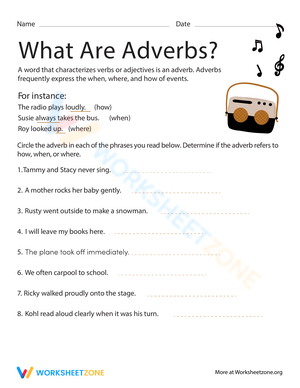
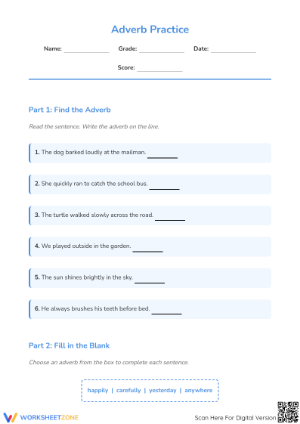
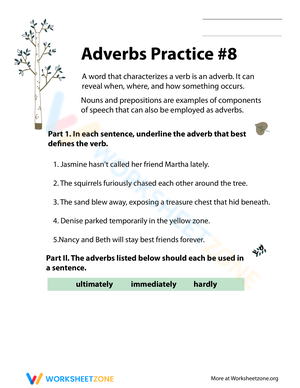
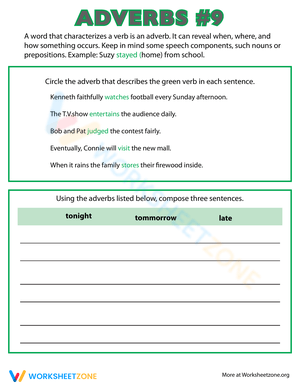
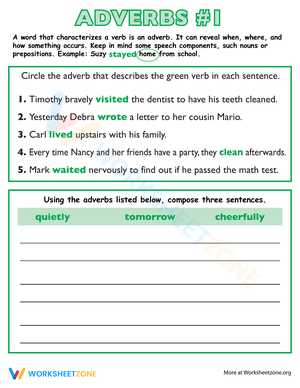
- Underline adverbs and draw an arrow to the verb each one modifies
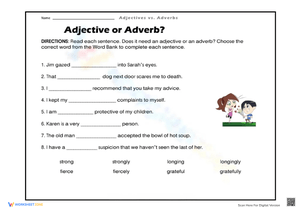
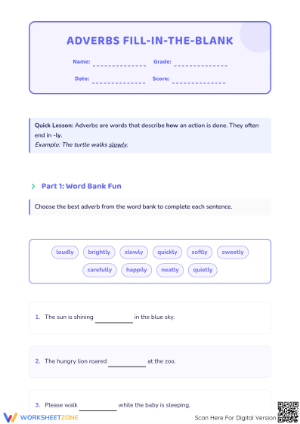
- Choose between the adjective and adverb form of a word based on what the sentence requires
The adjective-to-adverb transformation tasks cover the spelling shift students most often miss: when an adjective ends in y, the y changes to i before -ly is added, producing "happily" rather than "happyly." One worksheet addresses words like fast and hard that function as either part of speech without changing form at all, which is its own source of confusion worth addressing directly.
Errors That Surface Consistently When Students Work on Adverbs
The adjective-adverb distinction is where third graders lose the most ground, and the errors follow a predictable pattern. A student who correctly marks "quietly" as an adverb in "She sang quietly" will often mark "quiet" as the adverb in "She had a quiet voice" — because the word appears near a verb and looks familiar. What that student hasn't internalized yet is that classification depends entirely on what the word modifies, not where it sits in the sentence. Students who skip the step of finding the modified word first are essentially guessing.
The -ly spelling transformations generate their own consistent errors. "Happyly" appears often enough to be expected, but "gentlely" is more revealing: students who write that form understand the suffix rule but haven't recognized that "gentle" already ends in a vowel-e, so -ly attaches directly to give "gently," not "gentlely." These aren't careless slips — they're systematic ones, which means a completed worksheet on this skill gives a clear read on exactly where in the rule a student's understanding breaks down. Treat those exercises as formative checks worth following up on rather than tasks to mark and move past.
Standard Alignment
These resources address CCSS.ELA-LITERACY.L.3.1.A, which requires students to explain the function of adverbs in general and in particular sentences. The standard doesn't ask students only to label — it asks them to articulate what job the word is doing, which is why exercises here press students to answer "modifies what?" alongside "which category?" In most 3rd-grade ELA pacing guides, this standard lands in the second semester, after students have worked through adjective identification and can draw on that contrast to understand what distinguishes adverbs from modifiers they already know. Teachers reaching adverbs in January or February will find the sorting and adjective-comparison tasks align naturally with where most classes are in their writing units at that point.
Getting the Most Out of These Worksheets in Your Lesson Plans
The most productive window for grammar worksheets is the 10 to 12 minutes following a short whole-class introduction — while the concept is still active and before students transition to independent reading. One worksheet per session keeps the practice tight and prevents students from rushing through to reach a stopping point. Teachers running literacy centers can slot one worksheet into a quiet independent station while pulling a small group for direct instruction on the same skill, so both activities reinforce the same concept rather than pulling student attention in different directions.
Several teachers use the adverbs worksheets for 3rd grade as Monday warm-ups during the unit launch week, then return to a different worksheet on Friday as a low-stakes retrieval check. The gap between sessions is often enough to reveal who retained the category distinctions and who needs another pass. Pairing a manner-adverb worksheet with a brief acting activity — giving each student a verb card and an adverb card and having them perform the combination before sitting down — grounds the abstract idea of "modifying an action" in something physical. Students who do the acting first tend to make fewer errors on the written exercise that follows.
Adapting the Set for Different Learner Levels
For students still solidifying verb identification, start with worksheets where the verb in each sentence is already underlined. Asking them to find the adverb before they've located what it modifies adds cognitive weight that crowds out the target skill. Once they reliably identify verbs on their own, they're ready for the full task without that support structure.
Students ready for more challenge benefit most from the adjective-adverb contrast exercises and the open-ended production tasks. A useful extension is asking them to write two versions of the same sentence — one using the adjective form, one using the adverb form — and explain in one sentence how the meaning shifts. Students who need more time with the concept often do better with sorting tasks than fill-in-the-blank exercises, because sorting lets them hold all the options in front of them and reason through the choice before committing, rather than retrieving an answer from memory cold.
Frequently Asked Questions
What standard do these worksheets cover?
The primary alignment is CCSS.ELA-LITERACY.L.3.1.A, which requires students to explain the function of adverbs — not only identify them by name. That means students need to articulate what word an adverb modifies and what question it answers (how, when, or where), which is exactly what these exercises ask them to do.
My students keep mixing up adjectives and adverbs. What actually helps?
Teach students to locate the modified word before they try to classify the modifier. They underline the word being described, then ask: is that a noun or a verb? If it's a noun, the modifier is an adjective. If it's a verb, the modifier is an adverb. Students who skip that step and try to classify by looking at the modifier in isolation are largely guessing. The comparison exercises in this set give repeated practice with exactly that reasoning sequence, and most students who work through several of them stop making the substitution error within a few sessions.
Can I use these for assessment purposes?
They work well as formative checks. A completed worksheet on adverb identification gives a clear snapshot of where a student stands — which categories they handle accurately, where they're guessing, and whether the spelling transformations are sticking. For summative purposes, the adverbs worksheets for 3rd grade are most useful as preparation leading into a more formal assessment rather than as the assessment itself, since students will have already encountered the same formats during practice and familiarity with the exercise type inflates the score.
Is the -ly rule enough to teach adverb identification?
No, and leaning on it too heavily creates specific, predictable problems. The -ly pattern catches many manner adverbs but misses all time and place adverbs — soon, never, here, outside — and it leads students to incorrectly classify adjectives like friendly and lonely as adverbs. Each worksheet in this set focuses on a specific category because no single shortcut covers the full scope of what the standard requires students to know.












 Interactive Worksheet Maker
 Quiz Maker
 Word Search Maker
 Crossword Puzzle Maker
 Word Scramble Generator
 Sentence Scramble Generator
 Handwriting Worksheet Generator
 Name Tracing Generator
 Fill In The Blank Generator