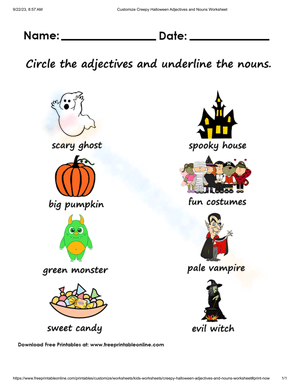
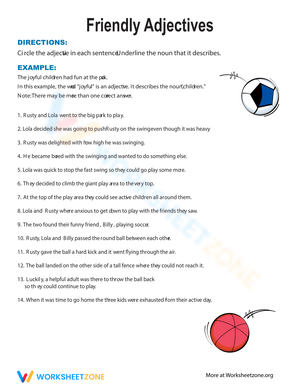
These 3rd grade adjectives worksheets resources give teachers ready-to-print practice that covers the full range of adjective work in Grade 3 ELA — from identifying descriptive words in context to building comparative and superlative forms with correct spelling. Third grade is when the grammar curriculum moves from simple naming to function and application, and adjectives sit at the center of that shift. The set is built around sentences and writing tasks third graders actually encounter, so the skills carry over into student writing rather than staying isolated inside the grammar block.
The Specific Skills Targeted
Each worksheet isolates a distinct skill rather than combining several adjective tasks in a single session. That focus matters — when students are still building a concept, mixing too many task types at once produces surface-level completion rather than genuine understanding. The skills covered across the set include:
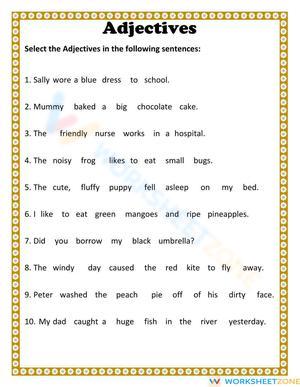
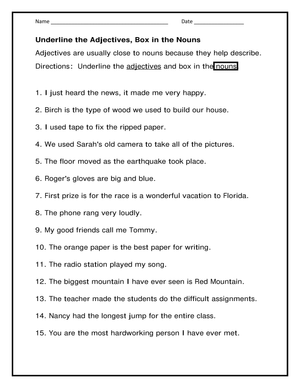
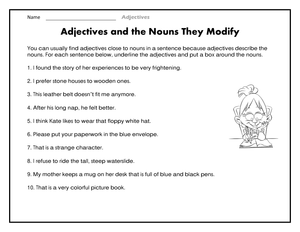
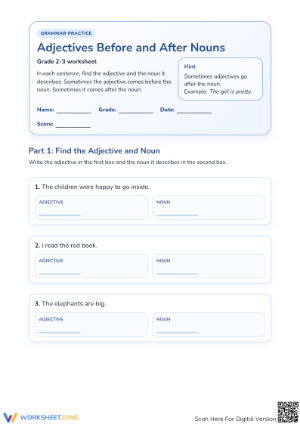
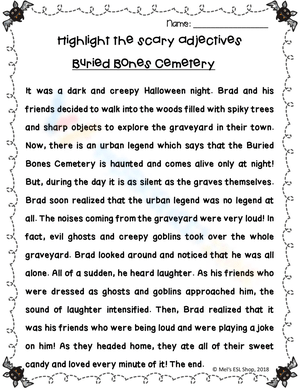
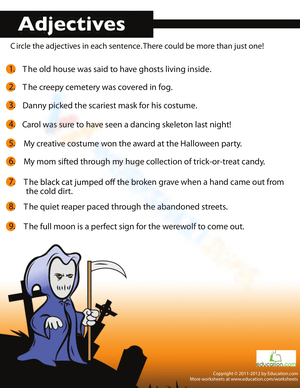
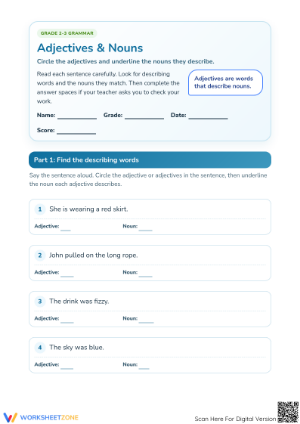
- Adjective identification: Students underline adjectives in sentences and identify the noun each one modifies. The sentences include adjectives in both attributive and predicative positions, so students can't rely on finding only the word directly before the noun.
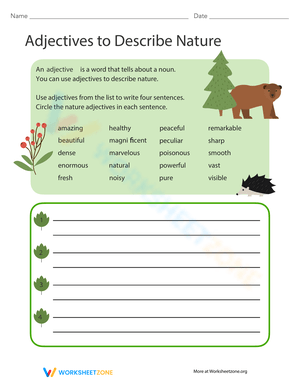
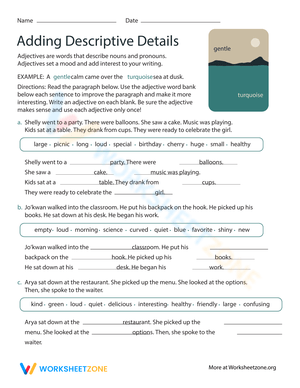
- Sentence expansion: Students receive a minimal sentence — "The dog barked." — and rewrite it by inserting adjectives that modify the subject and any objects. The task connects directly to writing craft rather than treating grammar as a separate subject.
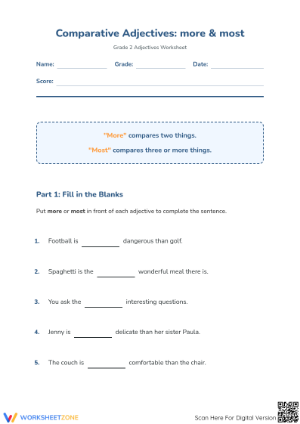
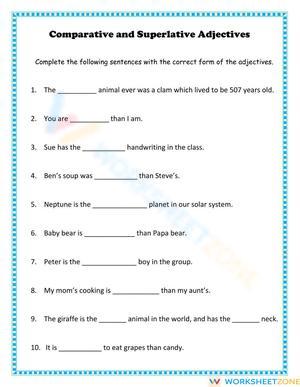
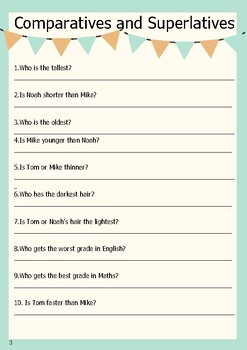
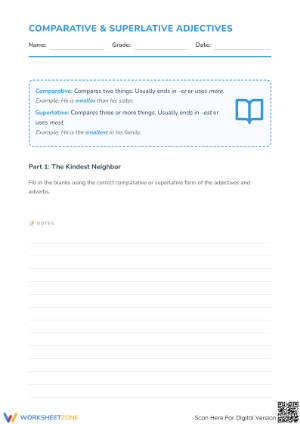
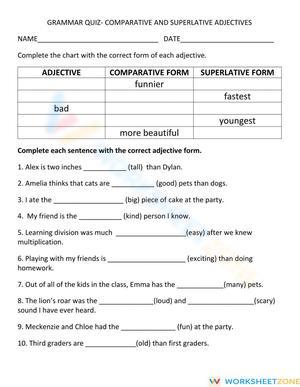
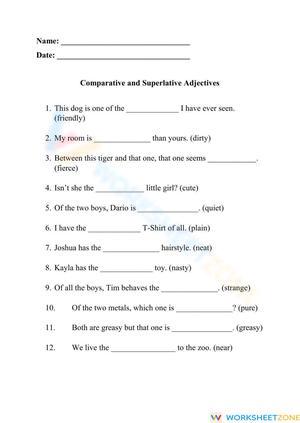
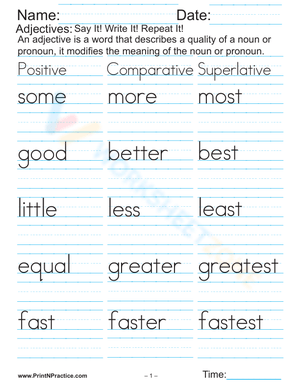
- Comparative and superlative forms: Students complete charts showing base, comparative, and superlative forms, including regular adjectives with spelling changes (big/bigger/biggest, happy/happier/happiest) and the irregular paradigm (good/better/best).
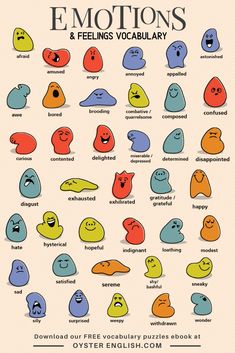
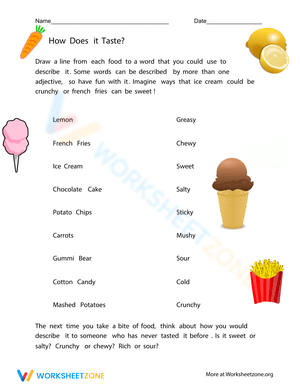
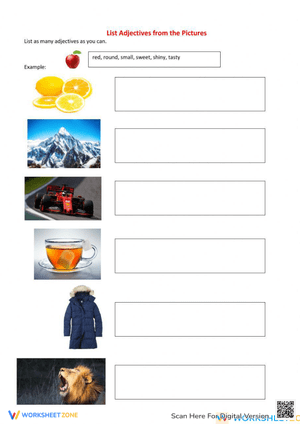
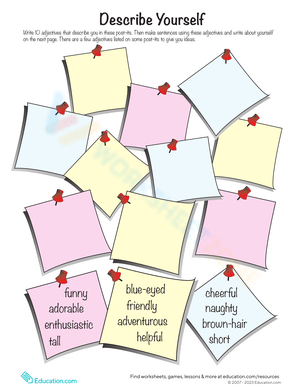
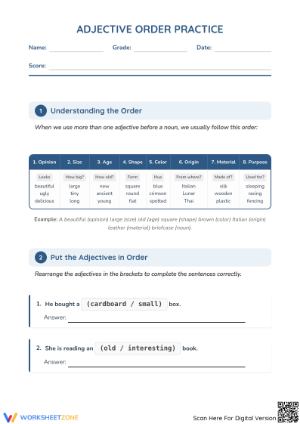
- Adjective sorting: Students sort descriptive words into categories — size, color, shape, number, feeling — building vocabulary alongside grammar awareness.
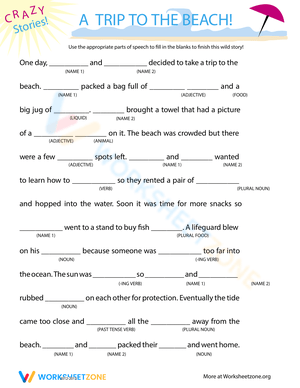
- Fill-in-the-blank narrative: Students choose their own adjectives to complete a short story passage, then read the result aloud. Because each student's choices differ, the activity generates real discussion about word selection rather than a single correct answer.
Standard Alignment
Two Common Core standards anchor the set. CCSS.ELA-LITERACY.L.3.1.A asks third graders to explain what an adjective does in a specific sentence — not just circle the part of speech, but articulate which noun it modifies and what detail it adds. That distinction between labeling and explaining is what separates lower-level identification tasks from the function-based work the standard requires, and a strong 3rd grade adjectives worksheets addresses both levels. CCSS.ELA-LITERACY.L.3.1.G covers comparative and superlative forms, including the spelling conventions — consonant doubling, the y-to-i change — alongside irregular forms. In classroom terms, L.3.1.G lands best after students already have a stable working vocabulary of descriptive adjectives, which typically means the second half of the year. Introducing comparatives before students can reliably identify basic adjectives splits their attention across two new concepts simultaneously, reducing what they retain from either.
Mistakes Students Make That These Worksheets Help You Catch
The double comparative is the most persistent error in this unit. Students write "more taller" or "more faster" because they have learned both the -er suffix rule and the word "more" as valid comparative strategies, without yet understanding that these are alternatives rather than additions. This error appears in independent writing well into fourth grade when it hasn't been caught explicitly in third. A sentence-editing task — where students find and correct over-marked comparatives — surfaces the confusion more reliably than fill-in-the-blank practice, because fill-in tasks let students default to whichever form feels easier rather than confronting the error directly.
Spelling changes are the other persistent trouble area. A student who writes "bigger" correctly during an explicit spelling exercise will still write "hapier" or "bigest" during sentence-expansion work, because managing word choice and a spelling rule simultaneously is harder than handling either alone. Worksheets that place a brief visual reference — consonant doubling examples, the y-to-i pattern — on the same sheet as the writing task reduce this error significantly. Students can self-monitor without losing their train of thought to flip through a grammar notebook.
How to Build These Worksheets Into Your Lesson Plans
These worksheets fit most naturally as the independent-practice segment of a gradual-release sequence: direct instruction and shared examples at the board, brief guided practice with a mentor sentence, then students working independently at their seats. That transition from whole-class work to individual written practice is where you find out who genuinely understood the lesson and who was following the group without yet owning the concept. Circulating during the first five minutes of independent work — rather than returning to your desk — catches misconceptions before they become habits.
For literacy centers, print the 3rd grade adjectives worksheets and slide each worksheet into a dry-erase pocket with a whiteboard marker. Students complete the task, check their answers against a posted key, and erase for the next group — one printed copy handles 20 or more uses. The adjective-sorting worksheet works particularly well at a center because it produces a physical arrangement students can revise before committing, which lowers the stakes on accuracy. For Monday morning warm-up after a weekend break, the identification worksheet makes a reliable re-entry task: low enough stakes that students don't freeze, focused enough that it reviews the prior week's instruction in 8 to 10 minutes before morning meeting wraps up.
Adjusting the Worksheets for a Range of Learners
Students who are still building descriptive vocabulary benefit from a word bank printed at the top of the sentence-expansion worksheets. Without it, they spend the bulk of their time searching for a word rather than applying the grammar skill. Adding a word bank does not reduce the grammatical demand — students still determine where the adjective belongs and which noun it modifies. For students ready to push further, the comparative chart extends naturally into original writing: after completing the chart, they compose three sentences, each using a different form from the same row. That small extension shifts the task from mechanical to applied without requiring anything extra to print. Students who are significantly below grade level on identification work benefit from two or three modeled sentences with the adjective already circled, followed by sentences where they do the circling themselves — rather than jumping straight into an unmarked paragraph that gives them no reference point.
Frequently Asked Questions
What Common Core standards does this set address?
The worksheets target CCSS.ELA-LITERACY.L.3.1.A, which requires students to explain the function of adjectives in specific sentences, and CCSS.ELA-LITERACY.L.3.1.G, which covers forming and using comparative and superlative adjectives — both regular forms with spelling changes and irregular forms.
How do these worksheets connect to writing instruction?
The sentence-expansion tasks are the most direct bridge. A 3rd grade adjectives worksheets that asks students to transform "The bird sang" into a fully described sentence requires the same deliberate word-choice work students do during writing workshop — they have to consider specificity, sound, and meaning alongside grammar correctness. Teachers who assign the sentence-expansion worksheet before a descriptive writing draft consistently see students carry more varied vocabulary into their drafts.
Can these worksheets work for students above or below grade level?
Yes, with the adjustments described in the differentiation section. Students below grade level work better with word banks and sentence-level tasks before moving to paragraph-level contexts. Students above grade level extend the comparative chart into original sentence writing without needing separate materials. Neither adjustment requires printing anything different.
Do the worksheets include answer keys?
Each worksheet in the set comes with a corresponding answer key. For open-ended tasks like sentence expansion, the key provides sample responses and notes on what constitutes a complete and correct adjective use, which makes grading judgment calls faster and more consistent across a class set.












 Interactive Worksheet Maker
 Quiz Maker
 Word Search Maker
 Crossword Puzzle Maker
 Word Scramble Generator
 Sentence Scramble Generator
 Handwriting Worksheet Generator
 Name Tracing Generator
 Fill In The Blank Generator