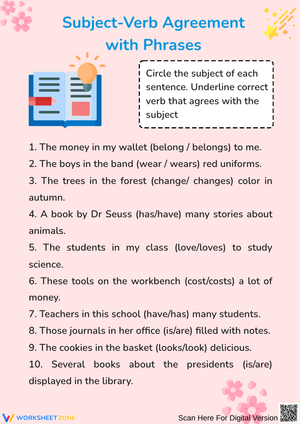
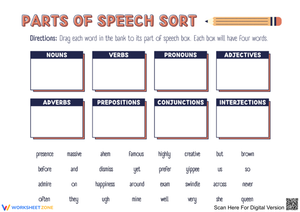
These prepositions printable worksheets for 3rd grade give teachers a focused set of exercises that move students from recognizing prepositions in mentor sentences to using them deliberately in their own writing. Each worksheet zeroes in on a specific function — spatial placement, directional movement, or time and sequence — rather than treating all prepositions as one undifferentiated list. The set runs from identification tasks, where students underline or circle, through sentence-expansion work that pushes students to add prepositional phrases to plain subject-verb structures.
Skills These Worksheets Build
The exercises across this set address a progression that tracks how preposition instruction typically unfolds in a third-grade classroom — identification first, then discrimination between similar prepositions, then controlled production in sentence-expansion tasks.
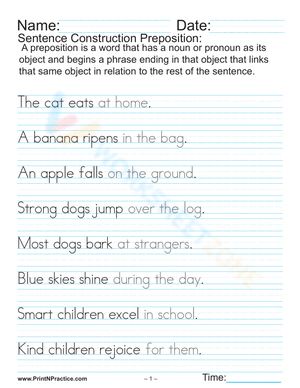
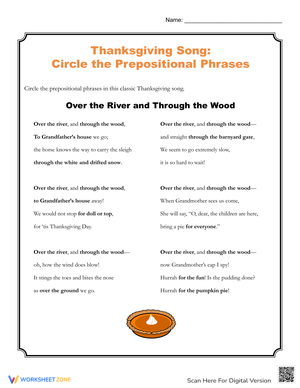
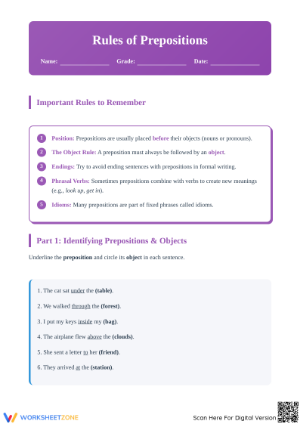
- Identification in context: Students underline prepositions within complete sentences drawn from narrative and informational text, so the words appear in realistic usage rather than stripped-out word lists.
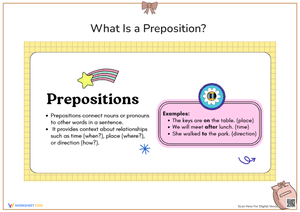
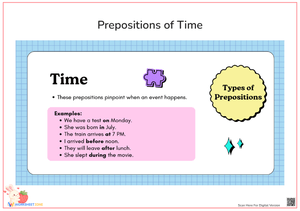
- Sorting by function: Students sort prepositions into three groups — place, time, and direction — building the conceptual vocabulary teachers need when they ask students to revise vague writing.
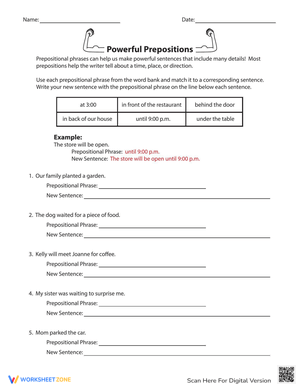
- Phrase completion: Each worksheet in this group gives students a preposition and asks them to supply the object, reinforcing that a prepositional phrase is not complete without a noun following it.
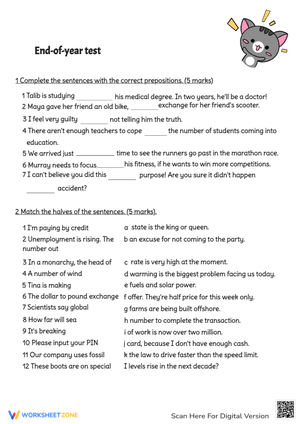
- Choosing between similar prepositions: Side-by-side choices like in / into, on / onto, and beside / behind ask students to read for meaning before selecting — a useful check on whether they have internalized the semantic distinction or are just pattern-matching.
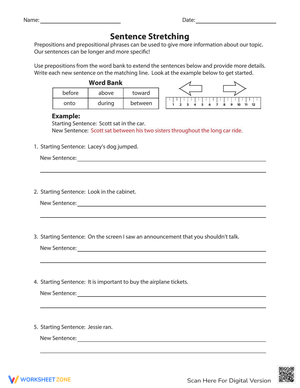
- Sentence expansion: Students take a bare subject-verb sentence — The fox ran. — and add one or two prepositional phrases to show where and when. These worksheets produce the most visible writing transfer of any in the set.
Mistakes Students Make That These Worksheets Help Surface
The most persistent error at this level is treating a preposition as complete on its own. When asked to write a sentence using under, students frequently produce something like The cat went under. — correctly placing the word but omitting the object. They have grasped that under is a location word without yet internalizing that it needs a target noun. Phrase-completion exercises catch this directly: the student has to supply the table or the bridge before the answer is acceptable.
The preposition-versus-adverb boundary trips up even students who are otherwise strong in grammar. She ran outside and She ran outside the building use the same word two different ways, and third graders almost never notice the distinction unless it is pointed out explicitly. Worksheets that show minimal pairs — identical sentence frames with and without a noun following the underlined word — make this visible in a way that a definition alone does not.
A third pattern worth watching: double prepositions. Students who are comfortable with beside will sometimes write beside of by analogy with out of or because of. This error shows up in sentence-expansion work more than in identification exercises, because that is when students are generating language rather than analyzing it.
Fitting These Worksheets Into Your Lesson-Planning Week
The prepositions printable worksheets for 3rd grade work well as Monday warm-ups after morning meeting — five minutes of circling prepositions in three or four sentences reactivates what students saw the previous week without requiring any re-teaching before the day's main lesson. The identification worksheets are quick enough to serve this purpose without bleeding into the reading block.
For whole-group introduction, pair a spatial-prepositions worksheet with a brief Total Physical Response activity first: ask students to place their pencil under their notebook, on top of their chair, behind their eraser. That physical sequence usually takes under three minutes, and students who complete the written task immediately afterward make noticeably fewer errors than students who go straight to paper. The muscle-memory anchoring does real work here, and it costs almost no instructional time.
The sentence-expansion worksheets fit well into a writer's workshop revision slot. After students draft a narrative, pull one of the expansion exercises as a focused revision task: find two sentences in your draft that are just subject-verb, and add a prepositional phrase to each. The worksheet models the move; the transfer happens in their actual writing. Grammar practice that stays isolated inside a single exercise rarely carries into independent writing without that deliberate connection back to the draft.
Using the Set Across Mixed Readiness Levels
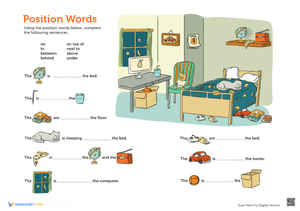
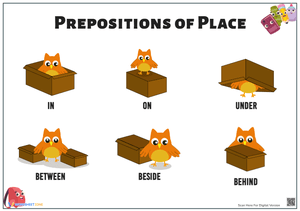
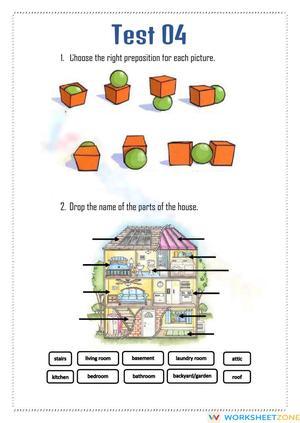
Students who are still building sentence-level reading fluency do best starting with the identification worksheets that include illustrations — pictures of a ball on a box, under a box, beside a box — before they tackle text-only exercises. The visual reference gives them a way to self-check that does not depend entirely on language processing. Removing the pictures too early is a common pacing mistake; some students need that visual anchor through several rounds of practice before the written words carry the same meaning on their own.
For students who move quickly through identification tasks, the sentence-expansion worksheets offer a natural extension: instead of adding one prepositional phrase, ask them to add two, then evaluate whether the resulting sentence is still clear. Students who write The dog ran through the yard at the corner before the big fence during the morning have discovered something real about when prepositional phrases stack up in a way that loses the reader — and that revision conversation is worth having with any third grader who is ready for it.
English Language Learners often find the sorting-by-function worksheets useful because they make semantic categories visible. A student whose home language handles spatial relationships through different grammatical structures needs explicit category instruction more than a native English speaker does. Using the set as a paired activity rather than independent work is often the better first step for this group — verbal explanation before written response tends to produce stronger results on the first pass through temporal and directional exercises.
Standard Alignment
These resources connect primarily to CCSS.ELA-LITERACY.L.3.1, which requires third graders to demonstrate command of standard English grammar and usage in both writing and speaking. The identification and sorting tasks address L.3.1a specifically, asking students to explain how a preposition functions in a sentence rather than simply name it.
Prepositional phrases are formally named in CCSS.ELA-LITERACY.L.4.1e, which requires students to form and use them. Third-grade teachers who use this set are building the conceptual groundwork for that fourth-grade standard — students who arrive in fourth grade able to identify and write prepositional phrases spend far less time in re-teaching when L.4.1e instruction begins. The sentence-expansion worksheets are particularly well-suited to this preview function. Teachers in states that have placed prepositional phrases explicitly in third grade through adapted standards — including some versions of the Texas TEKS and New York's Next Generation ELA Standards — will find the full set directly on-grade-level.
Frequently Asked Questions
Do these worksheets cover simple prepositions, prepositional phrases, or both?
Both levels are in the set. Earlier worksheets ask students to identify individual prepositions inside sentences. Later worksheets shift focus to the full phrase — preposition plus object — because that is the unit that actually functions in writing. Students who can spot under in a sentence but do not recognize under the old wooden bridge as a grammatical unit are not yet ready to use these phrases deliberately in their own work. The set addresses both identification levels before moving into sentence production.
Prepositional phrases are a 4th-grade CCSS standard — is it appropriate to use these in 3rd grade?
This is a genuinely common question. CCSS.ELA-LITERACY.L.4.1e formally introduces prepositional phrases, but L.3.1 covers grammar function broadly enough that third-grade teachers regularly introduce prepositions as foundational work. Using prepositions printable worksheets for 3rd grade as preview instruction in the second half of the year is a well-supported choice — students who encounter the concept in March or April retain it through the summer and arrive in fourth grade with a clear head start on L.4.1e instruction.
How do I use these for formative assessment rather than just practice?
After a ten-to-fifteen-minute mini-lesson on prepositional phrases, have students complete one identification worksheet independently and review the results before the next ELA block. Students who circle the full prepositional phrase — preposition plus object — are ready for sentence-expansion work. Students who circle only the preposition and consistently miss the noun that follows need one more round of phrase-level identification before moving on. That quick sort takes about ten minutes and prevents the most common pacing error: moving the whole class to sentence production before a significant portion of them can reliably identify the phrase unit.
Are these appropriate for English Language Learners?
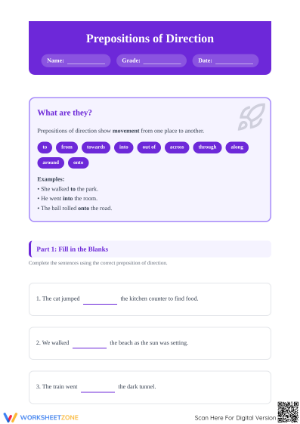
The prepositions printable worksheets for 3rd grade that focus on spatial relationships — and include illustrations — are the most accessible entry point for ELL students because meaning can be confirmed visually. Worksheets that focus on directional and temporal relationships, such as into, during, and before, require stronger context support, since those relationships are handled structurally in many other languages. Pairing ELL students with a partner for the first pass through those exercises, and building in a brief verbal explanation step before independent written work, produces stronger results than having students work alone on day one.












 Interactive Worksheet Maker
 Quiz Maker
 Word Search Maker
 Crossword Puzzle Maker
 Word Scramble Generator
 Sentence Scramble Generator
 Handwriting Worksheet Generator
 Name Tracing Generator
 Fill In The Blank Generator