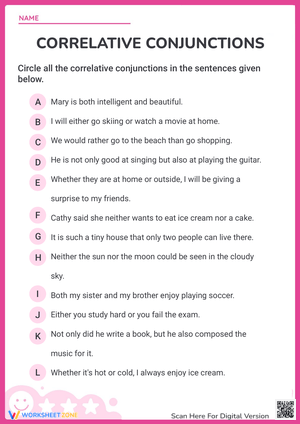
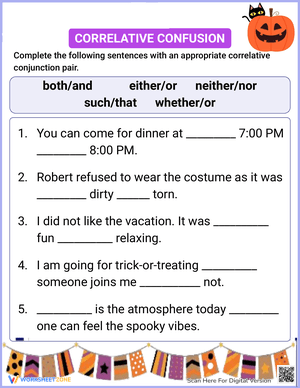
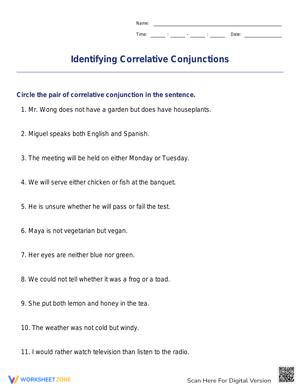
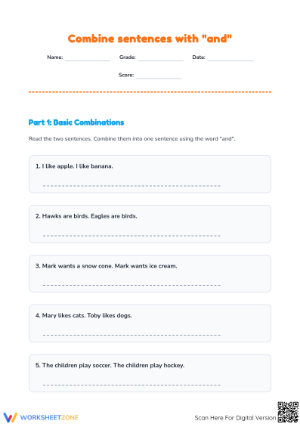
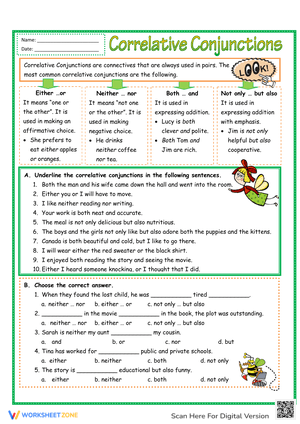
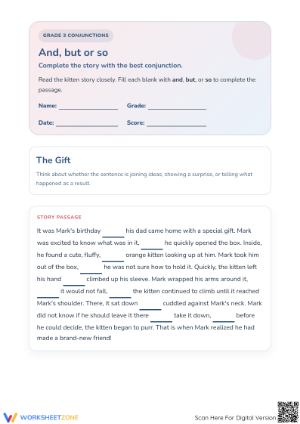
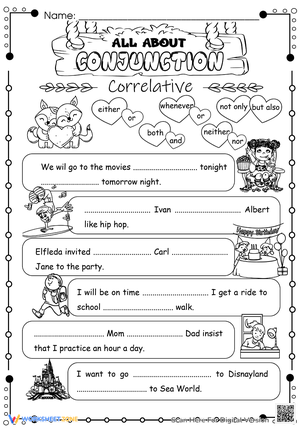
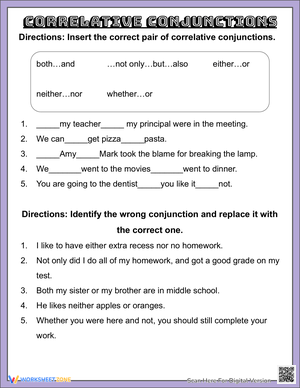
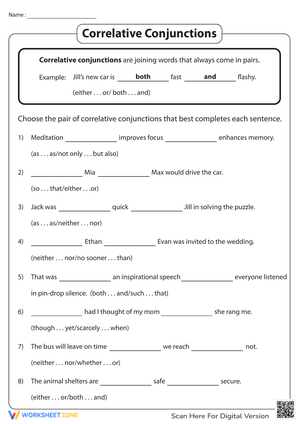
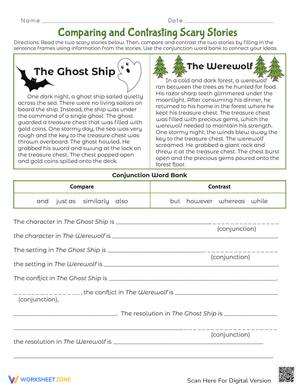
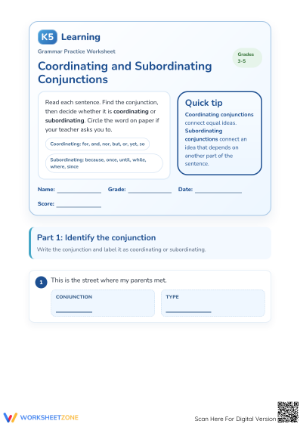
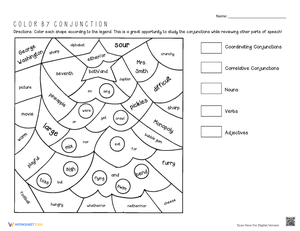
These conjunctions pdf worksheets for 3rd grade give students focused, repeated practice with the connecting words that push their writing past the choppy subject-verb patterns that dominate early drafts. The set works through both coordinating and subordinating conjunctions — not as vocabulary to circle and move on from, but as logical tools students apply inside actual sentences, making the grammatical choice and then seeing how it changes meaning.
The Specific Skills Targeted
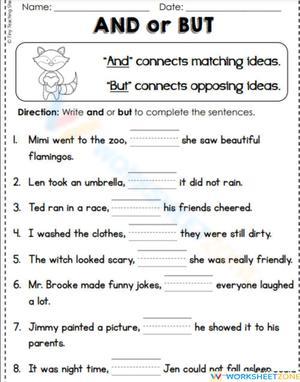
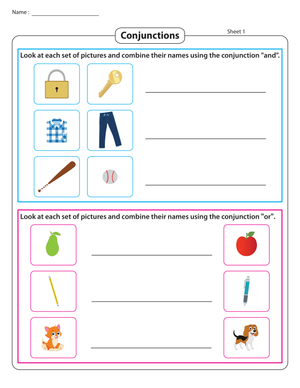
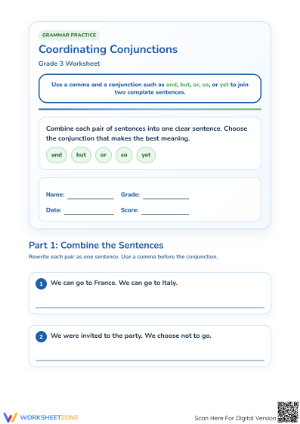
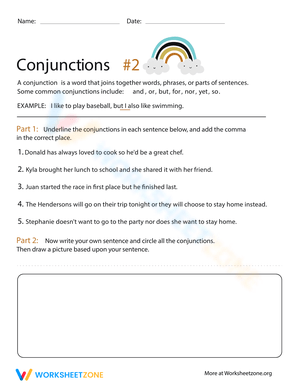
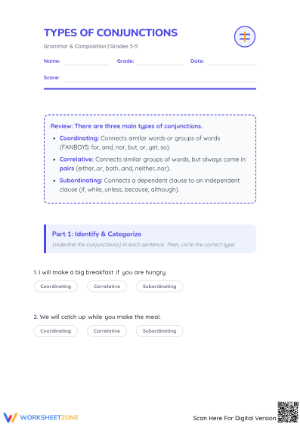
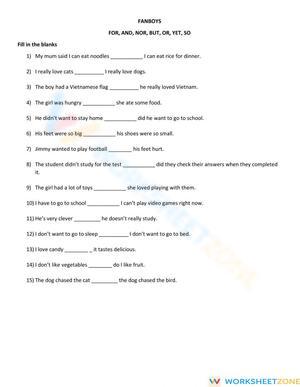
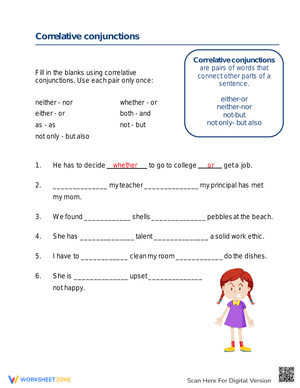
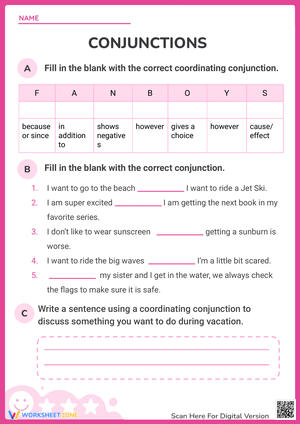
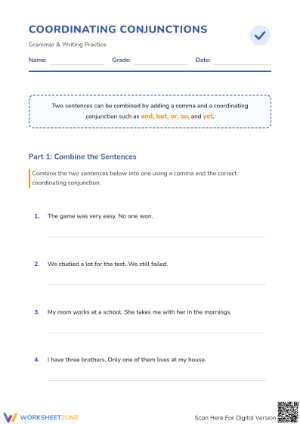
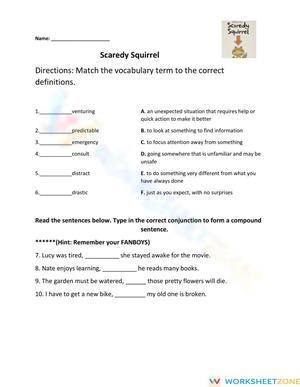
Coordinating conjunctions anchor the earlier worksheets. Students work through sentence-combining tasks where two complete thoughts are given and they must choose the connector that carries the right logical weight. "And," "but," "or," and "so" receive the most attention — and for good reason. The distinction between "and" (addition) and "but" (contrast) and "so" (result) is the conceptual core of the work. A student who writes "I was tired and I stayed up late" instead of "I was tired but I stayed up late" isn't making a spelling error; they're missing a distinction about contrast. These worksheets make that distinction the whole point of the exercise.
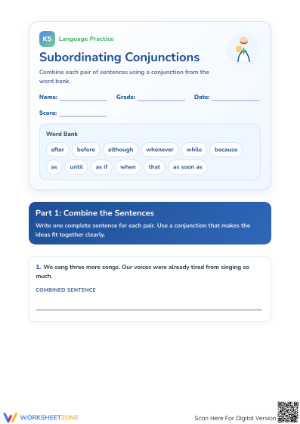
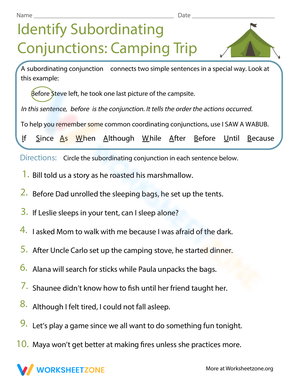
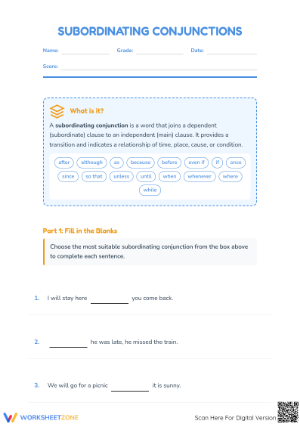
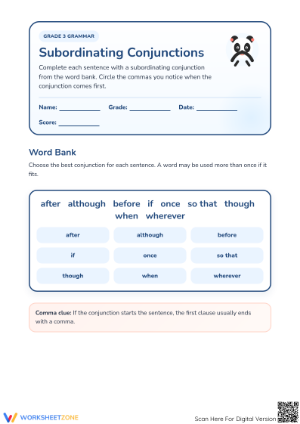
Subordinating conjunctions show up in later worksheets through clause-completion tasks. Students receive a dependent clause — "Because the storm wasn't letting up..." or "Although she had practiced all week..." — and write a main clause that makes the sentence logically complete. This requires students to think forward rather than backward in a sentence, tracking both grammatical dependency and semantic direction at the same time. That's a step up in cognitive demand from identification drills, and it produces more transfer to actual writing.
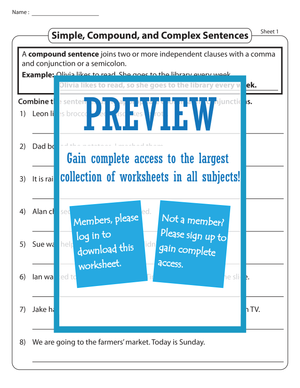
Several worksheets in the set also ask students to merge two or three short sentences into one using an appropriate conjunction. This sentence-combining format builds writing fluency directly by giving students a concrete revision strategy. The repetitive "subject-verb, subject-verb" pattern that fills early third-grade drafts is exactly what this exercise targets.
Frequent Student Errors Worth Watching For
The most persistent error isn't confusing one conjunction for another — it's defaulting to "and" for everything. Students who have been told to connect their ideas will string sentences together with "and" regardless of whether the relationship is additive, contrastive, or causal. A student who writes "We wanted to go to the park and it started raining and we stayed inside and we watched a movie" hasn't misunderstood what conjunctions are; they've understood only the most surface-level application. Each worksheet requires students to choose from multiple options and read for logical fit, which addresses this pattern directly.
Subordinating conjunction errors look different. The most common one: students write the dependent clause as a freestanding sentence. Because it was cold outside. feels complete to a 3rd grader — they've just stated a reason. Expect this fragment pattern to appear consistently in the clause-completion exercises, especially in the first week of instruction. It's useful diagnostic information: it tells you the student knows what the word means but hasn't yet internalized what makes a clause grammatically dependent.
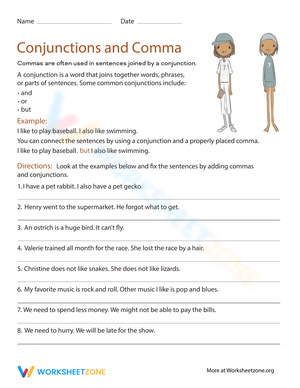
Comma placement in compound sentences produces a third category of mistakes. Students learn to place a comma before the coordinating conjunction when joining two independent clauses, but many overapply the rule to compound predicates ("She jumped, and ran to the door") or omit the comma entirely when the sentence is long. Because punctuation is embedded in the sentence-combining tasks rather than treated separately, teachers can catch this error pattern in context rather than waiting for it to show up in student writing.
Building These Worksheets Into Your Lesson Plans
The most effective starting point is a short whole-group session where you model the logic of one conjunction at the board before students work independently. Five minutes projecting two simple sentences and thinking aloud — "These two ideas disagree, so 'but' fits here; 'and' would say they go together" — gives students a mental hook that makes the worksheet task far more productive. Abstract grammar rules stick much more readily when students hear the reasoning process before they attempt it themselves.
These conjunctions pdf worksheets for 3rd grade slot naturally into Monday warm-ups after morning meeting, especially during a grammar unit. The sentence-combining format runs about eight minutes for most students — long enough to be substantive, short enough to fit cleanly before a writing workshop block. Some teachers use the subordinating conjunction worksheets as exit tickets on the days they introduce complex sentences. A student's response to "Although the character was scared..." tells you more about current understanding than a multiple-choice check would, and you can sort the papers into three piles in under two minutes.
For literacy centers, the sentence-combining worksheets are the most manageable independent option. Students can work through them without direct oversight, and the completed sentences give you something concrete to scan quickly during transitions. Pairing each worksheet with a brief oral share — one student reads their combined sentence aloud — turns the grammar station into a low-stakes speaking opportunity as well.
Standard Alignment
These worksheets address CCSS.ELA-LITERACY.L.3.1.H, which requires students to use coordinating and subordinating conjunctions as part of their command of standard English grammar conventions. In classroom terms, this standard lives in two places: during dedicated grammar instruction and during writing revision — when students return to a draft and look for places where consecutive short sentences could become one more complex thought. The worksheets serve both moments. They build the underlying skill during instruction, and the sentence-combining format mirrors exactly what revision looks like in a writing conference.
Adjusting the Set for a Range of Learners
Students who are still developing sentence fluency benefit from starting with coordinating conjunctions and working only with "and" and "but" before introducing "so" and "or." The contrast between additive and contrastive logic is concrete enough to practice with simple, familiar sentence content — playground decisions, lunch choices, weather observations. Keeping the subject matter low-stakes means the grammatical work stays in focus rather than getting lost in comprehension demands.
More advanced students move through coordinating conjunctions quickly and should spend most of their practice time on subordinating conjunction tasks — specifically the ones that require generating the main clause rather than selecting from a word bank. A useful extension: give these students a short paragraph from a current class read-aloud and ask them to find every conjunction, then rewrite two sentences by swapping the conjunction for a different one and explaining how the meaning changed. This moves the skill from mechanical to analytical.
For students who freeze at open-ended sentence completion, pre-populating the main clause and asking them to supply only the dependent clause removes enough of the blank-page pressure to get them started. "We had to cancel recess _______________" is a more accessible entry point than "_______________although the gym was still available." The task is still grammatically demanding — it still requires understanding dependency — without also demanding full generative writing from students who aren't there yet.
Frequently Asked Questions
Can these worksheets double as a formative assessment?
Yes, and the sentence-combining format is particularly useful for this purpose. A student's conjunction choice reveals something specific: a student who consistently writes "and" where "so" belongs is showing you they haven't yet mapped cause-and-effect logic onto their conjunction knowledge. That's more instructionally useful than a score on a fill-in-the-blank quiz. At the end of a unit, one worksheet completed without reference materials works well as a summative exit ticket.
How do these fit alongside a writing workshop model?
Conjunction instruction pairs naturally with the revision stage of writing workshop. After students have a working draft, these conjunctions pdf worksheets for 3rd grade give them a concrete revision strategy: find two consecutive short sentences and combine them. Teachers who introduce the skill through the worksheets first and then send students back to their own drafts to apply it see more transfer than those who teach conjunction grammar entirely in isolation. The worksheet practice builds the pattern recognition; the draft revision puts it to real use.
What order should coordinating and subordinating conjunctions be taught?
Coordinating conjunctions first, without exception. Students need to be fluent with compound sentences before the added complexity of dependent clauses makes grammatical sense. In practice, this usually means two to three weeks on FANBOYS — with particular attention to "but" and "so" as logical markers, not just filler words — before moving into "because," "although," and "when." Rushing into subordinating conjunctions before students are solid on the basics produces writing that looks complex on the surface but contains consistent fragment and comma errors underneath.
Is comma usage addressed alongside the conjunction skills?
It is, and deliberately so. Comma placement before coordinating conjunctions in compound sentences is built into the sentence-combining tasks — students punctuate the full sentence, not just fill in the conjunction. The subordinating conjunction worksheets also require students to recognize when a dependent clause leads the sentence and needs a comma after it before the main clause begins. Embedding punctuation into the practice rather than treating it as a separate skill reflects how these conjunctions pdf worksheets for 3rd grade are intended to function: as sentence-level writing practice, not isolated grammar drills.












 Interactive Worksheet Maker
 Quiz Maker
 Word Search Maker
 Crossword Puzzle Maker
 Word Scramble Generator
 Sentence Scramble Generator
 Handwriting Worksheet Generator
 Name Tracing Generator
 Fill In The Blank Generator