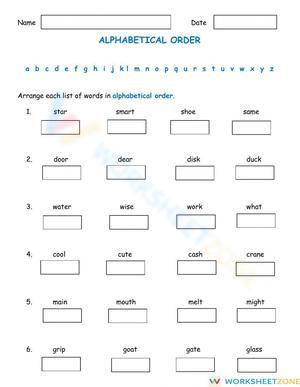
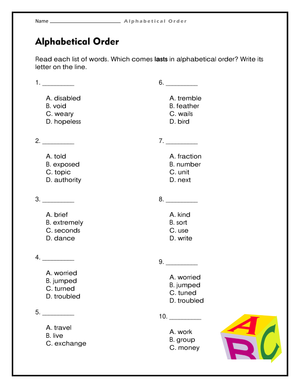
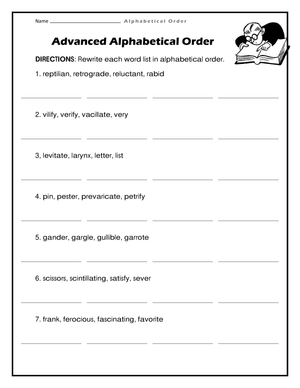
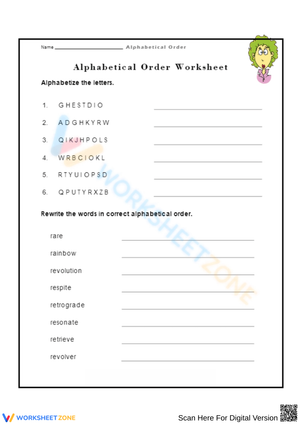
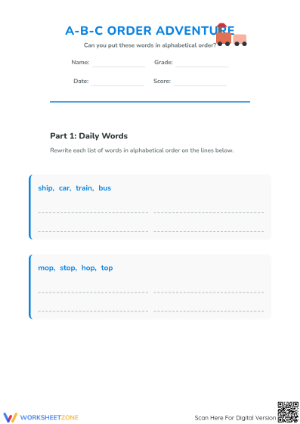
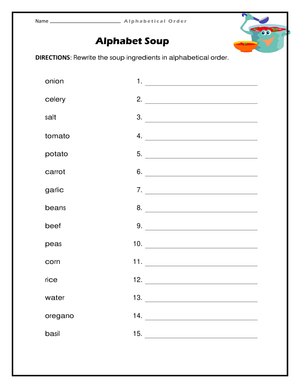
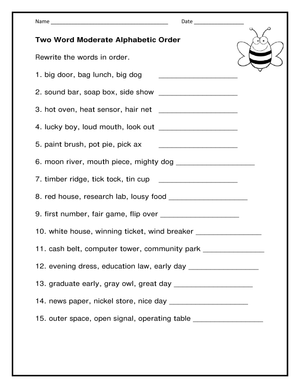
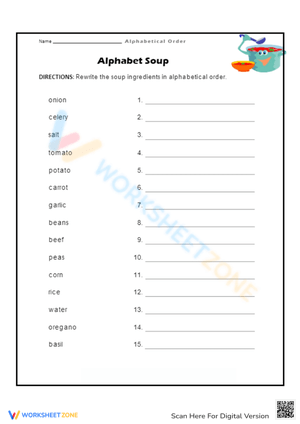
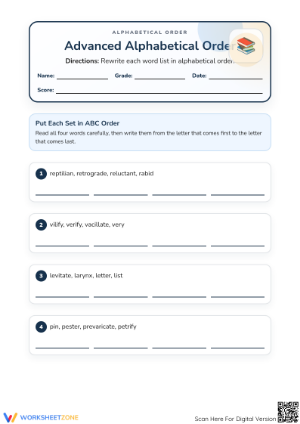
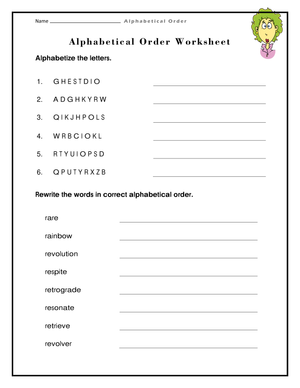
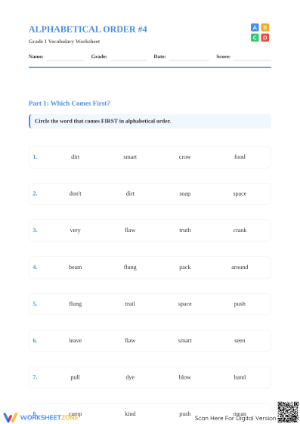
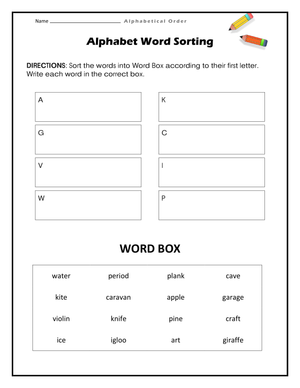
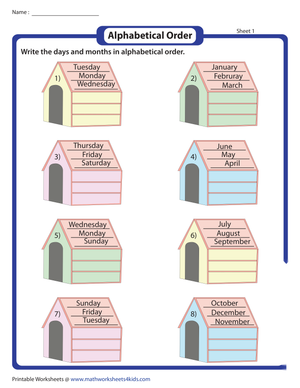
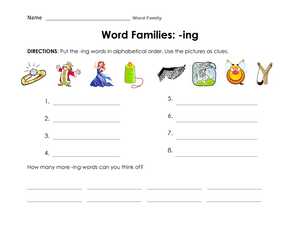
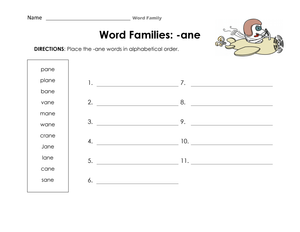
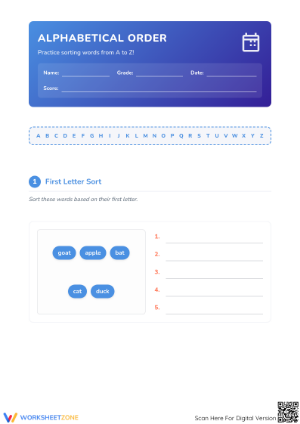
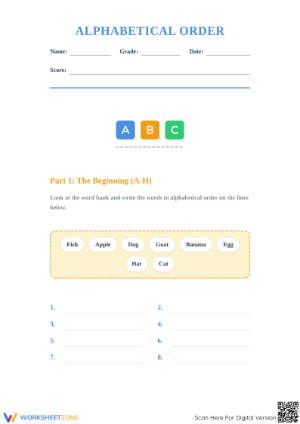
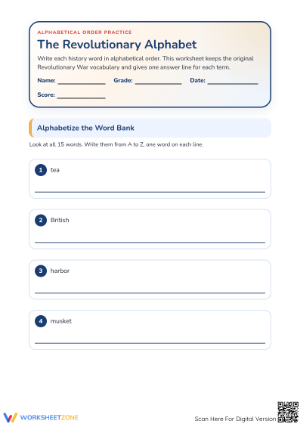
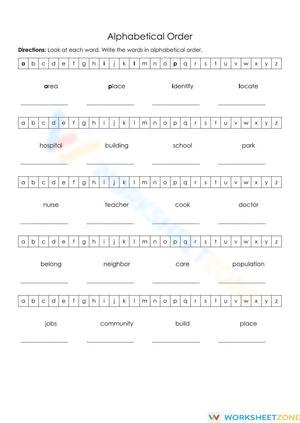
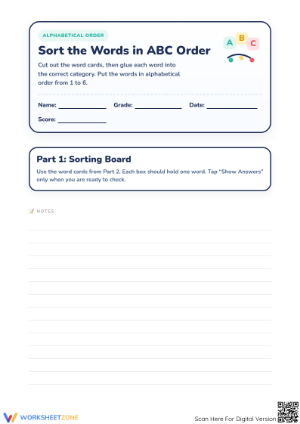
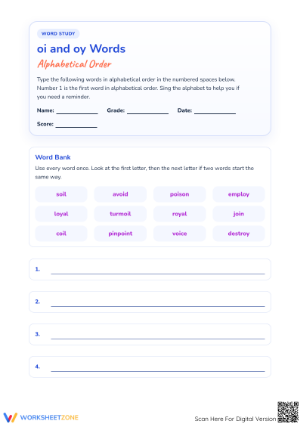
These 2nd grade alphabetical order printable worksheets resources give teachers seven standalone exercises that move students from basic first-letter sorting through third-letter comparisons and into practical guide word work. Each worksheet functions as a warm-up, a five-minute closer, or independent seat work without requiring any introduction beyond handing it out.
The Specific Skills Targeted
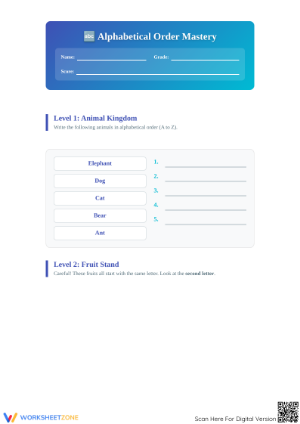
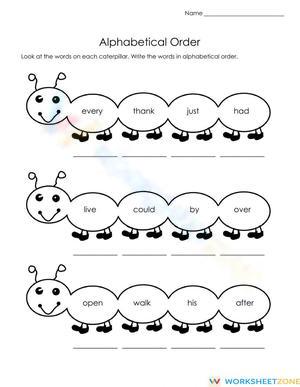
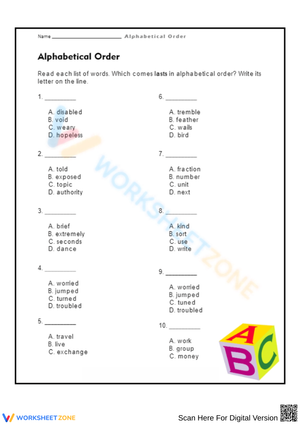
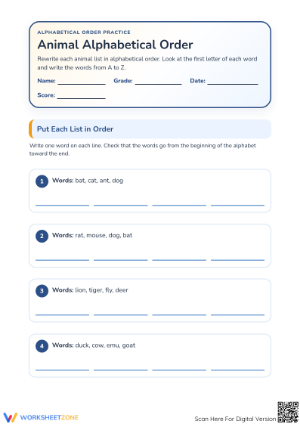
The set moves in a deliberate sequence, though any worksheet can be pulled independently based on where students currently are. First-letter sorting uses word lists with clearly distinct initial letters — words like "jump," "carrot," "forest," and "night" — so students focus on matching a letter to its place in the alphabet rather than wrestling with look-alike beginnings. Second-letter worksheets introduce sets where the opening letter is shared: sorting "bench," "blaze," "bright," and "brown" requires students to look past the b and compare what follows. Third-letter work is the most demanding piece in the set, and the instructions walk students through the comparison one letter position at a time before asking them to sort a full list independently.
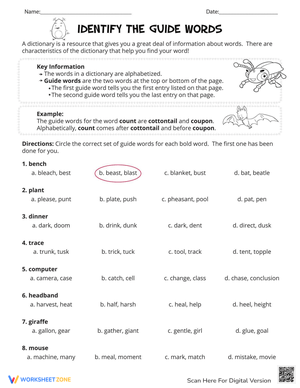
One worksheet is built around guide words, using a layout that mimics two columns of a dictionary page. Students read a pair of guide words at the top, then decide which words from a word bank would appear on that page and which fall before or after it. This is the direct bridge to actual dictionary use — a skill that surfaces in 2nd grade classroom reference work and in low-stakes assessments throughout the year.
Mistakes Students Make That Teachers Should Anticipate
The most reliable error pattern appears the moment students hit second-letter sorting: they finish quickly and incorrectly, having looked only at the first letter. A student who flawlessly sorts "dog," "fox," "lamp," and "train" will turn around and place "blend" before "black" without hesitating, because both start with bl and the e versus a comparison demands a slower visual scan than most 7-year-olds apply by default.
Third-letter errors follow a different pattern. Students who lose track of which letter position they're comparing often restart from the beginning of the word each time, burning through working memory before they ever reach the third character. Watch for repeated erasing and rewriting — that's almost always a sign the student is re-reading from the start rather than holding the comparison position in mind. Asking students to underline the target letter in each word before they begin sorting catches this habit early and makes the invisible step visible.
A subtler problem shows up in the guide word worksheet. Students frequently interpret guide words as the first and last entries in the entire dictionary rather than on one specific page. A student will confidently decide that "robin" should appear after "rose" on a page with guide words "rake" and "river" — their alphabet reasoning is sound, but they haven't grasped what guide words actually mark. Two minutes with a physical dictionary open to any page, pointing to the top words, resolves this faster than any amount of written explanation on the worksheet itself.
Standard Alignment
These worksheets address CCSS ELA-Literacy L.2.2.e, which requires second graders to consult reference materials — including beginning dictionaries — to check spelling and clarify meaning. In classroom terms, that standard doesn't get met the first time a student opens a dictionary. It requires repeated, low-stakes practice with alphabetical sequencing until reference use becomes automatic rather than effortful. The first- and second-letter sorting worksheets build the sequence knowledge the standard assumes. The guide word worksheet is the direct application of that knowledge to an actual reference task. Used together across several weeks, the 2nd grade alphabetical order printable worksheets set covers the full instructional arc the standard implies without requiring a stand-alone unit block.
Where These Worksheets Fit in Your Weekly Routine
The most practical entry point for most classrooms is morning work. The first-letter sorting worksheet takes students about six minutes working independently — short enough to finish before the day's opening routines, long enough to count as a genuine cognitive warm-up. Second- and third-letter worksheets work well as early-finisher tasks during word study rotations, where students who complete a spelling sort can move into alphabetical ordering without needing teacher redirection.
For classrooms with an active word wall, one low-prep extension is to pull five words each Friday and have students write them in alphabetical order on the back of that week's completed worksheet. That return visit — spaced across several weeks rather than concentrated into two days — is where the 2nd grade alphabetical order printable worksheets exercises do their best work. Spaced retrieval converts a rule students can recite into a reflex they use automatically when they open a dictionary.
Reaching Different Learners With the Same Set
Students who are still uncertain about alphabet sequence benefit from keeping a letter strip on their desk while working through the sorting exercises. That's not bypassing the skill — it reduces the cognitive load on sequence recall so students can direct attention to the comparison task itself. Once a student sorts accurately with the strip available, removing it becomes a clear and manageable next step rather than a frustrating jump.
For students who move through the set quickly, the guide word worksheet can be extended by asking them to generate three words of their own that would fit between each pair of guide words, rather than choosing from the word bank. That shift from recognition to production is a meaningful increase in difficulty and requires no additional materials. For students who need the most support, having a teacher highlight the specific letter position being compared across each word in a list — before the student begins — makes the comparison step visible without changing what the task measures.
Frequently Asked Questions
When should students move from first-letter to second-letter sorting?
When a student accurately sorts a mixed ten-word list with different starting letters without consulting an alphabet reference, they're ready for second-letter work. In most 2nd grade classrooms, this transition happens within the first six to eight weeks of school, though students who entered without strong alphabet fluency from 1st grade often benefit from another week of first-letter practice before moving on.
Can these worksheets be used for homework?
The first- and second-letter sorting worksheets travel home without issue — the directions are self-contained, and parents can check answers without difficulty. The guide word worksheet is better kept in school until after direct instruction on guide words, since the concept is genuinely hard to explain to a child at home without a physical dictionary to point to.
How does this set connect to actual dictionary use?
The progression mirrors what students actually do when they open a dictionary: use alphabetical order to find the right section, then guide words to find the right page, then entry order to locate the specific word. The 2nd grade alphabetical order printable worksheets guide word exercise is explicitly modeled on those last two steps, so students who work through the full set arrive at dictionary use with the mechanics already practiced rather than encountering the task cold.
What if a student knows the alphabet song but still struggles to sort?
Singing the alphabet and applying alphabetical sequence are genuinely different skills. Most students who struggle with sorting know the song perfectly — the breakdown is in translating a memorized sequence into a live comparison between two specific letters mid-word. Asking those students to locate both letters on an alphabet strip and point to each one before deciding which comes first externalizes the comparison step they've been trying to manage entirely in their heads, and that small shift usually produces an immediate difference.












 Interactive Worksheet Maker
 Quiz Maker
 Word Search Maker
 Crossword Puzzle Maker
 Word Scramble Generator
 Sentence Scramble Generator
 Handwriting Worksheet Generator
 Name Tracing Generator
 Fill In The Blank Generator