


























Views
Downloads

Alphabetical Order Mastery Worksheet | Grade 1-5 Ready
Paste this activity's link or code into your existing LMS (Google Classroom, Canvas, Teams, Schoology, Moodle, etc.).
Students can open and work on the activity right away, with no student login required.
You'll still be able to track student progress and results from your teacher account.
This comprehensive alphabetical order worksheet guides students through four distinct stages of sorting mastery. By progressing from simple first-letter identification to complex third and fourth-letter analysis, learners build the foundational dictionary skills necessary for advanced literacy. It provides a clear, structured path for students to organize vocabulary across multiple subjects.
At a Glance
- Grade: 1-5 · Subject: ELA & Vocabulary
- Standard:
CCSS.ELA-LITERACY.L.2.2.E— Use alphabetical order to consult reference materials and organize vocabulary- Skill Focus: Multi-letter alphabetizing
- Format: 3 pages · 24 problems · Answer key included · PDF
- Best For: Independent practice and skill scaffolding
- Time: 20–30 minutes
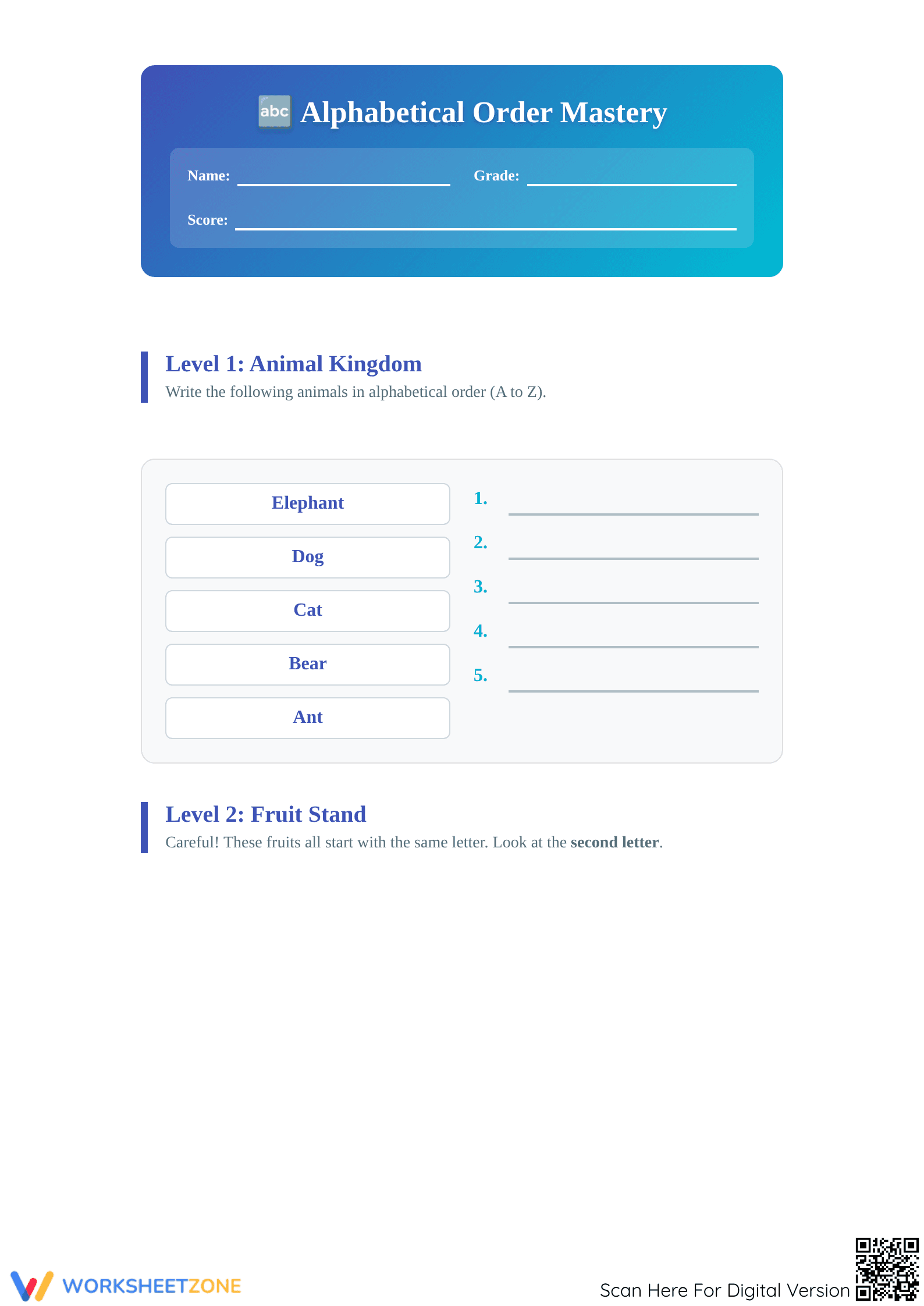
The resource contains three pages of high-quality practice, featuring 24 total tasks divided into thematic sections. It includes a clear header for student tracking and a full answer key for rapid grading. The layout uses clean boxes and numbered lines to help students maintain focus while writing, ensuring that the mechanics of the task do not interfere with the cognitive load of sorting.
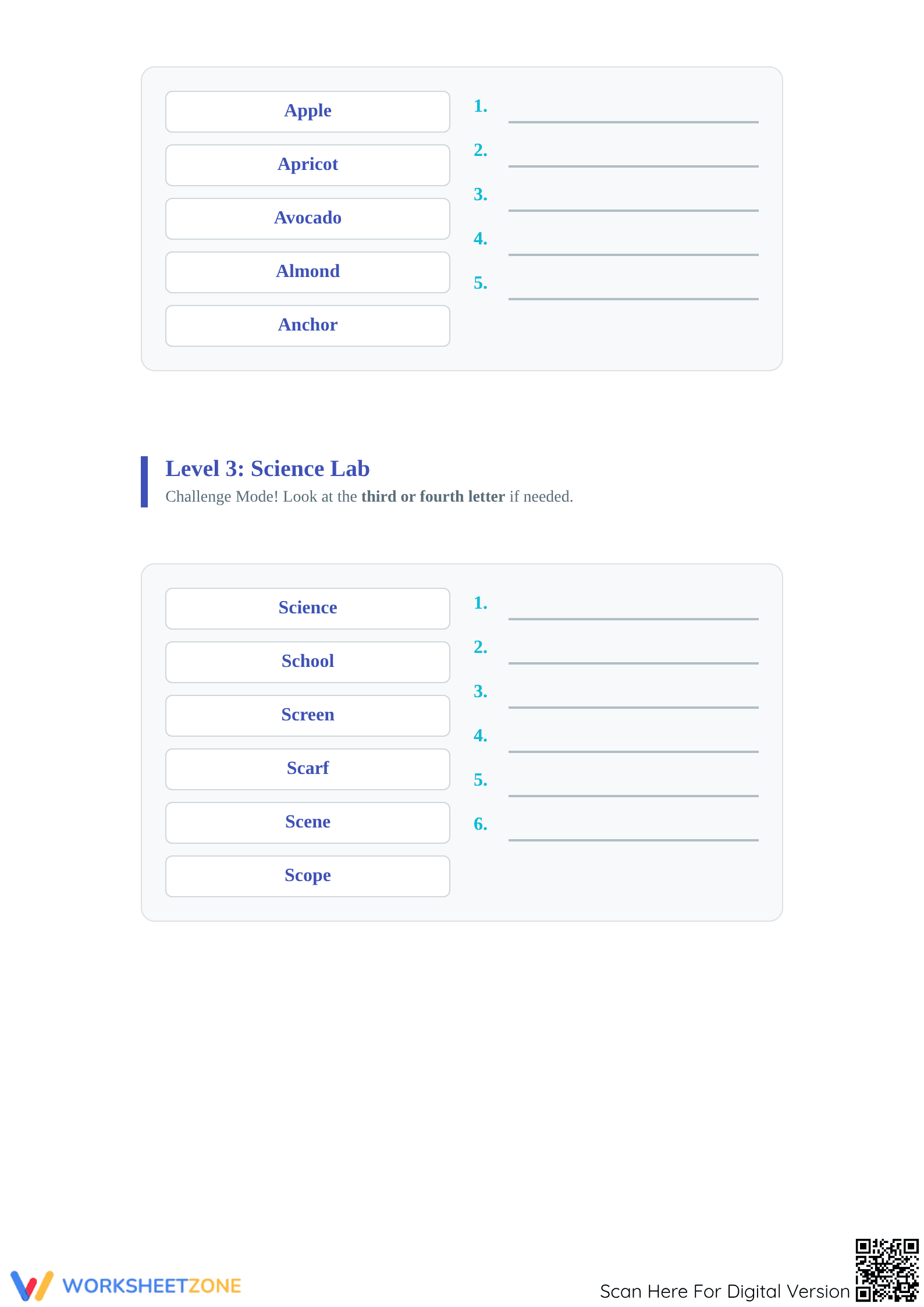
- Level 1 & 2 (Introductory): Focuses on basic A-Z sorting using the first letter (Animal Kingdom) and introduces the concept of looking at the second letter (Fruit Stand) when initial letters match.
- Level 3 (Intermediate): Challenges students with "Science Lab" vocabulary where they must look at the third or fourth letter to determine the correct sequence.
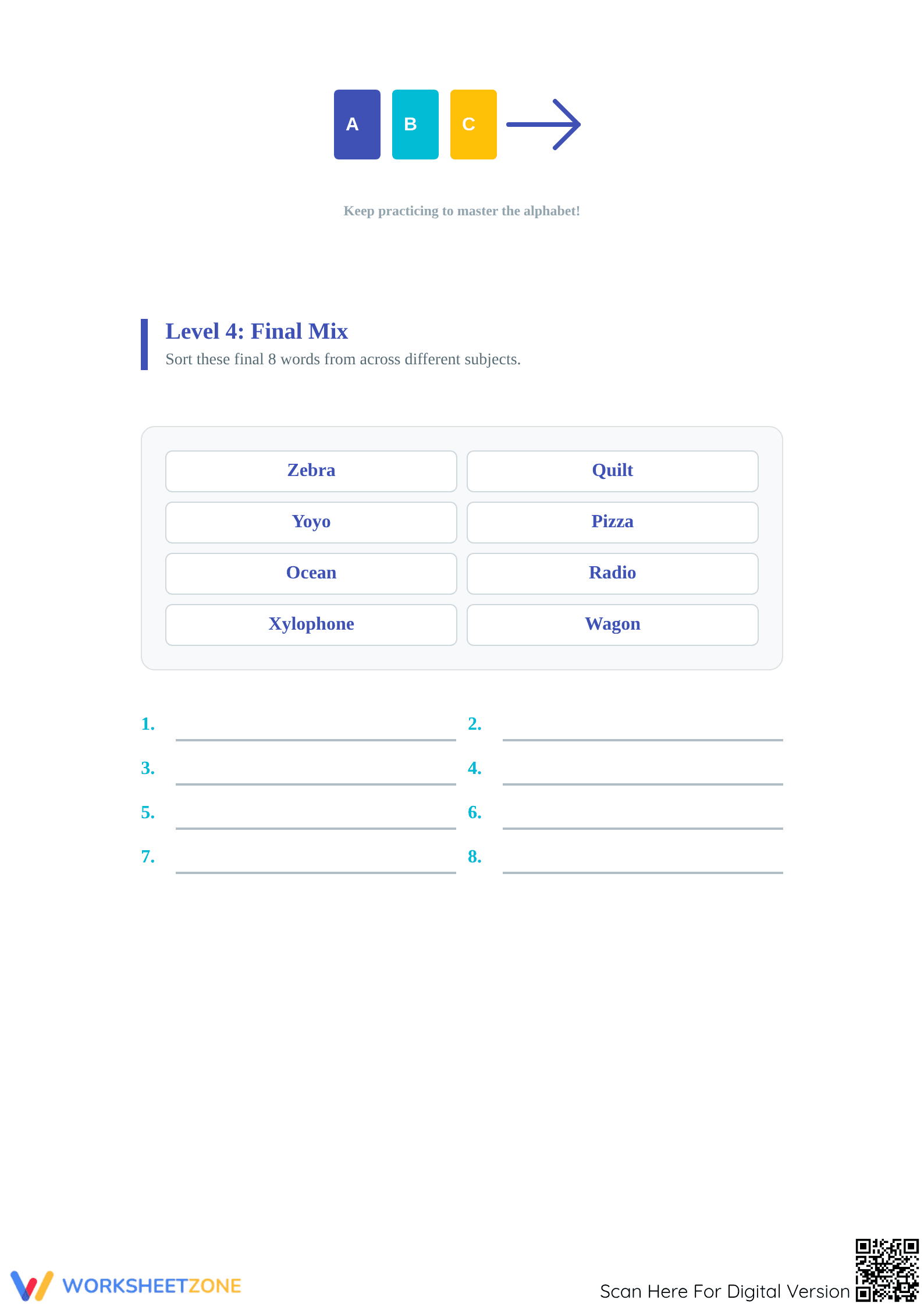
- Level 4 (Advanced): A "Final Mix" of eight words from diverse subjects, requiring students to apply all previous sorting rules independently without thematic cues.
This worksheet is primarily aligned with CCSS.ELA-LITERACY.L.2.2.E, which requires students to use alphabetical order to consult reference materials. It also supports CCSS.ELA-LITERACY.L.3.2.G by reinforcing the spelling patterns required for dictionary use. Both standard codes can be copied directly into lesson plans, IEP goals, or district curriculum mapping tools.
Use this as a formative assessment after introducing dictionary skills. Start with Level 1 as a whole-class warm-up, then allow students to progress through Levels 2 and 3 at their own pace. For a quick check, observe students during Level 3; if they struggle to identify the third letter, provide a highlighter to mark the differing characters. Completion typically takes 25 minutes.
This resource is designed for elementary students in grades 1 through 5, particularly those needing a refresher on organizational mechanics. It works exceptionally well for English Language Learners (ELL) who are mastering the English alphabet. Pair this worksheet with a physical classroom dictionary or a word wall to bridge the gap between paper practice and real-world application.
Research by Fisher & Frey (2014) emphasizes the importance of scaffolded practice in developing foundational literacy skills like alphabetization. This worksheet applies the gradual release of responsibility model by moving from highly supported tasks to independent application. Mastery of alphabetical order is a critical precursor to efficient information retrieval and dictionary usage, which are key components of the NAEP framework for reading and writing. By isolating the sorting mechanic across 24 targeted problems, the resource ensures that students internalize the logic of "looking deeper" into a word's structure. This systematic approach reduces cognitive fatigue and allows for higher retention of organizational rules. Educators can utilize the tiered levels to provide immediate feedback, ensuring that students do not solidify incorrect sorting habits before moving to more complex vocabulary sets.


