


























Views
Downloads

Alphabetical Order Worksheet | Grade 2 Essential
Paste this activity's link or code into your existing LMS (Google Classroom, Canvas, Teams, Schoology, Moodle, etc.).
Students can open and work on the activity right away, with no student login required.
You'll still be able to track student progress and results from your teacher account.
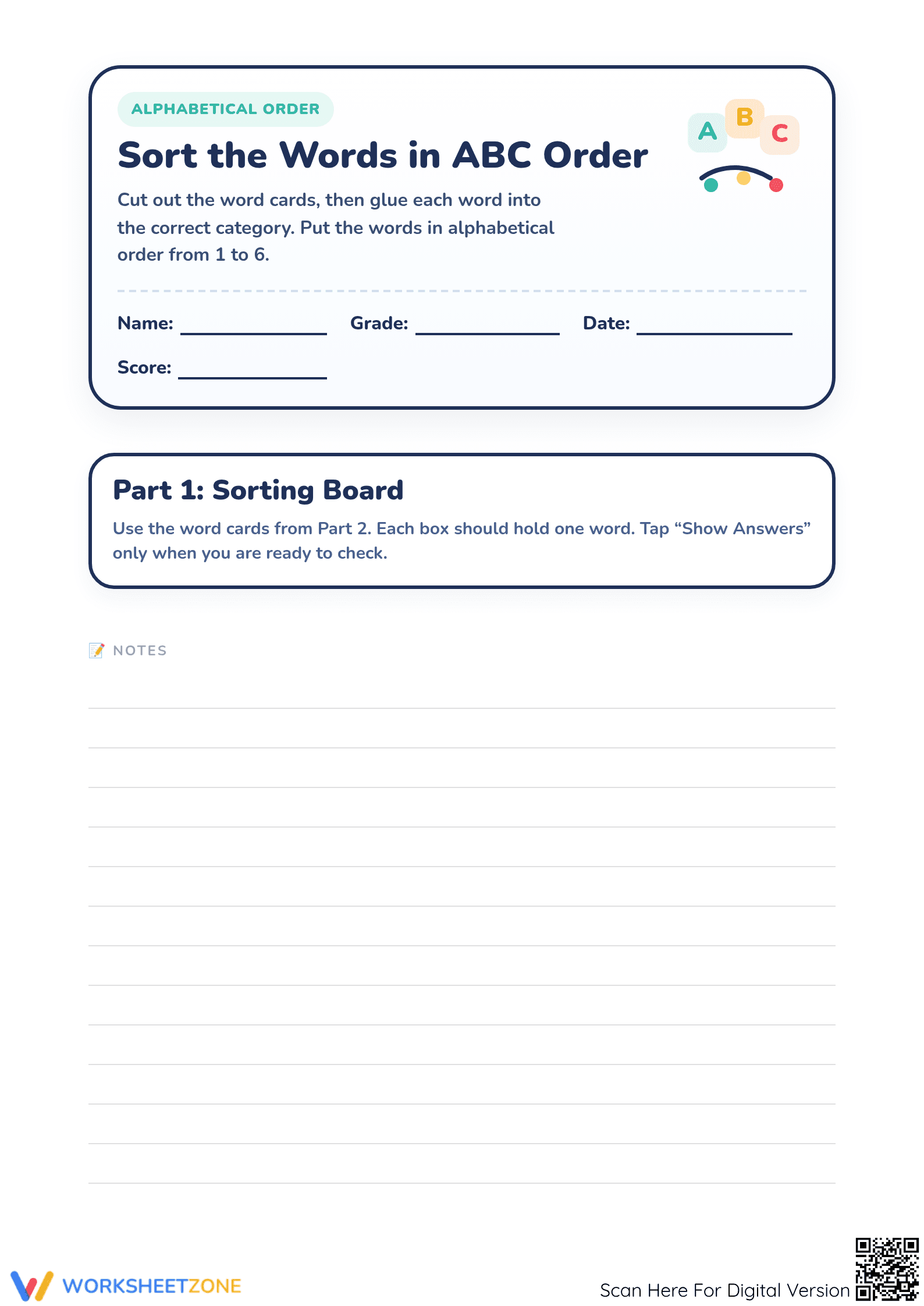
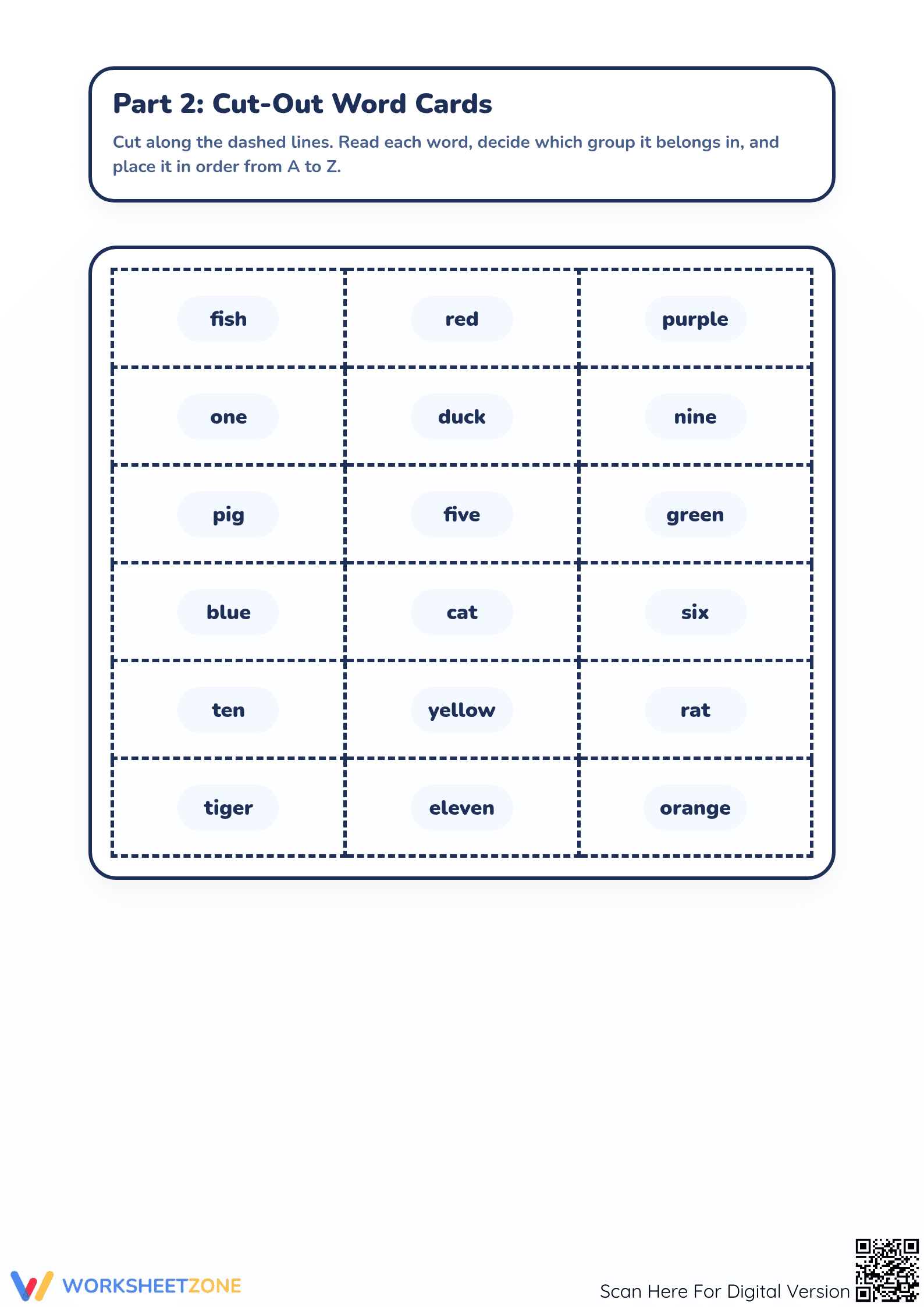
This Grade 2 alphabetical order worksheet provides students with a hands-on way to master word organization. By combining categorization with ABC sorting, learners develop the cognitive flexibility needed for advanced dictionary skills. Students will cut, group, and sequence 18 different words to demonstrate mastery of the English alphabet's structure and logic.
At a Glance
- Grade: 2 · Subject: ELA
- Standard:
CCSS.ELA-LITERACY.L.2.2.E— Consult reference materials like dictionaries to check and correct spellings and order- Skill Focus: Alphabetical Order & Categorization
- Format: 4 pages · 18 problems · Answer key included · PDF
- Best For: Independent literacy centers or sub plans
- Time: 20–30 minutes
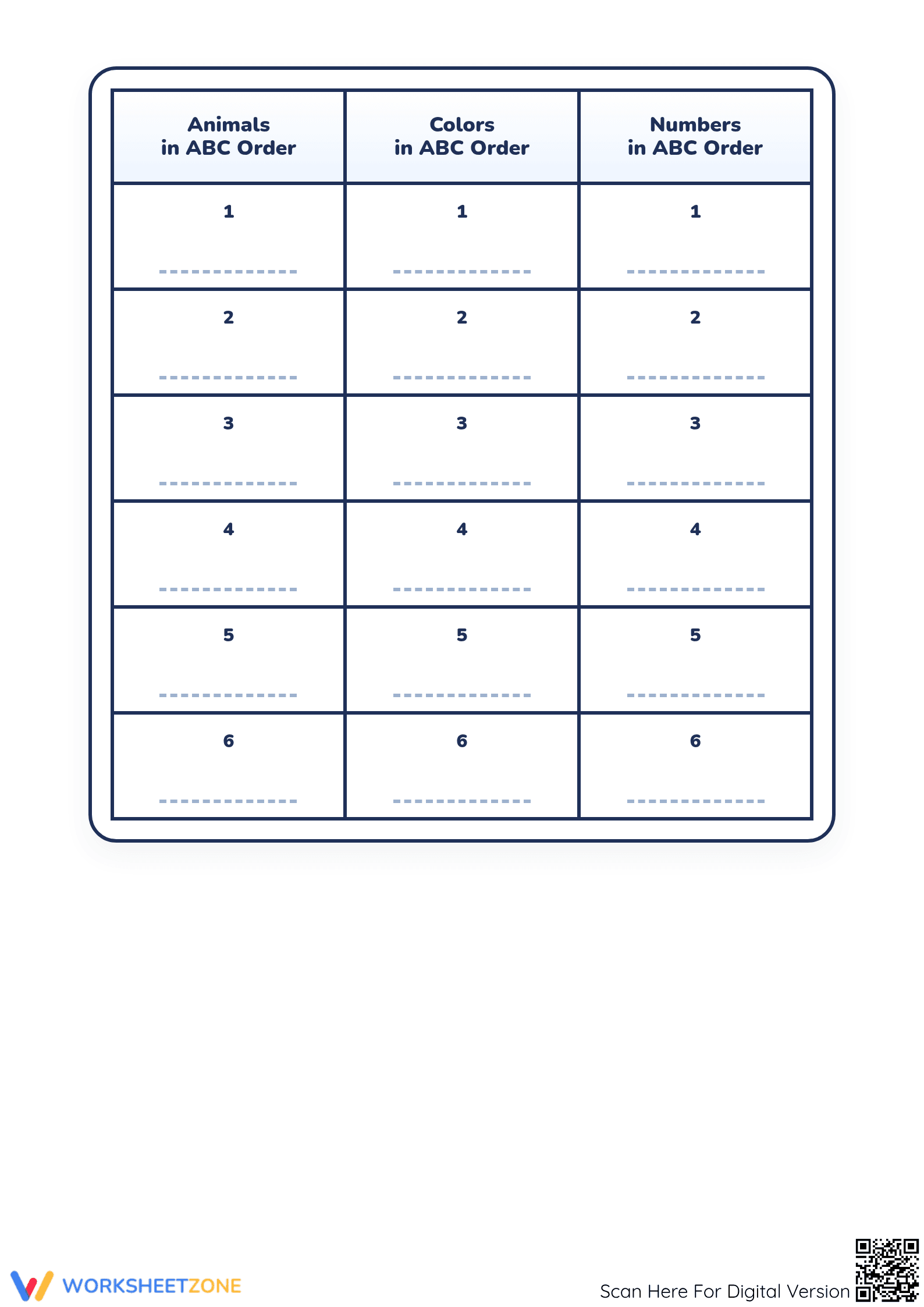
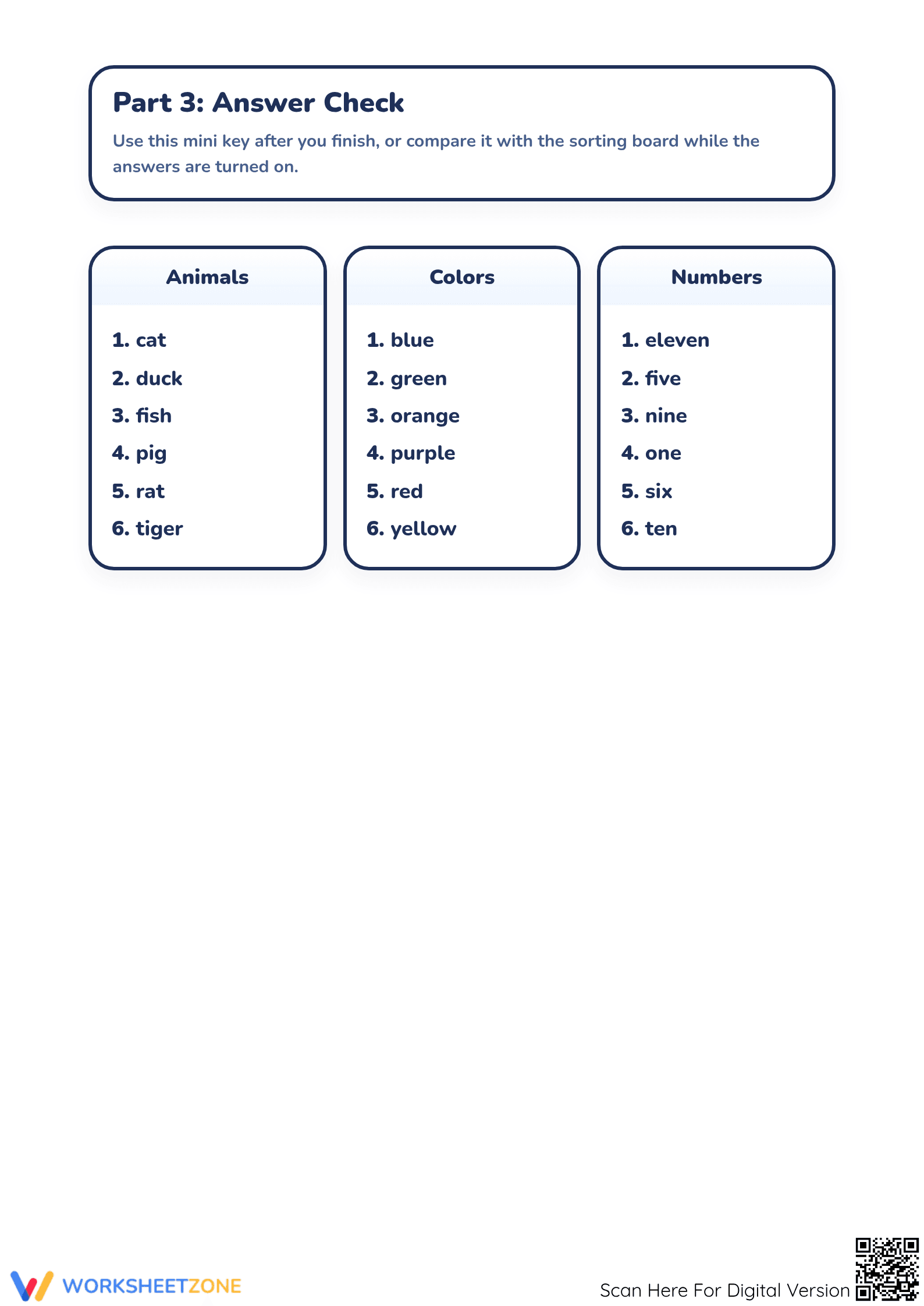
The resource consists of a four-page PDF designed for immediate classroom use. It includes a dedicated sorting board with three distinct columns: Animals, Colors, and Numbers. The third page features 18 individual word cards with dashed lines for easy cutting. To ensure student success, the final page provides a clear answer check for self-correction or teacher grading.
The zero-prep workflow is designed for maximum efficiency. First, print the four-page document (30 seconds). Second, distribute the sorting board and word cards to students; they will need scissors and glue (1 minute). Finally, review the completed boards using the provided answer check (30 seconds). This entire sequence requires less than two minutes of teacher preparation time, making it an ideal emergency sub plan.
This activity aligns with CCSS.ELA-LITERACY.L.2.2.E, which requires students to consult reference materials, including beginning dictionaries, as needed to check and correct spellings. Alphabetizing is the foundational prerequisite for this standard. Additionally, it supports vocabulary acquisition and classification skills. Both standard codes can be copied directly into lesson plans, IEP goals, or district curriculum mapping tools.
Use this worksheet during the independent practice phase of a lesson on dictionary skills. It serves as an excellent formative assessment to see if students can handle alphabetizing beyond the first letter. Alternatively, place it in a literacy center. Teachers should observe if students struggle with words starting with the same letter, which indicates a need for further instruction on second-letter sequencing.
This resource is tailored for Grade 2 students but is effective for Grade 1 enrichment or Grade 3 review. It is particularly helpful for English Language Learners (ELLs) who benefit from the visual grouping of common nouns. Pair this worksheet with a classroom anchor chart of the alphabet or a dictionary search to reinforce the utility of ABC order.
Alphabetical sequencing is a critical component of orthographic processing and lexical retrieval. According to Fisher & Frey (2014), the ability to categorize and then sequence information is a hallmark of developing literacy that bridges the gap between simple word recognition and complex reference skills. This worksheet targets CCSS.ELA-LITERACY.L.2.2.E by requiring students to manipulate 18 distinct vocabulary terms across three semantic domains. Research from the RAND AIRS 2024 report suggests that tactile activities, such as cut-and-paste sorting, increase engagement and retention of structural language rules compared to passive reading alone. By requiring students to evaluate the first and second letters of words like "blue" and "black" or "cat" and "color," the task reinforces phonemic awareness and spelling accuracy. This structured approach ensures that Grade 2 learners build the necessary stamina and accuracy for independent dictionary use and academic research in later elementary years.


