


























Views
Downloads
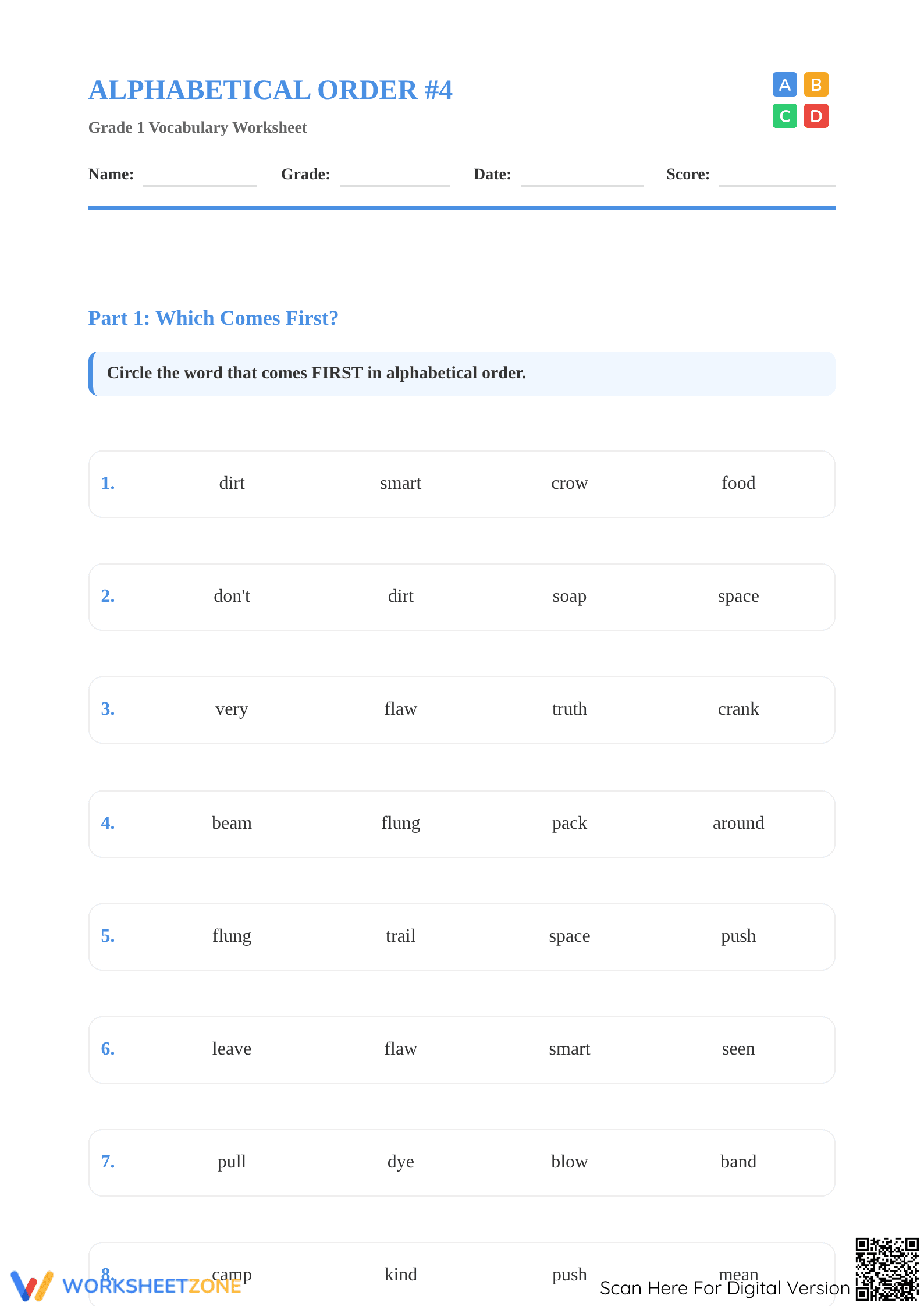
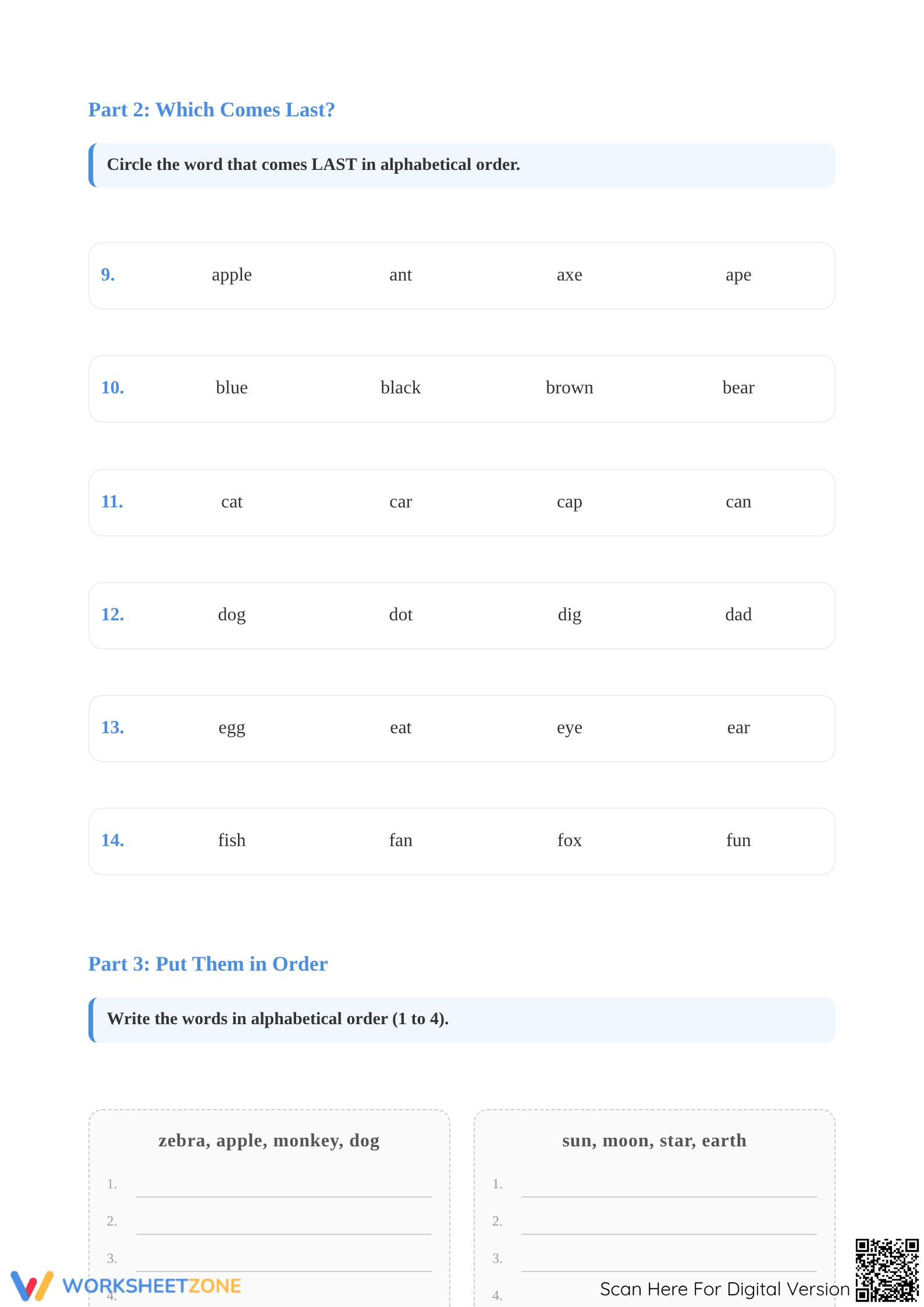
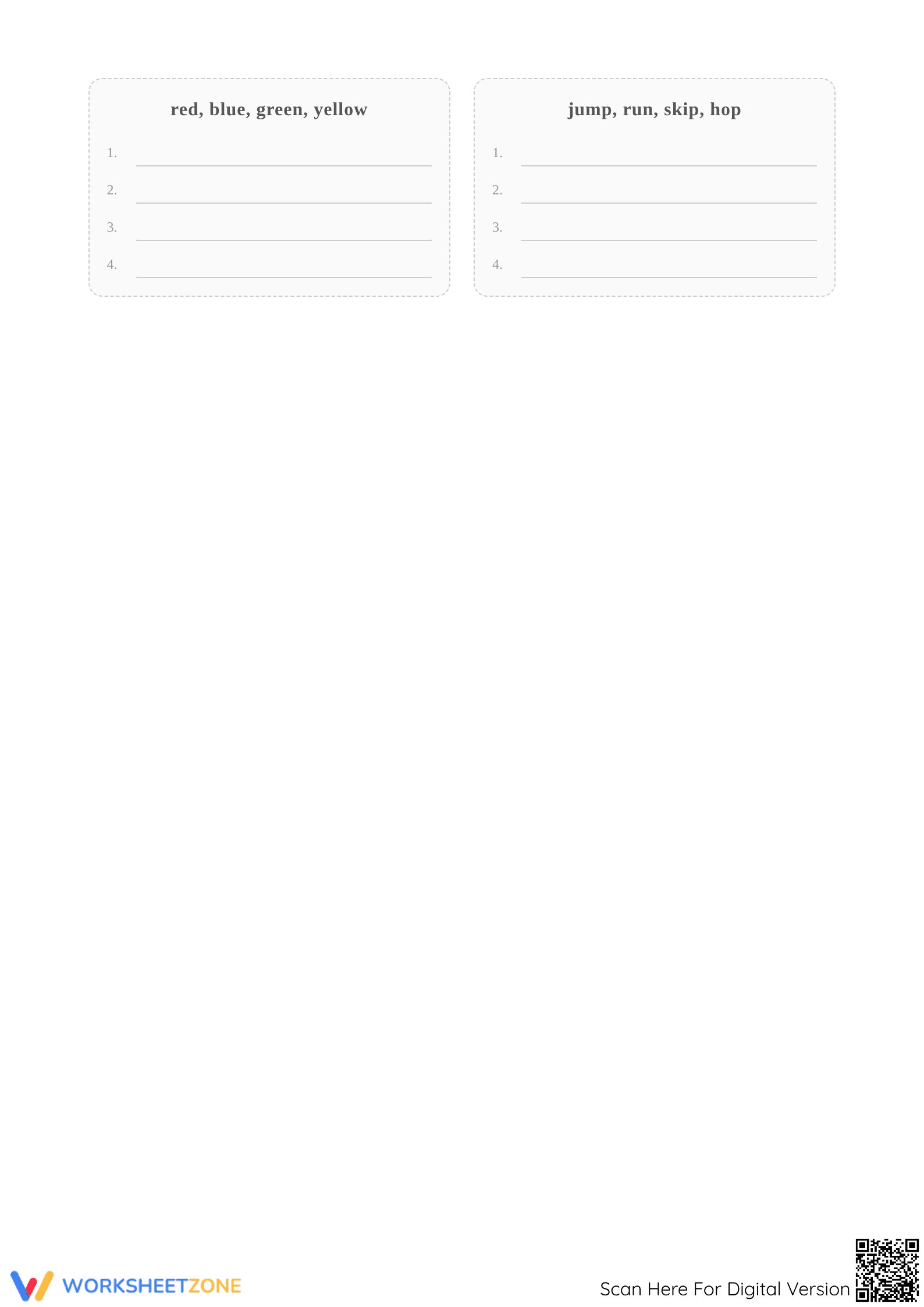

Alphabetical Order Worksheet | Grade 1 Essential Practice
Paste this activity's link or code into your existing LMS (Google Classroom, Canvas, Teams, Schoology, Moodle, etc.).
Students can open and work on the activity right away, with no student login required.
You'll still be able to track student progress and results from your teacher account.
This Grade 1 alphabetical order worksheet provides a comprehensive framework for students to master the sequencing of words based on the alphabet. By engaging with three distinct task types, learners move from simple identification to active sorting, ensuring they can confidently organize vocabulary in any academic context. This resource is designed to build the foundational literacy skills necessary for future dictionary and reference work.
At a Glance
- Grade: 1 · Subject: ELA
- Standard:
CCSS.ELA-LITERACY.L.1.1— Demonstrate command of the conventions of standard English grammar and usage when writing- Skill Focus: Alphabetical order (ABC Order)
- Format: 3 pages · 18 problems · Answer key included · PDF
- Best For: Independent literacy centers or morning work
- Time: 15–20 minutes
Inside this 3-page PDF, you will find 18 structured tasks divided into three logical parts. Part 1 asks students to identify which word comes first in a set of four, while Part 2 focuses on identifying the word that comes last. Part 3 challenges students to rewrite entire word lists in the correct sequence. The layout is clean and spacious, providing ample room for young writers to practice their penmanship while they sort. A full answer key is provided for rapid grading.
Zero-Prep Workflow
- Print (1 minute): Select the student pages and answer key. The high-contrast design ensures clear copies on school printers.
- Distribute (30 seconds): Hand out packets during your ELA block or place them in a literacy station for self-directed learning.
- Review (30 seconds): Use the answer key to check work or display it on a document camera for whole-class self-correction.
This resource is an ideal sub-plan component because the instructions are self-explanatory and require no additional teacher modeling once the concept of alphabetical order has been introduced.
Standards Alignment: This worksheet aligns with `CCSS.ELA-LITERACY.L.1.1` by reinforcing foundational conventions of the English language. While Grade 1 focuses on letter recognition, the inclusion of words with similar starting letters provides a gentle introduction to advanced sorting. The standard code can be copied directly into lesson plans, IEP goals, or curriculum mapping tools.
How to Use It: Assign this worksheet during the "You Do" phase of a gradual release lesson on reference skills. It works exceptionally well as a formative assessment after a whole-group alphabetizing activity. Teachers should observe if students are reciting the alphabet song to find the correct order, which is a key indicator of their current processing stage. Expect completion within 20 minutes for most first-grade learners.
Who It's For: This resource is tailored for Grade 1 students but serves as an excellent intervention tool for Grade 2 students who need a refresher. It is also highly effective for English Language Learners (ELLs) who are familiarizing themselves with the English alphabet's structure. Pair this with a classroom word wall or an alphabet anchor chart for maximum student support.
Research from Fisher & Frey (2014) emphasizes that foundational literacy skills are best acquired through structured practice moving from recognition to production. This worksheet facilitates that progression by requiring students to identify word positions before generating a complete sequence. By isolating the alphabetizing skill across 18 tasks, the resource ensures students move beyond rote memorization into functional application. This systematic approach is a critical precursor to effective dictionary usage and information retrieval. The inclusion of an answer key allows for immediate feedback, a proven factor in reducing sequencing errors in early childhood education.


