


























Views
Downloads
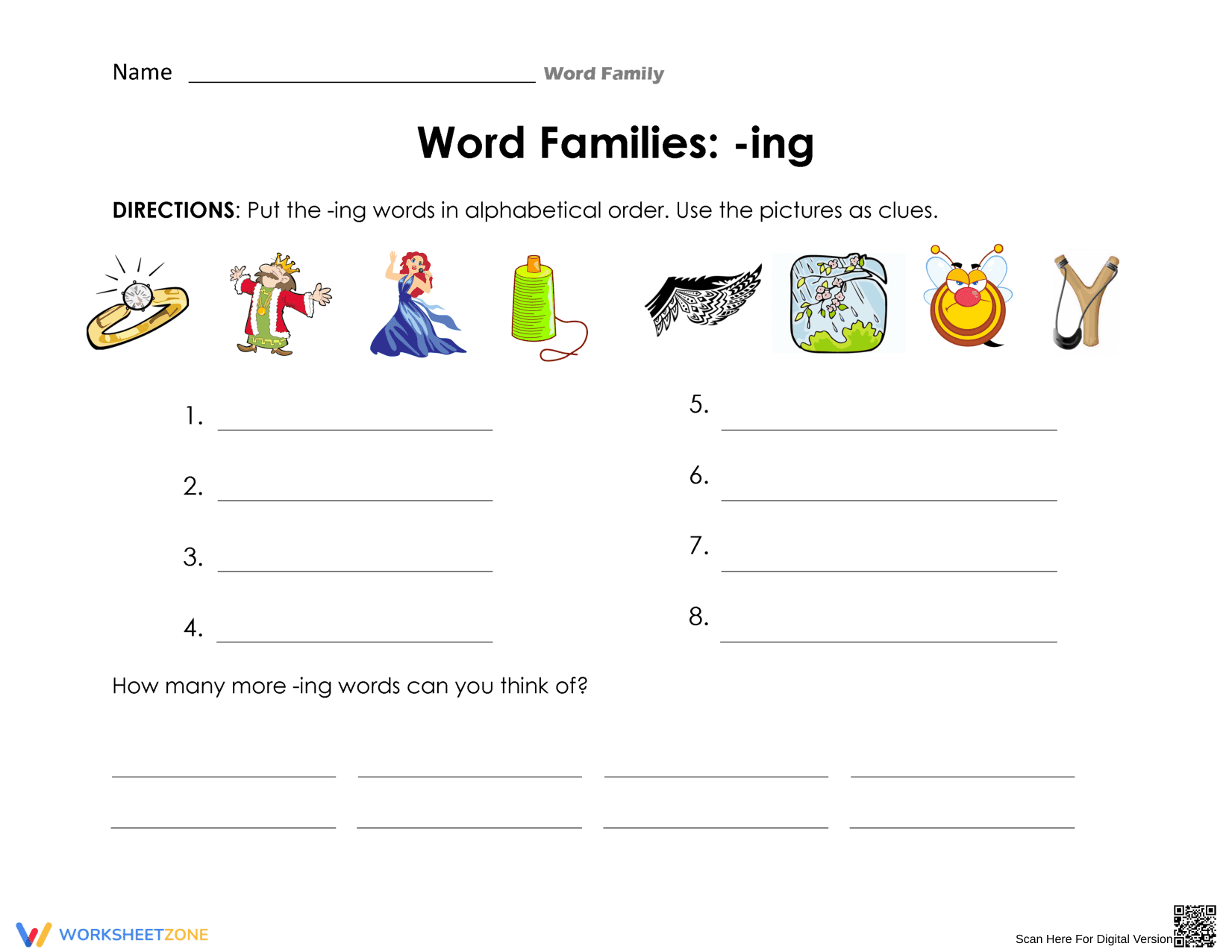

Essential -ing Word Families Alphabetical Order Worksheet
Paste this activity's link or code into your existing LMS (Google Classroom, Canvas, Teams, Schoology, Moodle, etc.).
Students can open and work on the activity right away, with no student login required.
You'll still be able to track student progress and results from your teacher account.
This worksheet targets phonics and organizational skills by challenging students to sort "-ing" word family members into alphabetical order. By pairing visual icons with word-building exercises, the activity reinforces spelling patterns while developing dictionary-readiness skills. It is an ideal resource for independent practice or quick formative assessment in early elementary classrooms.
At a Glance
- Grade: 1–2 · Subject: English Language Arts
- Standard:
CCSS.ELA-LITERACY.L.2.2— Use spelling patterns and alphabetical order to organize common word families- Skill Focus: -ing Word Families & Alphabetical Order
- Format: 1 page · 16 problems · Answer key included · PDF
- Best For: Literacy centers and independent morning work
- Time: 15–20 minutes
What's Inside
This single-page worksheet features eight illustrations representing "-ing" words like ring, king, and wing. Students identify the word for each picture and record it in alphabetical order. The bottom half prompts learners to generate eight additional "-ing" words. This layout provides both guided sorting and open-ended vocabulary expansion in one zero-prep document.
Zero-Prep Workflow
Integrating this activity into your lesson requires less than two minutes of total teacher preparation. Follow these three simple steps: Print the worksheet (30 seconds), Distribute to your small groups or whole class (30 seconds), and Review the results using the included answer key (60 seconds). This streamlined process makes the resource ideal for unexpected sub plans or as a transition activity between core literacy blocks.
Standards Alignment
The primary focus is `CCSS.ELA-LITERACY.L.2.2`, requiring command of standard English spelling. Specifically, alphabetizing words to the second and third letter supports reference skills found in sub-standard L.2.2.e. Both standard codes can be copied directly into lesson plans, IEP goals, or district curriculum mapping tools.
How to Use It
Use this as a "Check for Understanding" after a lesson on the "-ing" word family. It serves as an excellent formative assessment; observing whether a student struggles with images or alphabetizing helps differentiate future instruction. Assign this during the "You Do" phase, expecting completion within 20 minutes for most Grade 2 learners.
Who It's For
This resource is designed for Grade 1 students ready for advanced sorting or Grade 2 students mastering dictionary skills. It pairs well with short vowel readers or suffix anchor charts. The picture support makes it accessible for English Language Learners (ELL) building foundational vocabulary alongside their peers.
Research in the RAND AIRS 2024 report indicates that phonics instruction is most effective when paired with organizational cognitive tasks, such as alphabetizing. By requiring students to process the internal structure of words like "sling" and "sting" to determine their sequence, this worksheet moves beyond rote memorization into active linguistic analysis. Fisher & Frey (2014) emphasize that the gradual release of responsibility—transitioning from guided sorting to independent word generation—is a proven scaffold for retention. Utilizing standard `CCSS.ELA-LITERACY.L.2.2`, this tool ensures learners meet national benchmarks for spelling and vocabulary organization. The 16-task format provides sufficient repetition to cement the "-ing" spelling pattern while visual icons provide context for acquisition, making it a robust addition to an evidence-based literacy curriculum.


