


























Views
Downloads

Oi and Oy ABC Order Worksheet | Printable Grade 3 ELA
Paste this activity's link or code into your existing LMS (Google Classroom, Canvas, Teams, Schoology, Moodle, etc.).
Students can open and work on the activity right away, with no student login required.
You'll still be able to track student progress and results from your teacher account.
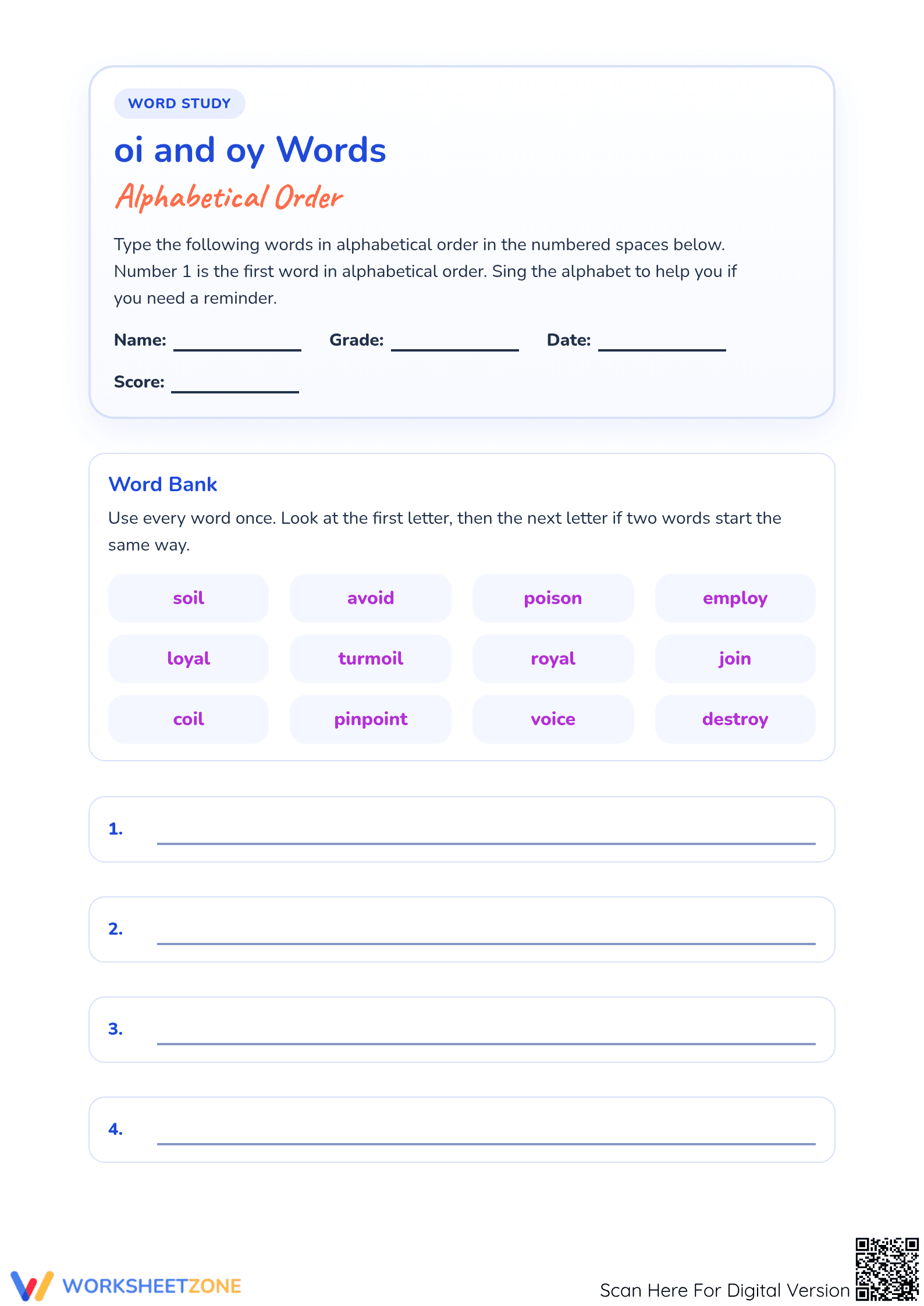
Sorting words in alphabetical order is a foundational literacy skill that reinforces both spelling recognition and dictionary readiness. This Grade 3 Word Study worksheet focuses on the "oi" and "oy" diphthongs, challenging students to organize twelve targeted vocabulary words. By the end of this activity, learners will demonstrate increased fluency in phonics-based spelling patterns and sequencing.
At a Glance
- Grade: 3 · Subject: English Language Arts (ELA)
- Standard:
CCSS.ELA-LITERACY.L.3.2— Demonstrate command of the conventions of standard English spelling and alphabetizing- Skill Focus: Phonics (oi/oy) & Alphabetical Order
- Format: 1 page · 12 problems · Answer key included · PDF
- Best For: Literacy centers and morning work practice
- Time: 10–15 minutes
This single-page PDF contains a curated list of twelve words featuring the "oi" and "oy" spelling patterns, including "soil," "avoid," "royal," and "destroy." Students are provided with a structured numbered chart to rewrite the words in correct alphabetical sequence. The clear, uncluttered layout ensures that students can focus entirely on the linguistic task without visual distractions. A comprehensive answer key is included to facilitate quick teacher review or student self-correction.
Skill Progression
- Guided Recognition: Students identify and vocalize the "oi" and "oy" vowel teams within the provided word bank.
- Supported Practice: Learners compare the second and third letters of words sharing the same initial character to determine sequence.
- Independent Mastery: Students independently transfer all twelve sorted words into the numbered chart with correct spelling.
This gradual-release approach builds the confidence necessary for more complex dictionary and reference work using the I Do, We Do, You Do model.
Standards Alignment
This activity is aligned with CCSS.ELA-LITERACY.L.3.2, which requires students to demonstrate command of the conventions of standard English capitalization, punctuation, and spelling. Specifically, it supports the ability to recognize and use spelling patterns and generalizations. By requiring students to sort words with similar vowel teams, the worksheet forces closer attention to letter-by-letter composition. Both standard codes can be copied directly into lesson plans, IEP goals, or district curriculum mapping tools.
How to Use It
Educators can utilize this resource as an excellent warm-up activity during a dedicated phonics block or as a formative assessment after introducing diphthong rules. During the activity, observe if students are whispering the alphabet or using a reference chart; this provides an immediate formative observation tip regarding their level of automaticity with alphabetical sequencing. Most students will complete the task within 12 minutes.
Who It's For
This worksheet is designed for third-grade students but is also appropriate for Grade 2 learners needing a challenge or older students requiring targeted spelling intervention. For students who need more support, pair this worksheet with a visual alphabet strip. It also pairs naturally with a reading passage that features these specific vowel teams, allowing students to see the vocabulary used in a broader narrative context.
According to the RAND AIRS 2024 report on literacy instruction, explicit practice with word-internal spelling patterns significantly improves overall reading fluency and decoding speed. By isolating the "oi" and "oy" diphthongs within an alphabetizing task, this worksheet requires students to process words beyond their initial graphemes, reinforcing orthographic mapping. This dual-task demand aligns with the Fisher & Frey (2014) framework for purposeful independent practice. Research suggests that short, focused bursts of spelling practice are more effective for long-term retention than isolated memorization. The structured nature of this resource allows for immediate feedback, which is critical for correcting phonological misconceptions. As students master the L.3.2 standard, they build the cognitive architecture required for advanced dictionary navigation and vocabulary acquisition. This self-contained summary provides the essential context for why alphabetical order remains a vital component of the elementary ELA curriculum.


