




























Views
Downloads
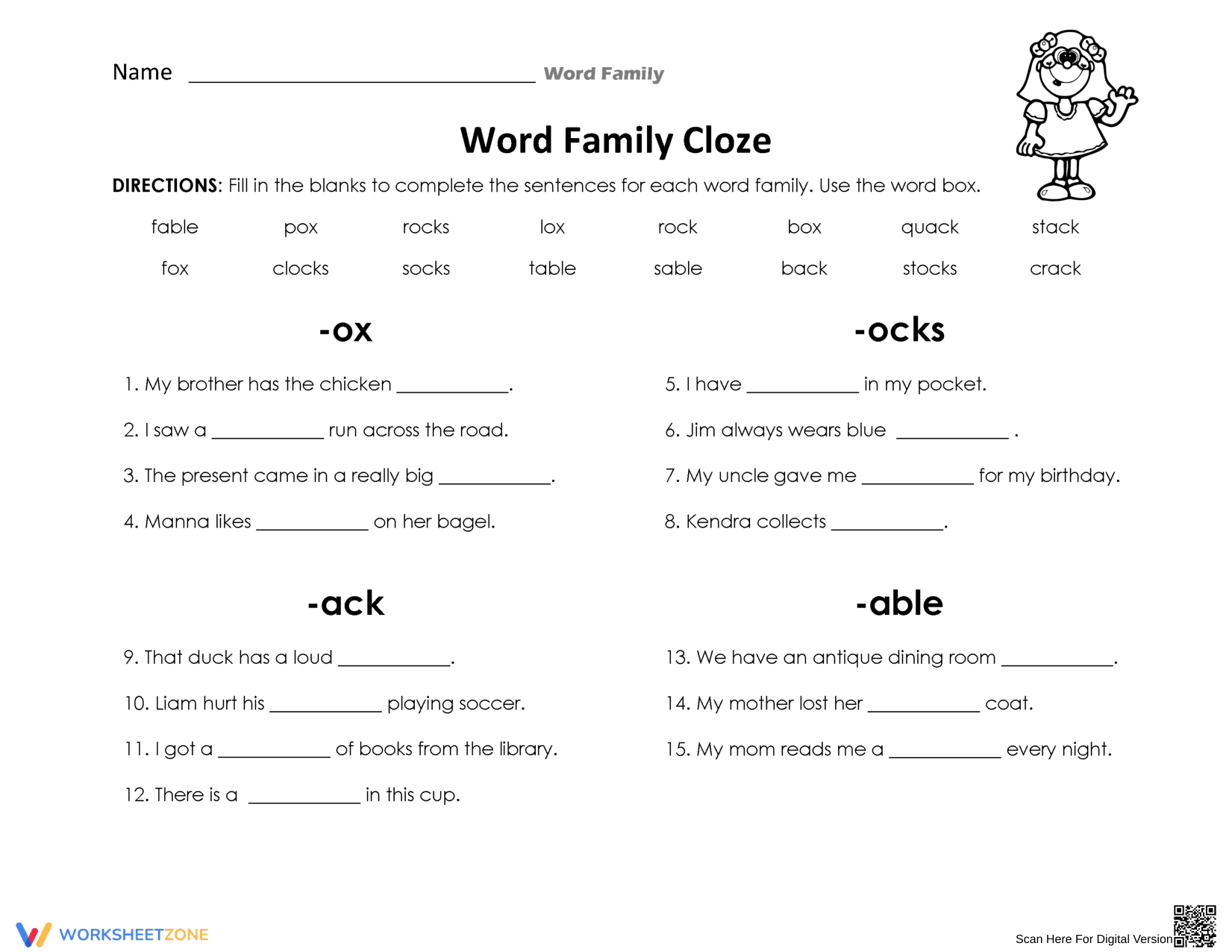

Word Family Cloze Worksheet | Essential Grade 1-2 Phonics

Paste this activity's link or code into your existing LMS (Google Classroom, Canvas, Teams, Schoology, Moodle, etc.).
Students can open and work on the activity right away, with no student login required.
You'll still be able to track student progress and results from your teacher account.
This Word Family Cloze worksheet provides Grade 1 and Grade 2 students with targeted practice in identifying and applying common phonetic patterns. By completing sentences with words from specific word families, learners strengthen their decoding skills and expand their reading vocabulary. This resource focuses on building fluency through contextual application rather than isolated memorization.
At a Glance
- Grade: 1-2 · Subject: English Language Arts
- Standard:
RF.1.3— Decode words using knowledge of common spelling-sound correspondences and word patterns- Skill Focus: Phonics & Word Families
- Format: 1 page · 15 problems · Answer key included · PDF
- Best For: Independent literacy centers or phonics review
- Time: 15–20 minutes
This printable contains 15 cloze sentences organized into four distinct word family categories: -ox, -ocks, -ack, and -able. A clear vocabulary word bank at the top provides 16 options, ensuring students have the necessary support to find the correct fit for each sentence. The one-page layout is designed for clarity, featuring ample whitespace and large text to support early readers.
Skill Progression
- Guided Practice: The worksheet begins with the -ox and -ocks families, providing 8 tasks that require students to distinguish between similar ending patterns.
- Supported Practice: The -ack and -able sections offer 7 additional sentences, moving toward more varied ending sounds and multi-syllabic words.
- Independent Practice: Students select the most appropriate word for each context, demonstrating their ability to synthesize phonetic knowledge with sentence meaning.
This structured approach follows the gradual release of responsibility model, moving students from basic pattern recognition to independent application in a sentence-level context.
Standards Alignment
This resource is directly aligned to CCSS.ELA-LITERACY.RF.1.3, which requires students to know and apply grade-level phonics and word analysis skills in decoding words. By focusing on specific word families, it also supports CCSS.ELA-LITERACY.L.1.2.E, which focuses on identifying common spelling patterns. Both standard codes can be copied directly into lesson plans, IEP goals, or district curriculum mapping tools.
How to Use It
Use this worksheet as a formative assessment after introducing the four featured word families. For best results, have students read the completed sentences aloud to a partner to verify that the chosen word makes sense in context. Teachers should observe whether students are using the word bank strategically or relying on initial sounds to guess the word. The activity typically takes 15 to 20 minutes to complete.
Who It's For
This worksheet is designed for first and second-grade students who are developing their foundational reading skills. It is particularly effective for English Language Learners (ELLs) who benefit from seeing words used in complete sentences rather than in isolation. It pairs naturally with a rhyming word anchor chart or a short decodable passage that features the -ack and -able families.
Research by Fisher & Frey (2014) indicates that cloze procedures effectively develop syntactic and semantic awareness in early readers. This Grade 1-2 worksheet utilizes this format to target the RF.1.3 standard, focusing on word family recognition and application. By requiring students to select the correct phonetic pattern (-ox, -ocks, -ack, -able) to complete a sentence, the resource bridges the gap between isolated phonics drills and authentic reading comprehension. This contextualized practice ensures students are not just memorizing sounds but understanding how those sounds contribute to meaning. The 15 distinct tasks provide sufficient repetition to solidify these foundational spelling-sound correspondences. This systematic approach to phonics instruction is a cornerstone of evidence-based literacy programs, providing the necessary scaffolding for students to become fluent, independent decoders.


