


























Views
Downloads

Alphabetical Order Practice | Essential Grade 2-3 ELA
Paste this activity's link or code into your existing LMS (Google Classroom, Canvas, Teams, Schoology, Moodle, etc.).
Students can open and work on the activity right away, with no student login required.
You'll still be able to track student progress and results from your teacher account.
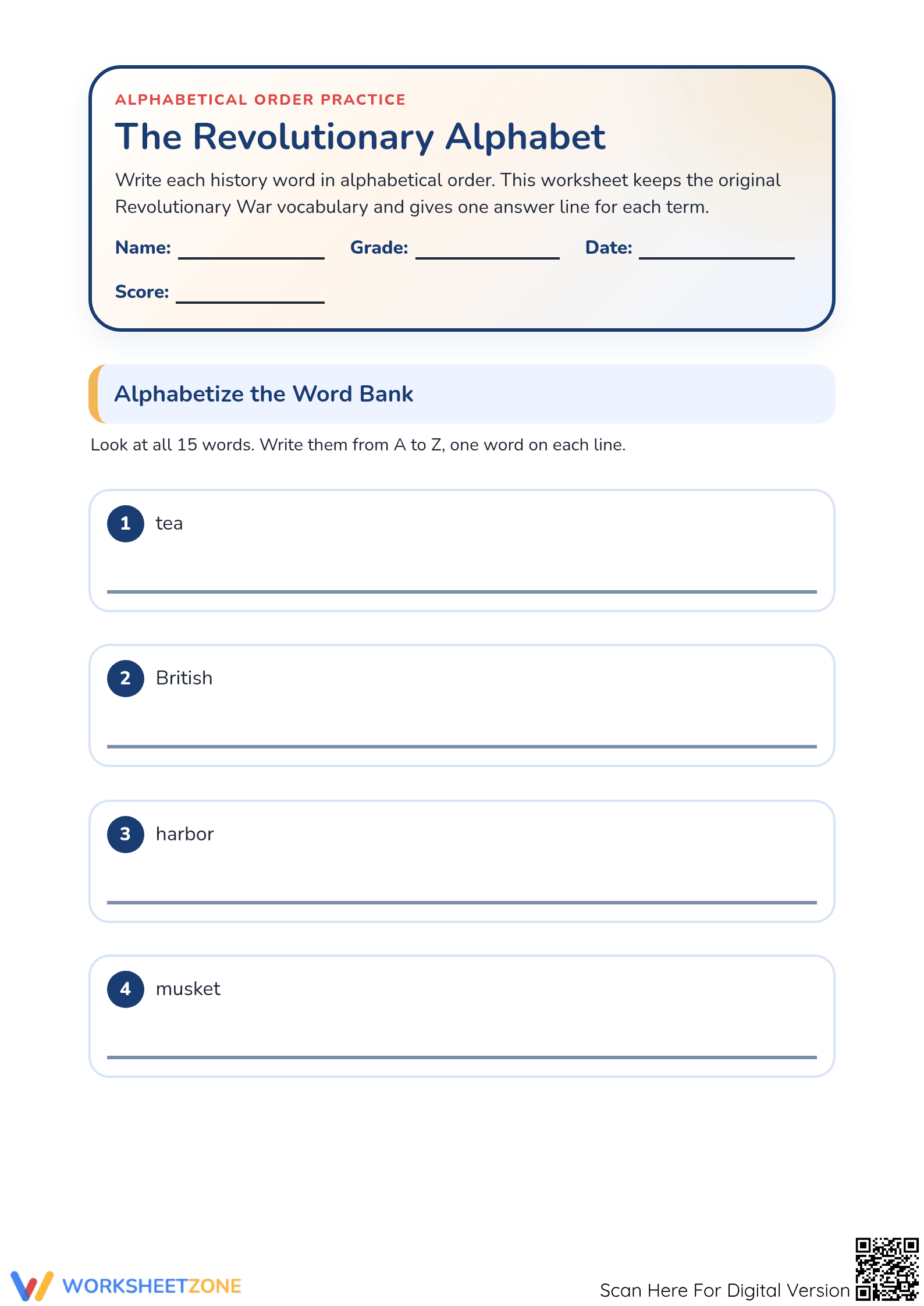
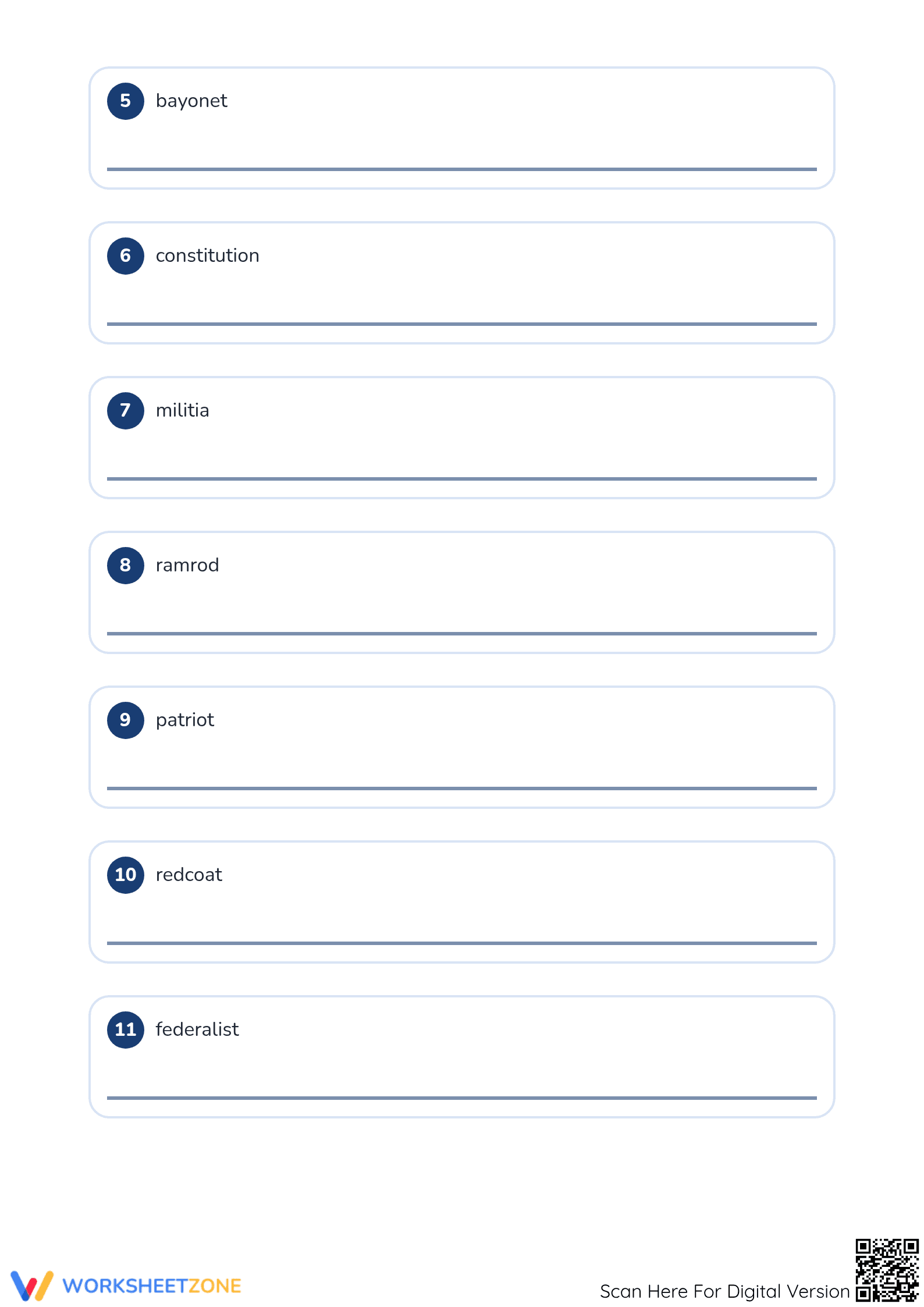
This Grade 2-3 alphabetical order worksheet helps students master dictionary skills by organizing 15 historical terms from the American Revolution. By sorting words like militia and constitution, learners strengthen their understanding of letter sequencing and vocabulary. This resource ensures students can efficiently locate information in reference materials while building content-area knowledge.
At a Glance
- Grade: 2-3 · Subject: ELA & Vocabulary
- Standard:
CCSS.ELA-LITERACY.L.2.2.E— Use alphabetical order to consult reference materials and check spellings- Skill Focus: Alphabetizing to the second and third letter
- Format: 3 pages · 15 problems · Answer key included · PDF
- Best For: Independent practice or social studies integration
- Time: 15–20 minutes
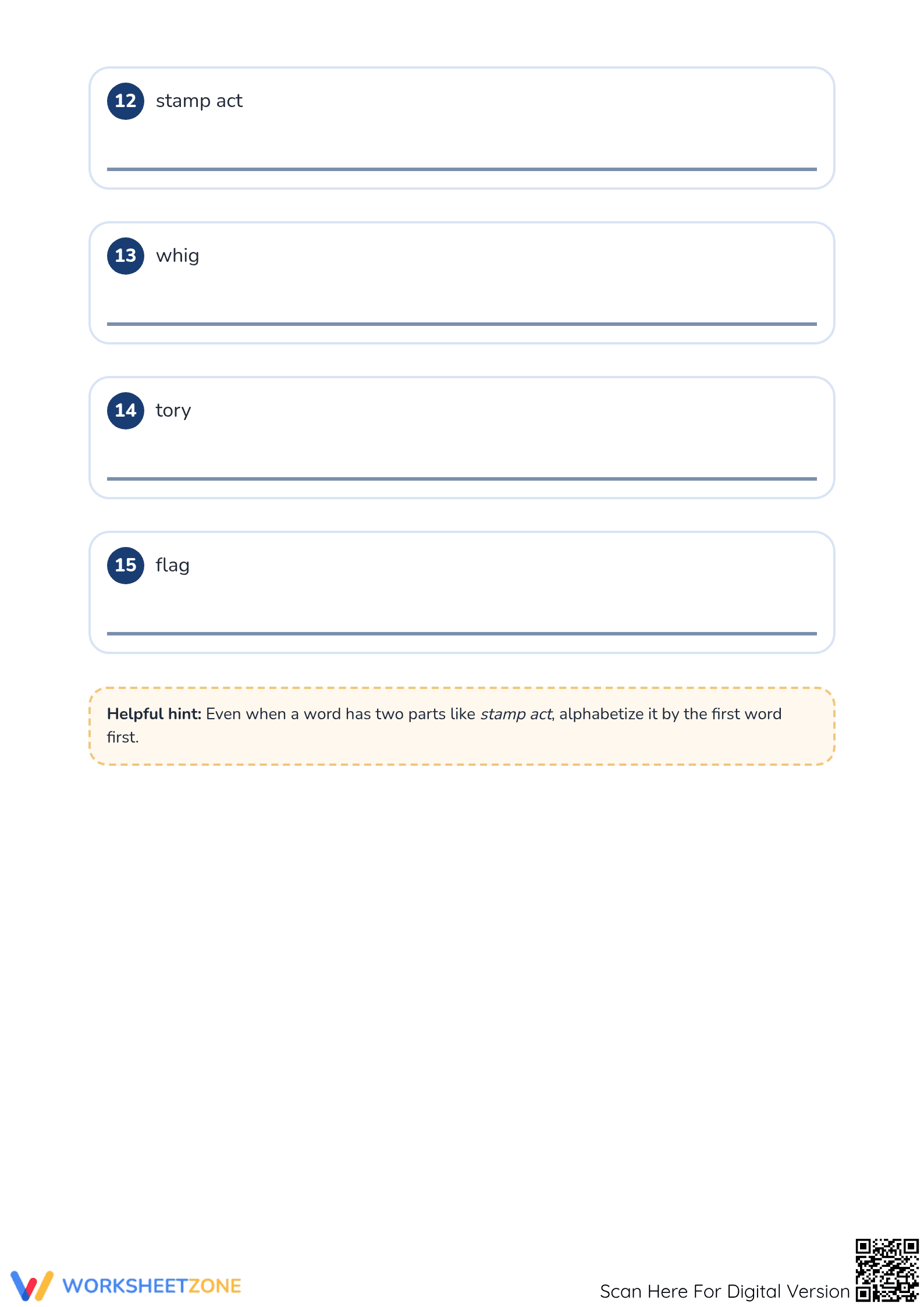
Inside this 3-page PDF, you will find a structured Revolutionary Alphabet activity featuring 15 specific vocabulary terms. Each page provides ample writing space for students to rewrite words in their correct A-to-Z sequence. A helpful hint box is included to guide students through multi-word terms like stamp act, and a full answer key is provided for rapid grading and immediate feedback.
The zero-prep design allows for an immediate classroom workflow. First, print the three-page set in under 30 seconds. Second, distribute the worksheets as a warm-up, center activity, or morning work task. Finally, use the included answer key for a quick whole-class review or peer-grading session. This resource is an ideal solution for emergency sub plans or unexpected schedule gaps where meaningful ELA practice is required.
This resource aligns with CCSS.ELA-LITERACY.L.2.2.E, which requires students to consult reference materials, including beginning dictionaries, as needed to check and correct spellings. By practicing alphabetical order, students develop the foundational mechanics required for advanced research and organizational tasks. Both standard codes can be copied directly into lesson plans, IEP goals, or district curriculum mapping tools.
Use this worksheet during a literacy block after introducing the concept of the second-letter rule in alphabetizing. It also serves as an excellent formative assessment; observe if students struggle with words starting with the same letter, such as British and bayonet. Expect completion within 15 to 20 minutes depending on student familiarity with the historical terms and their current proficiency with sequencing.
This activity is designed for second and third-grade students who are transitioning from basic letter recognition to complex sorting. It is particularly effective for English Language Learners who benefit from seeing vocabulary in a structured, numbered list. Pair this with a Revolutionary War anchor chart or a primary source reading passage for a cross-curricular experience that reinforces both history and language arts.
According to the RAND AIRS 2024 report on foundational literacy, the ability to organize information alphabetically is a critical precursor to effective information retrieval and digital literacy. This worksheet targets CCSS.ELA-LITERACY.L.2.2.E by requiring students to apply sequencing logic to a set of 15 content-specific words. Research indicates that when students engage with alphabetical order within a thematic context—such as the American Revolution—they retain vocabulary at a higher rate than through isolated word lists. By practicing the mechanics of sorting to the second and third letter, learners build the cognitive pathways necessary for using dictionaries, indexes, and online databases. This resource provides the structured repetition needed for mastery while integrating social studies terminology, ensuring that the skill is both practiced and applied. It is a high-utility tool for any Grade 2 or Grade 3 ELA curriculum focusing on mechanics and reference skills.


