


























Views
Downloads
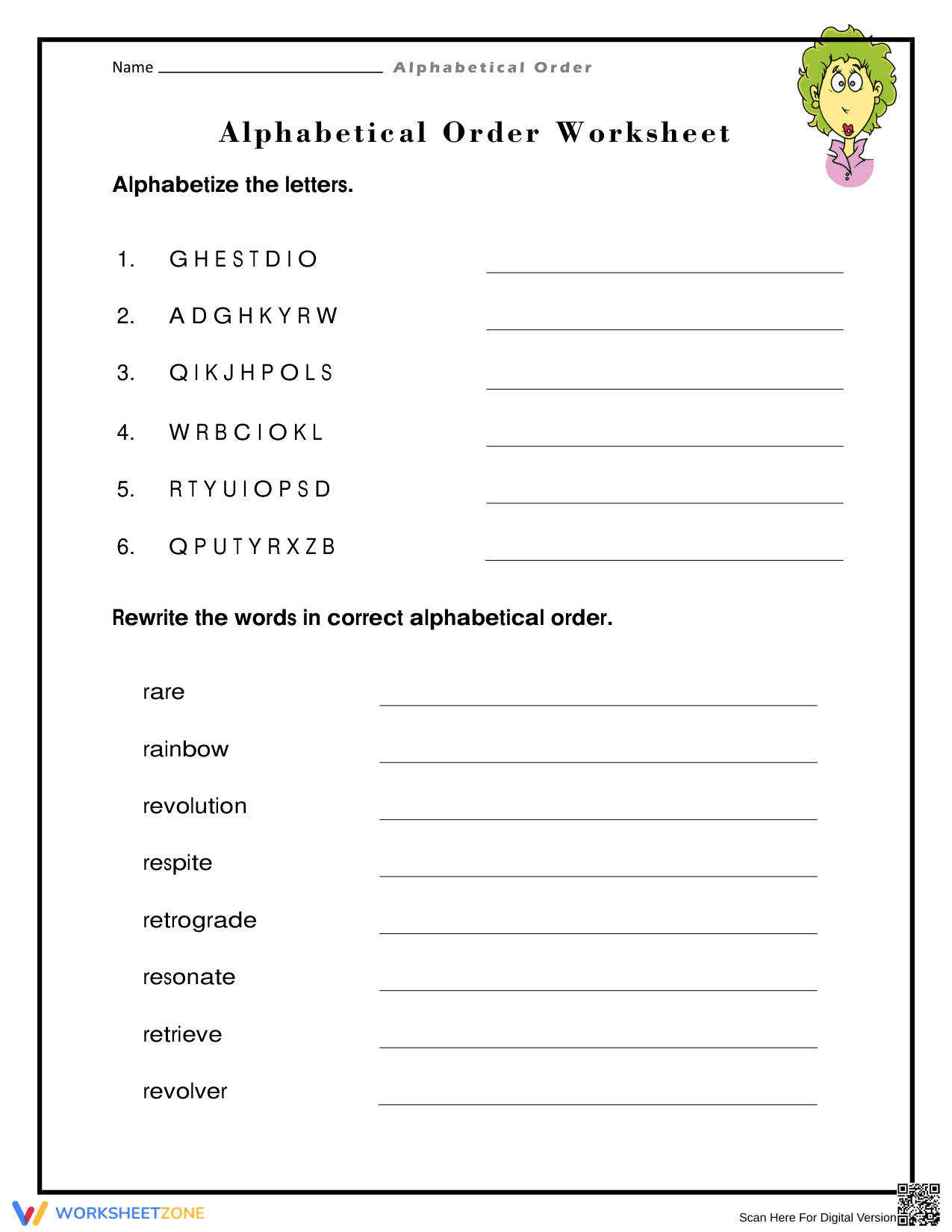

Alphabetical Order Worksheet | Grade 2 Essential
Paste this activity's link or code into your existing LMS (Google Classroom, Canvas, Teams, Schoology, Moodle, etc.).
Students can open and work on the activity right away, with no student login required.
You'll still be able to track student progress and results from your teacher account.
This comprehensive alphabetical order worksheet provides students with targeted practice in organizing both individual letters and complex word sets. By bridging the gap between basic letter recognition and advanced dictionary skills, it ensures learners can efficiently navigate text and reference materials. Students will master the sequencing logic required for academic success in literacy and language arts.
At a Glance
- Grade: 2 · Subject: English Language Arts
- Standard:
CCSS.ELA-LITERACY.L.2.2— Organize words into alphabetical order using first, second, and third letters accurately.- Skill Focus: Alphabetical Sequencing & Logic
- Format: 1 page · 14 problems · Answer key included · PDF
- Best For: Independent practice or literacy center activity
- Time: 15–20 minutes
Inside this single-page PDF are 14 tasks specifically designed for Grade 2 and 3 students. The first section contains six letter-alphabetizing exercises that reinforce basic sequence knowledge and pattern recognition. The second half of the worksheet features eight challenging vocabulary words—including "respite" and "retrograde"—that require students to analyze the second and third letters to determine the correct alphabetical placement.
Implementing this resource is effortless and efficient for any classroom setting. First, print the single-page worksheet for your class in less than thirty seconds. Next, distribute the sheets during your literacy block as a transition or independent activity. Finally, use the provided answer key to review the results in under two minutes, providing students with immediate feedback on their sequencing accuracy and logic.
Aligned primarily to CCSS.ELA-LITERACY.L.2.2, this resource requires students to demonstrate command of standard English conventions. Specifically, it supports the prerequisite skills for L.2.2.E, which involves using glossaries and beginning dictionaries to determine word meanings. Both standard codes can be copied directly into lesson plans, IEP goals, or district curriculum mapping tools to ensure documentation accuracy.
Assign this worksheet as a "bell-ringer" activity to settle the class at the start of an ELA lesson, or use it as a formative assessment after teaching dictionary skills. While students work, observe if they are writing the alphabet at the top of their page as a scaffold; this observation provides a quick insight into their level of automaticity with the ABC sequence. Expect completion in about 15 minutes.
This worksheet is ideal for 2nd and 3rd-grade students who are moving beyond simple first-letter alphabetizing. It provides excellent differentiation for advanced 1st graders or as a review for older students struggling with text organization. Pair this resource with a physical dictionary hunt or a classroom word wall activity to reinforce the practical application of alphabetical order in real-world reading scenarios.
According to the RAND AIRS 2024 study on literacy foundations, the ability to rapidly organize and retrieve information based on alphabetical sequence is a strong predictor of late-elementary reading fluency and overall academic performance. This Grade 2 Alphabetical Order worksheet addresses this foundational need by providing 14 high-quality tasks that transition students from simple letter strings to increasingly complex vocabulary words. Research from Fisher & Frey (2014) emphasizes that a "gradual release of responsibility" is most effective when students move from recognized patterns to complex word-sorting tasks, an instructional structure mirrored in this classroom-ready PDF. By mastering standard CCSS.ELA-LITERACY.L.2.2 through these structured exercises, students build the cognitive scaffolds necessary for efficient dictionary usage and advanced text navigation. This zero-prep resource offers the essential practice required to cement these skills, ensuring that every learner achieves total mastery in word organization and standard English conventions within a single instructional block.


