


























Views
Downloads
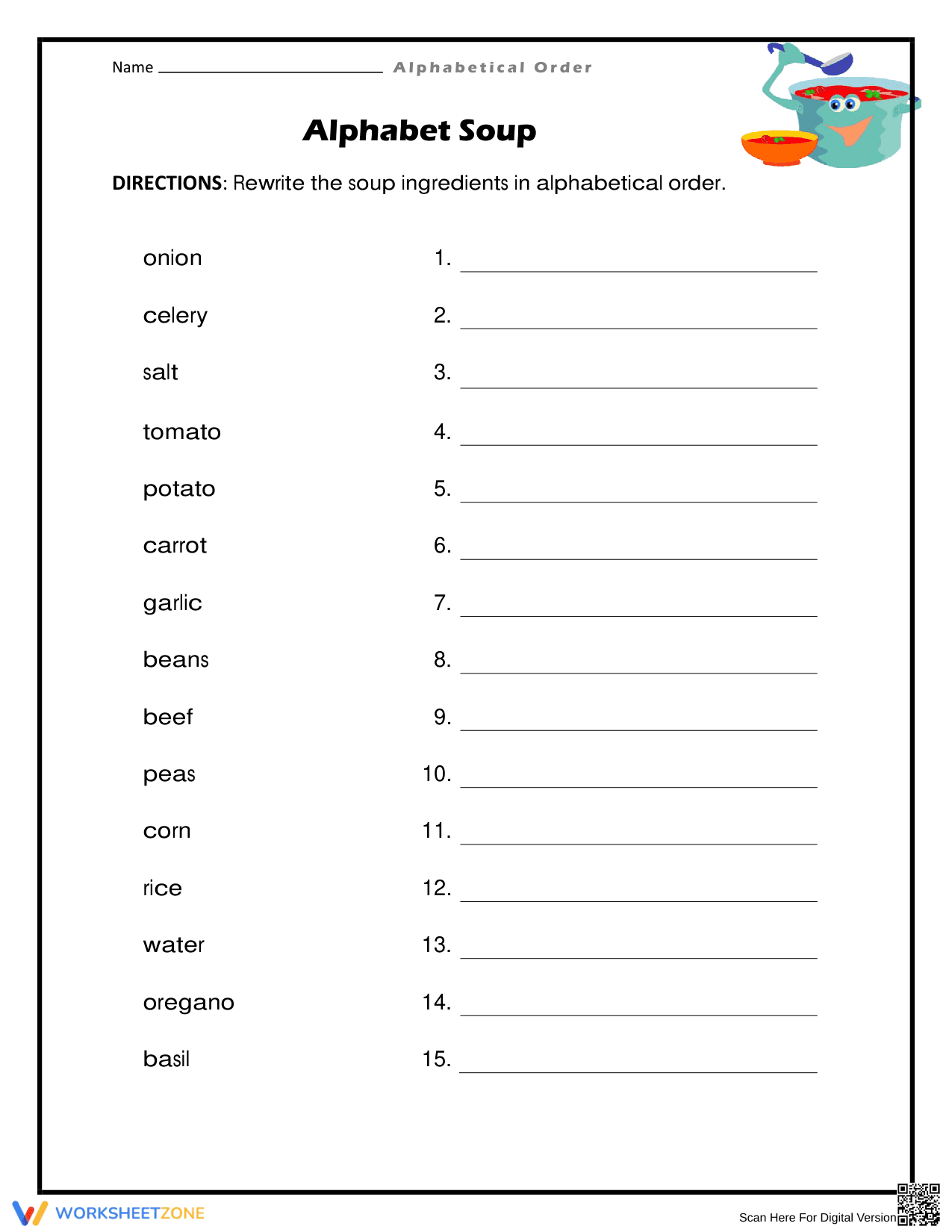

Alphabetical Order Worksheet | Grade 2 Essential English
Paste this activity's link or code into your existing LMS (Google Classroom, Canvas, Teams, Schoology, Moodle, etc.).
Students can open and work on the activity right away, with no student login required.
You'll still be able to track student progress and results from your teacher account.
Mastering alphabetical order is a foundational skill that bridges the gap between basic literacy and independent research. This "Alphabet Soup" worksheet provides students with a fun, culinary-themed context to practice organizing vocabulary words by their first and second letters. By reordering fifteen unique ingredients, learners strengthen their dictionary navigation skills and overall word recognition.
At a Glance
- Grade: 2 · Subject: English Language Arts
- Standard:
CCSS.ELA-LITERACY.L.2.2— Order words alphabetically to navigate reference materials and check spellings- Skill Focus: Alphabetical Order
- Format: 1 page · 15 problems · Answer key included · PDF
- Best For: Independent practice or literacy center activity
- Time: 15–20 minutes
What's Inside
This single-page resource features a clear, thematic layout designed for immediate student engagement. It contains fifteen common food items—such as onion, celery, and basil—listed alongside numbered lines for reordering. The worksheet includes a word list for reference, designated spaces for student names, and a visual soup pot illustration to maintain interest. A complete answer key is provided for quick grading.
Zero-Prep Workflow
The zero-prep workflow for this worksheet ensures it can be integrated into a lesson in under two minutes. First, print the required number of copies for your class or small group. Second, distribute the sheets to students as they arrive or during a literacy block transition. Finally, review the answers together or have students self-correct using the provided key. This makes it an ideal emergency sub plan or "fast-finisher" task.
Standards Alignment
This activity is primarily aligned with CCSS.ELA-LITERACY.L.2.2, which requires students to demonstrate command of the conventions of standard English capitalization, punctuation, and spelling. Specifically, it supports the sub-skill of using alphabetical order to navigate reference materials like dictionaries. This standard code can be copied directly into lesson plans, IEP goals, or district curriculum mapping tools.
How to Use It
Use this worksheet as a formative assessment after a mini-lesson on dictionary skills. As students work, observe if they correctly identify words starting with the same letter (like beef and beans) and look to the second or third letter for correct placement. It also serves as an excellent warm-up activity to settle students into a focused literacy mindset at the start of the day.
Who It's For
This resource is designed for students in grades 1 through 3, with the primary focus on second-grade proficiency. It is particularly beneficial for English Language Learners who are building their food-related vocabulary. Pair this worksheet with a physical dictionary scavenger hunt or an anchor chart displaying the alphabet to provide additional support for struggling learners.
Educational research, such as the RAND AIRS 2024 report, underscores the importance of automating foundational literacy skills like alphabetical order to reduce cognitive load during more complex reading and writing tasks. By mastering the sequence of letters within a thematic context, students develop the mechanical fluency required for efficient information retrieval in later grades. The CCSS.ELA-LITERACY.L.2.2 standard emphasizes that consistent practice with word organization leads to greater accuracy in spelling and reference material usage. This worksheet provides fifteen structured opportunities for students to organize vocabulary, a process that Fisher & Frey (2014) identify as essential for building academic word consciousness. Implementing this print-and-go resource allows teachers to provide high-quality, standards-aligned practice without adding to their daily preparation burden. It is a reliable tool for classroom teachers, tutors, and homeschooling parents looking to reinforce core ELA mechanics through engaging, scaffolded exercises.


