


























Views
Downloads

Alphabetical Order Worksheet | Grade 2 Essential Practice
Paste this activity's link or code into your existing LMS (Google Classroom, Canvas, Teams, Schoology, Moodle, etc.).
Students can open and work on the activity right away, with no student login required.
You'll still be able to track student progress and results from your teacher account.
This Grade 2 alphabetical order worksheet provides students with comprehensive practice in organizing words by their initial letters. By categorizing vocabulary into segments of the alphabet, learners develop the foundational dictionary skills necessary for independent research and literacy. This resource ensures students can confidently sequence words from A to Z through structured, repetitive practice.
At a Glance
- Grade: 2 · Subject: English Language Arts
- Standard:
CCSS.ELA-LITERACY.L.2.2.E— Use alphabetizing to consult reference materials and check spellings- Skill Focus: Alphabetical Order (A-Z)
- Format: 3 pages · 34 problems · Answer key included · PDF
- Best For: Independent practice and morning work
- Time: 20–30 minutes
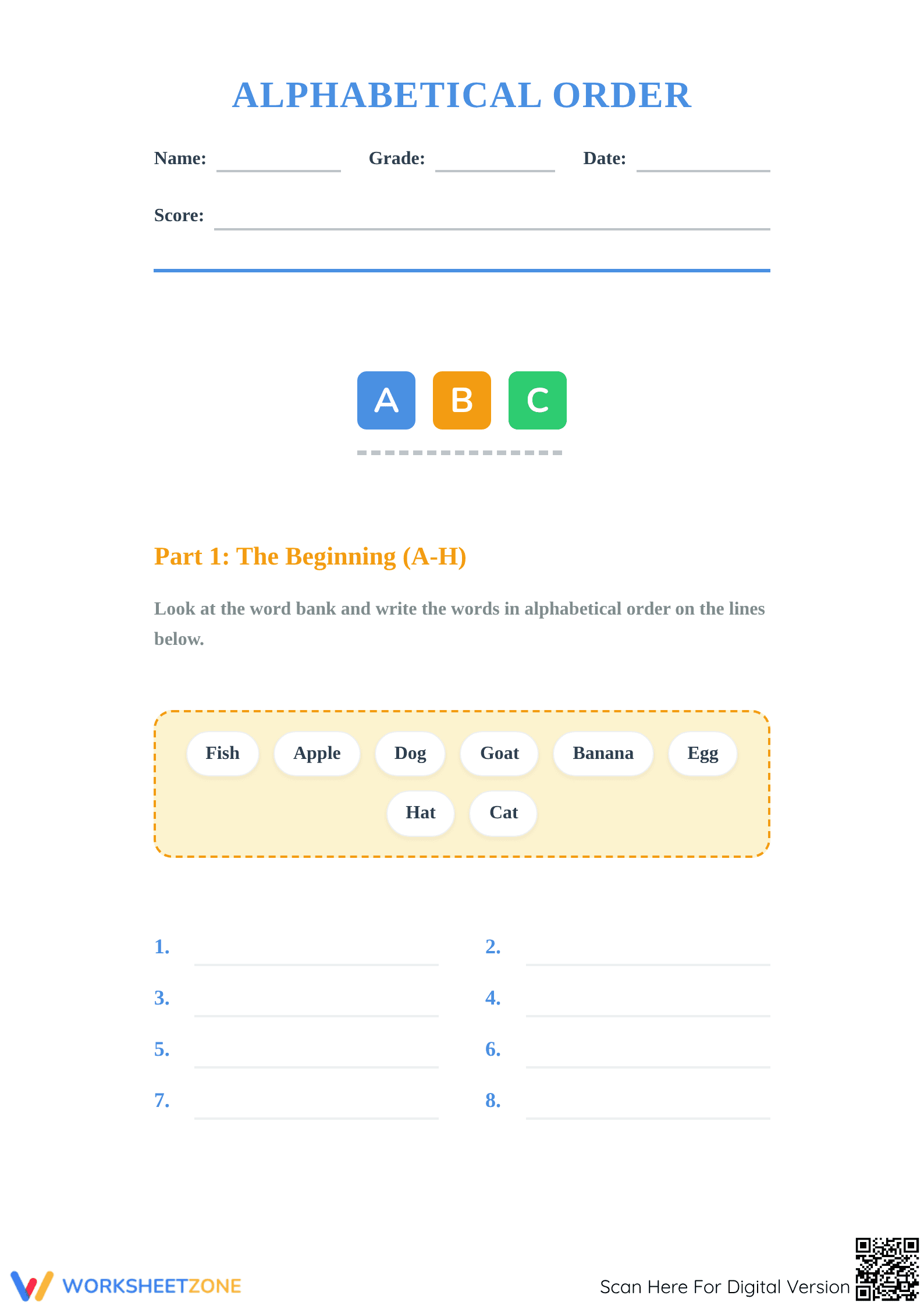
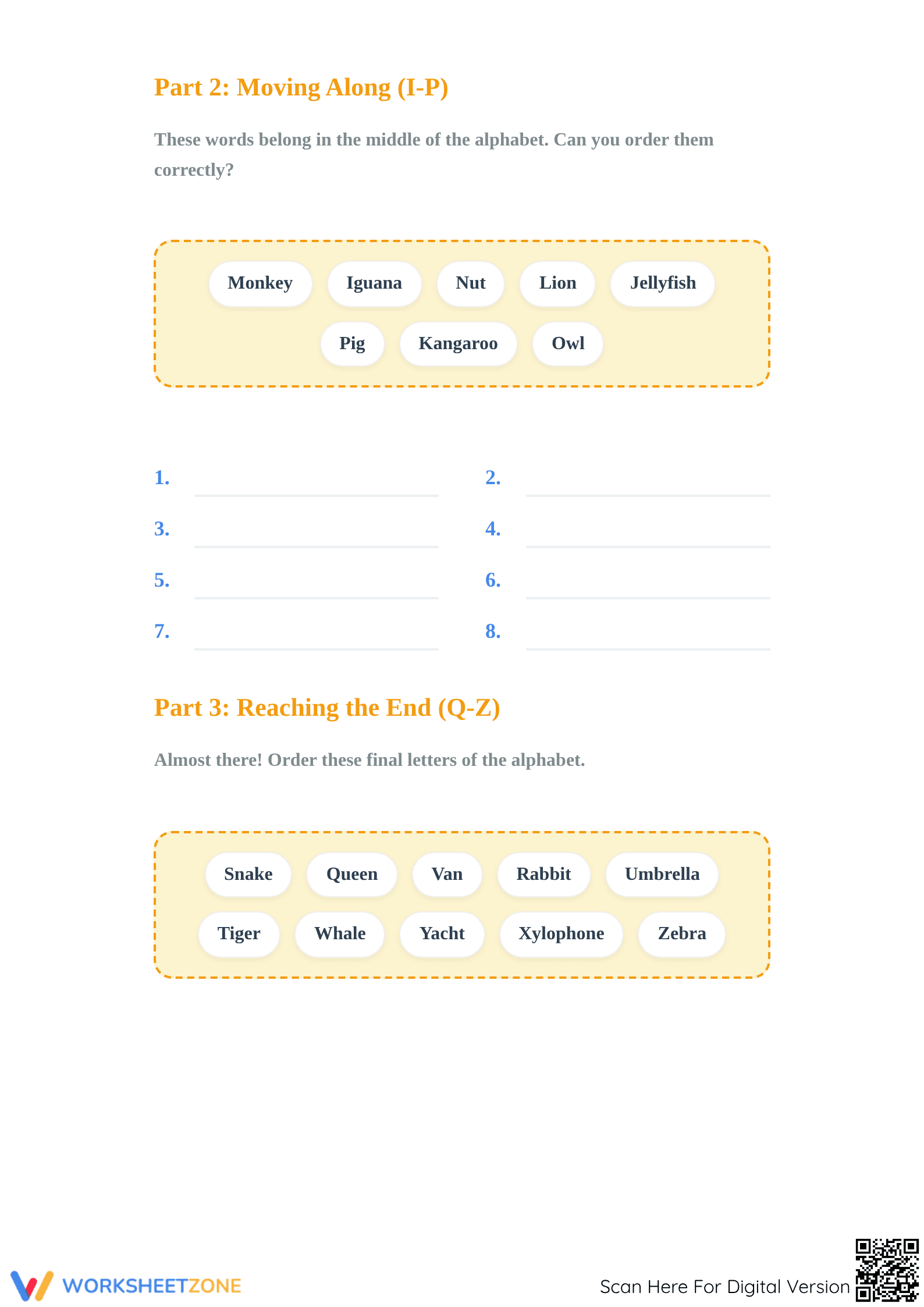
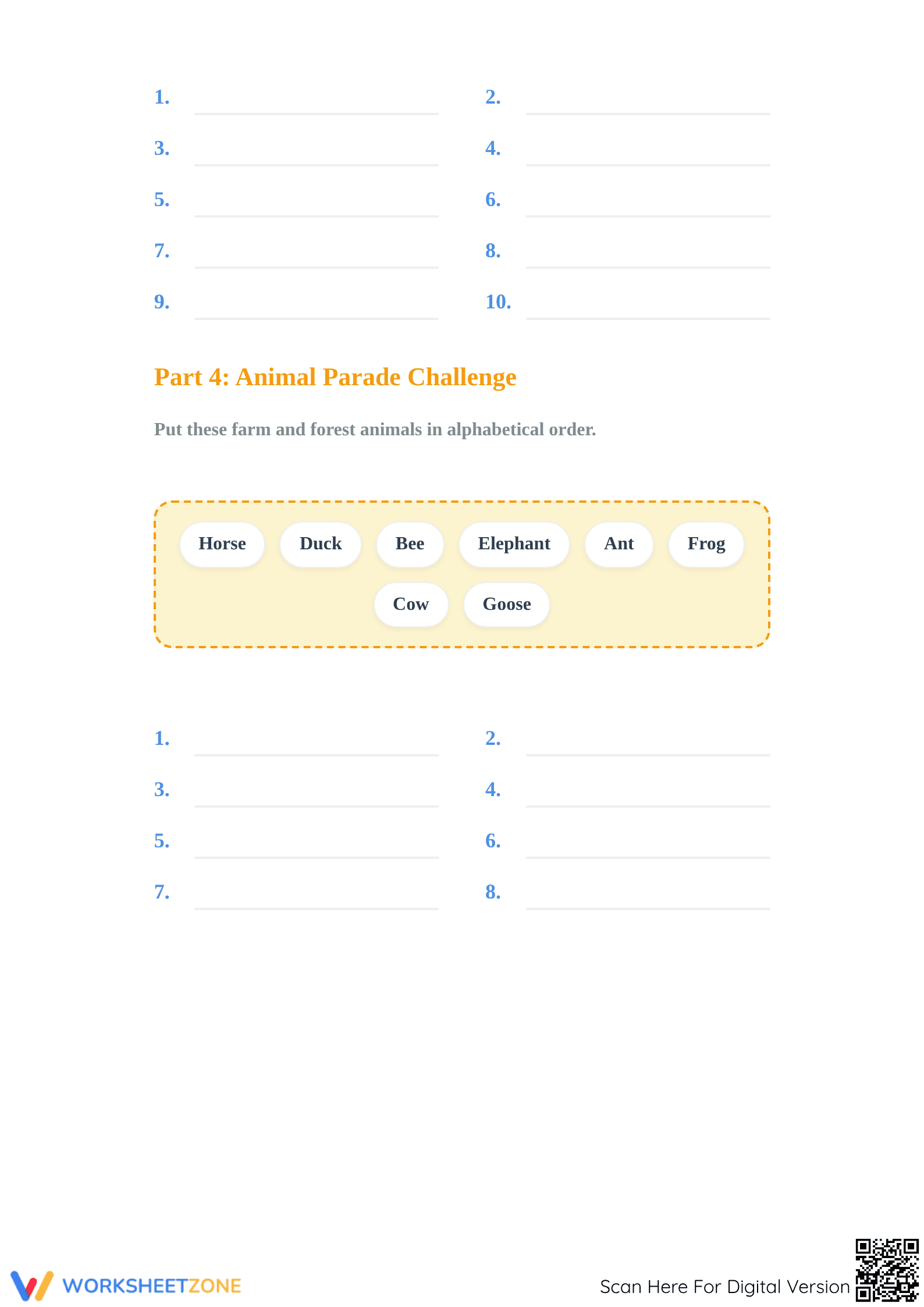
What's Inside: This 3-page PDF contains four distinct sections designed to build mastery. Part 1 focuses on the beginning of the alphabet (A-H), Part 2 covers the middle (I-P), and Part 3 addresses the end (Q-Z). The final section, the Animal Parade Challenge, integrates various animal names to test cumulative knowledge. Each page features clear word banks and numbered lines, with a full answer key provided for rapid grading.
Zero-Prep Workflow
Teachers can implement this resource in under two minutes. First, print the three-page set for each student (30 seconds). Second, distribute the worksheets during your grammar block or as a transition activity (30 seconds). Third, use the included answer keys to review student work or allow for self-correction at a dedicated checking station (1 minute). This streamlined process makes it an ideal choice for substitute folders or unexpected schedule changes.
Standards Alignment
The primary focus is `CCSS.ELA-LITERACY.L.2.2.E`, which requires students to consult reference materials, including beginning dictionaries, as needed to check and correct spellings. By mastering the sequence of the alphabet, students prepare for more complex tasks like using a glossary or index. Both standard codes can be copied directly into lesson plans, IEP goals, or district curriculum mapping tools.
How to Use It
Use this worksheet as a summative assessment after introducing the alphabet song and letter sequencing. It works effectively during small-group rotations where the teacher can observe if a student struggles with specific letter transitions, such as the "L-M-N" sequence. Expect students to complete the full set in approximately 25 minutes, though it can be broken into individual pages for shorter sessions.
Who It's For
This resource is designed for second-grade students but serves as excellent enrichment for first graders or remedial support for third graders. It is particularly helpful for English Language Learners (ELLs) who need to reinforce the English alphabet's structure. Pair this worksheet with a classroom word wall or a physical primary dictionary to bridge the gap between paper practice and real-world application.
According to the RAND AIRS 2024 report, systematic practice in foundational literacy skills like alphabetizing is a significant predictor of later reading fluency and information retrieval efficiency. This worksheet addresses `CCSS.ELA-LITERACY.L.2.2.E` by providing 34 targeted opportunities for students to apply alphabetical sequencing to common nouns. Research from Fisher & Frey (2014) emphasizes that the gradual release of responsibility—moving from segmented alphabet practice to a cumulative challenge—supports long-term retention of organizational skills. By isolating the alphabet into manageable chunks (A-H, I-P, Q-Z), this resource reduces cognitive load for early learners while building the stamina required for complex vocabulary tasks. Educators can utilize this data-backed approach to ensure that 100% of their students meet the grade-level expectations for reference material usage and basic grammar mechanics.


