


























Views
Downloads
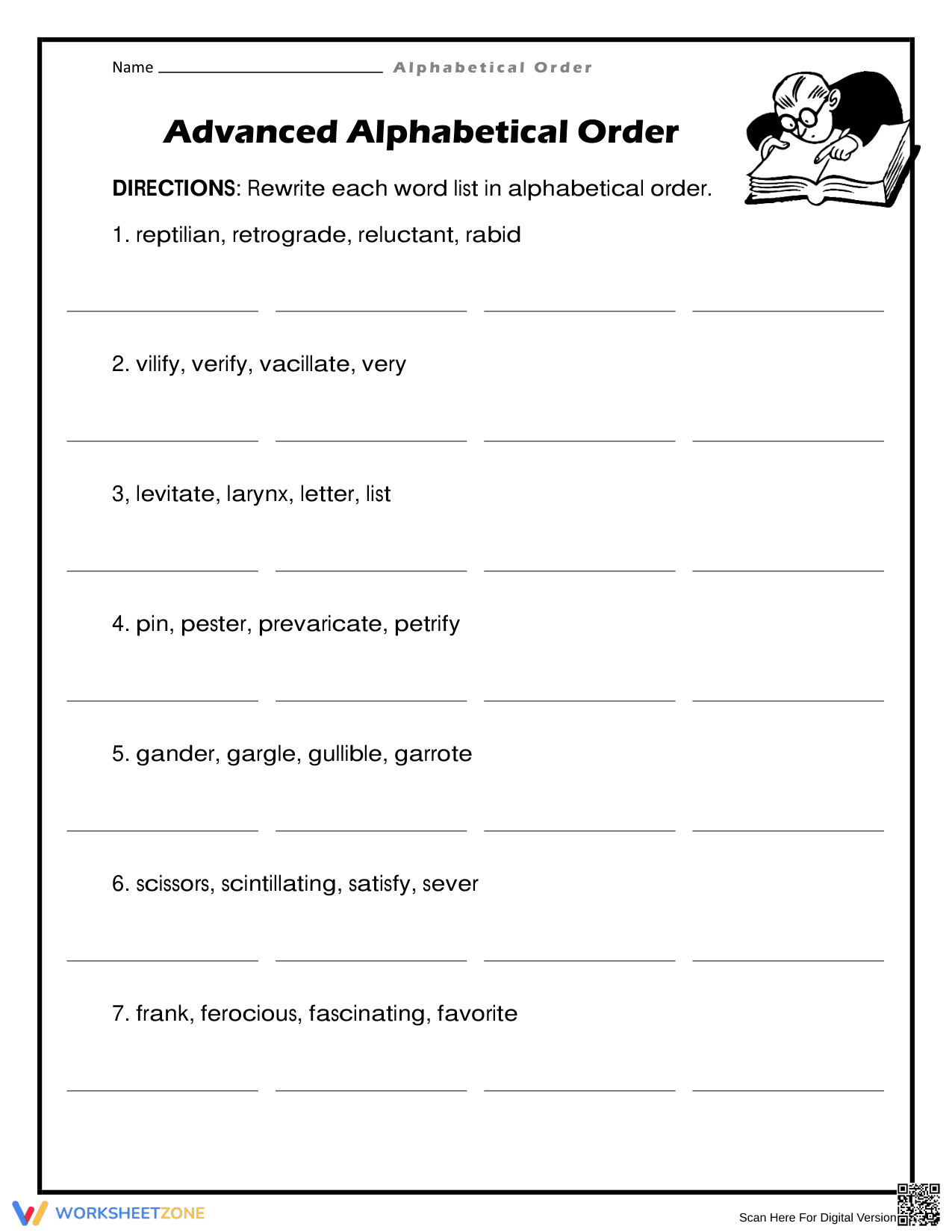

Advanced Alphabetical Order Worksheet | Essential Grade 3
Paste this activity's link or code into your existing LMS (Google Classroom, Canvas, Teams, Schoology, Moodle, etc.).
Students can open and work on the activity right away, with no student login required.
You'll still be able to track student progress and results from your teacher account.
This advanced alphabetical order worksheet challenges students to sort complex vocabulary words with high precision. By focusing on words with similar prefixes and starting letters, it builds the foundational dictionary skills necessary for independent reading and writing. Students will practice organizing 28 challenging terms to improve their cognitive processing and linguistic fluency.
At a Glance
- Grade: 3 · Subject: English Language Arts
- Standard:
CCSS.ELA-LITERACY.L.3.2.G— Consult reference materials to check and correct spellings and alphabetize words- Skill Focus: Advanced Alphabetical Sorting
- Format: 1 page · 7 tasks · Answer key included · PDF
- Best For: Vocabulary enrichment and dictionary skill practice
- Time: 15–20 minutes
This single-page PDF contains seven distinct word lists, each featuring four sophisticated vocabulary words. The worksheet is designed for minimal teacher preparation, providing clear directions and ample writing space for students to rewrite the lists in their correct alphabetical sequence. An answer key is included to facilitate quick grading or self-correction.
Skill Progression
- Guided practice: The first few lists introduce words with different second letters, allowing students to establish a sorting rhythm.
- Supported practice: Middle tasks include words with identical first two letters, requiring students to look to the third or fourth character.
- Independent practice: Final lists feature sophisticated vocabulary like 'scintillating' and 'prevaricate' to challenge high-flyers and expand their lexicon.
This structured approach follows the gradual release of responsibility model, ensuring students build confidence before tackling the most difficult sorting challenges.
Standards Alignment
This resource is aligned with CCSS.ELA-LITERACY.L.3.2.G, which requires students to consult reference materials, including beginning dictionaries, as needed to check and correct spellings. Proper alphabetization is the prerequisite skill for efficient dictionary navigation. Both standard codes can be copied directly into lesson plans, IEP goals, or district curriculum mapping tools.
How to Use It
Use this worksheet during a literacy center rotation or as a transition activity between direct instruction and independent reading. It also serves as an excellent formative assessment tool; observe if students struggle more with the third-letter sorting or if their vocabulary knowledge impacts their sorting speed. Completion typically takes 15 to 20 minutes.
Who It's For
This resource is ideal for third-grade students who have mastered basic ABC order and require more rigorous practice. It is particularly effective for gifted and talented students or as an enrichment activity for learners who finish their primary ELA assignments early. Pair this with a physical dictionary or a vocabulary anchor chart for maximum impact.
According to a RAND AIRS 2024 analysis of elementary literacy instructional materials, the automaticity of dictionary skills—rooted in robust alphabetical order proficiency—is a significant predictor of student success in independent research tasks. This Grade 3 worksheet targets the specific sub-skill of alphabetizing to the third and fourth letter, which CCSS.ELA-LITERACY.L.3.2.G identifies as critical for lexical development. By engaging with 28 advanced vocabulary terms across 7 structured tasks, students bridge the gap between simple letter recognition and complex linguistic organization. Research by Fisher & Frey (2014) emphasizes that such focused vocabulary practice is most effective when students are required to manipulate words directly, as seen in this sorting activity. This resource provides the necessary scaffolding to ensure that learners transition from basic literacy to the advanced stages of language arts mastery required by modern educational standards.


