


























Views
Downloads


Character Traits Worksheet | Printable Grade 4 ELA
Paste this activity's link or code into your existing LMS (Google Classroom, Canvas, Teams, Schoology, Moodle, etc.).
Students can open and work on the activity right away, with no student login required.
You'll still be able to track student progress and results from your teacher account.
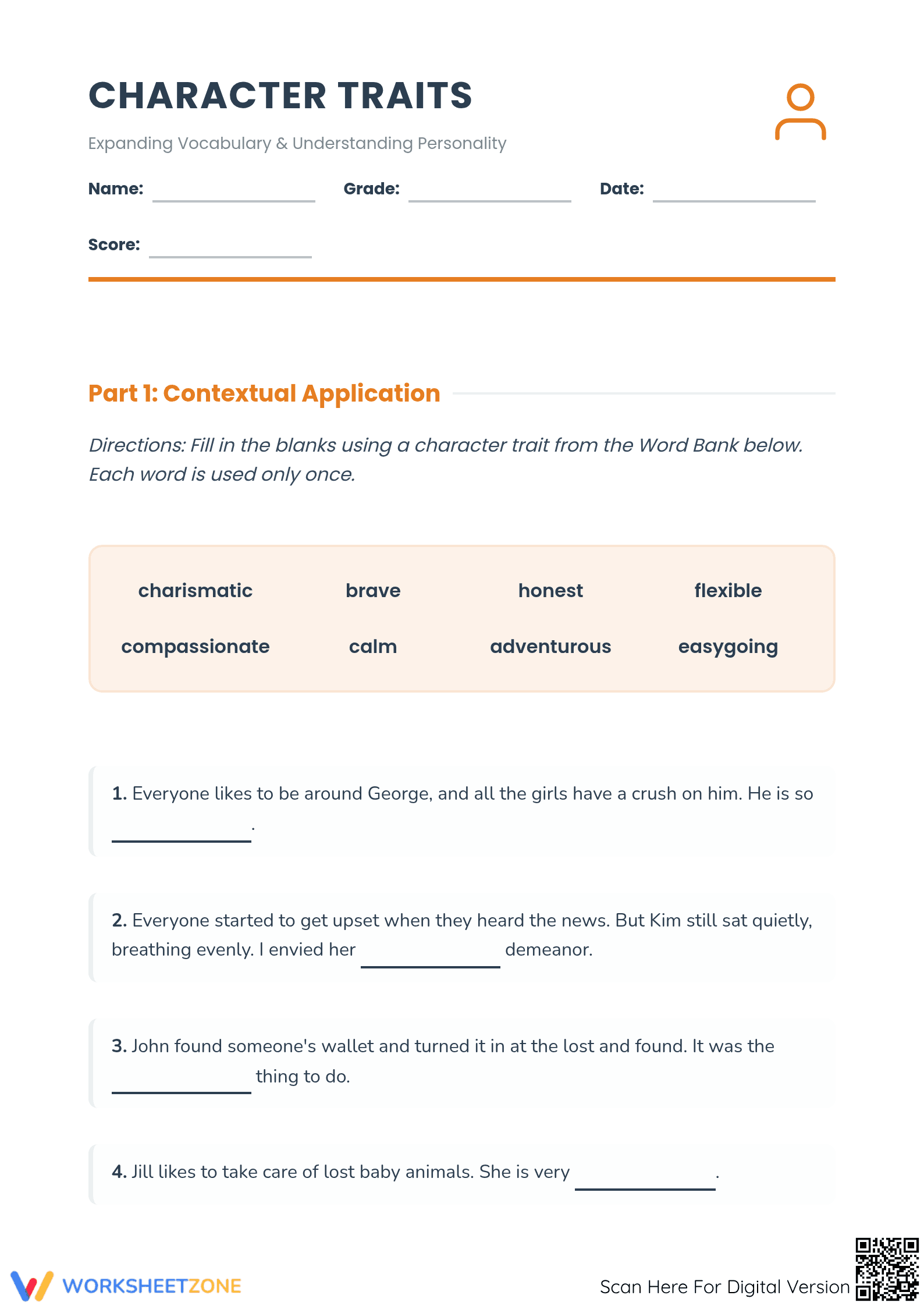
This comprehensive Grade 4 character traits worksheet helps students move beyond simple adjectives to nuanced vocabulary like "charismatic" and "compassionate." By analyzing character actions and motives in context, learners build the deep inferencing skills required for upper elementary reading comprehension and narrative writing. Students will identify, define, and personally connect with essential personality descriptors.
At a Glance
- Grade: 4 · Subject: English Language Arts
- Standard:
CCSS.ELA-LITERACY.RL.4.3— Describe in depth a character, setting, or event in a story or drama- Skill Focus: Character Trait Application & Vocabulary
- Format: 3 pages · 13 problems · Answer key included · PDF
- Best For: Vocabulary expansion and literary analysis practice
- Time: 25–35 minutes
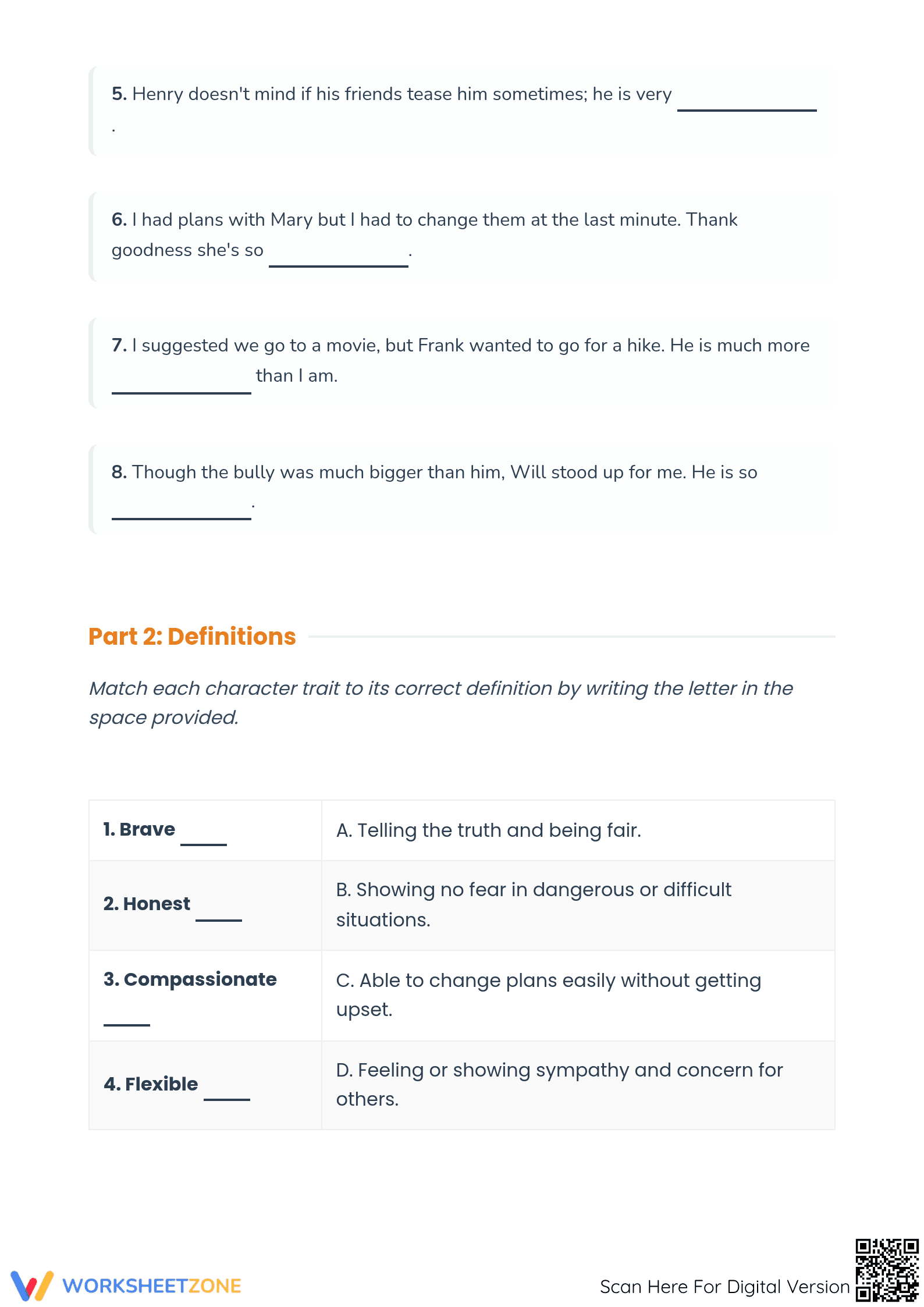
Inside this three-page PDF, you will find a structured vocabulary journey. It begins with an 8-item contextual application section where students use a word bank to complete descriptive sentences. The second page features a matching activity to solidify formal definitions of traits like "flexible" and "honest." Finally, a personal connection prompt invites students to reflect on their own character in a short-response format.
Skill Progression
- Guided Application: Students analyze sentence-level context clues to select appropriate traits from a provided word bank, focusing on words like "demeanor" and "envied."
- Conceptual Reinforcement: A targeted matching task decouples traits from narrative context to ensure students understand the formal dictionary-level differences between similar personality descriptors.
- Independent Synthesis: The final writing task requires students to internalize the vocabulary by drafting a personal reflection that justifies a chosen trait with real-world evidence.
This sequence supports the gradual release of responsibility model, moving from scaffolded identification to independent application.
Standards Alignment
This resource is specifically aligned with `CCSS.ELA-LITERACY.RL.4.3`, which requires students to describe a character in depth by drawing on specific details in the text. It also supports `CCSS.ELA-LITERACY.L.4.6` regarding the acquisition and use of grade-appropriate general academic vocabulary. Both standard codes can be copied directly into lesson plans, IEP goals, or district curriculum mapping tools.
How to Use It
Use this worksheet as a mid-lesson check for understanding after introducing the concept of characterization. It works excellently as a formative assessment to see if students can distinguish between external actions and internal traits. For a deeper challenge, ask students to highlight the specific evidence in the worksheet sentences that led them to pick a specific trait like "adventurous" or "easygoing." Expected completion time is approximately 30 minutes.
Who It's For
This is designed for Grade 4 students but is highly appropriate for Grade 3 enrichment or Grade 5 review. It is an ideal resource for English Language Learners (ELL) who need explicit vocabulary support for abstract personality concepts. Pair this worksheet with a short story passage to help students bridge the gap between sentence-level practice and full-text literary analysis.
Characterization is a foundational pillar of literacy that allows students to move from surface-level decoding to deep thematic understanding. Research from Fisher & Frey (2014) emphasizes that explicit vocabulary instruction—specifically the transition from knowing a word's definition to applying it in context—is critical for reading proficiency. This worksheet targets `CCSS.ELA-LITERACY.RL.4.3` by forcing students to analyze the underlying motives behind character behavior. By working through 13 distinct tasks involving high-utility academic words like "charismatic" and "demeanor," students build the mental schema necessary to describe complex characters in literature. According to NAEP data, students who can accurately infer character traits from subtle textual cues consistently outperform peers in overall comprehension assessments. This resource provides the necessary scaffolding to bridge the gap between simple identification and sophisticated literary analysis, ensuring students are prepared for the rigorous demands of middle school ELA and beyond.


