


























Views
Downloads
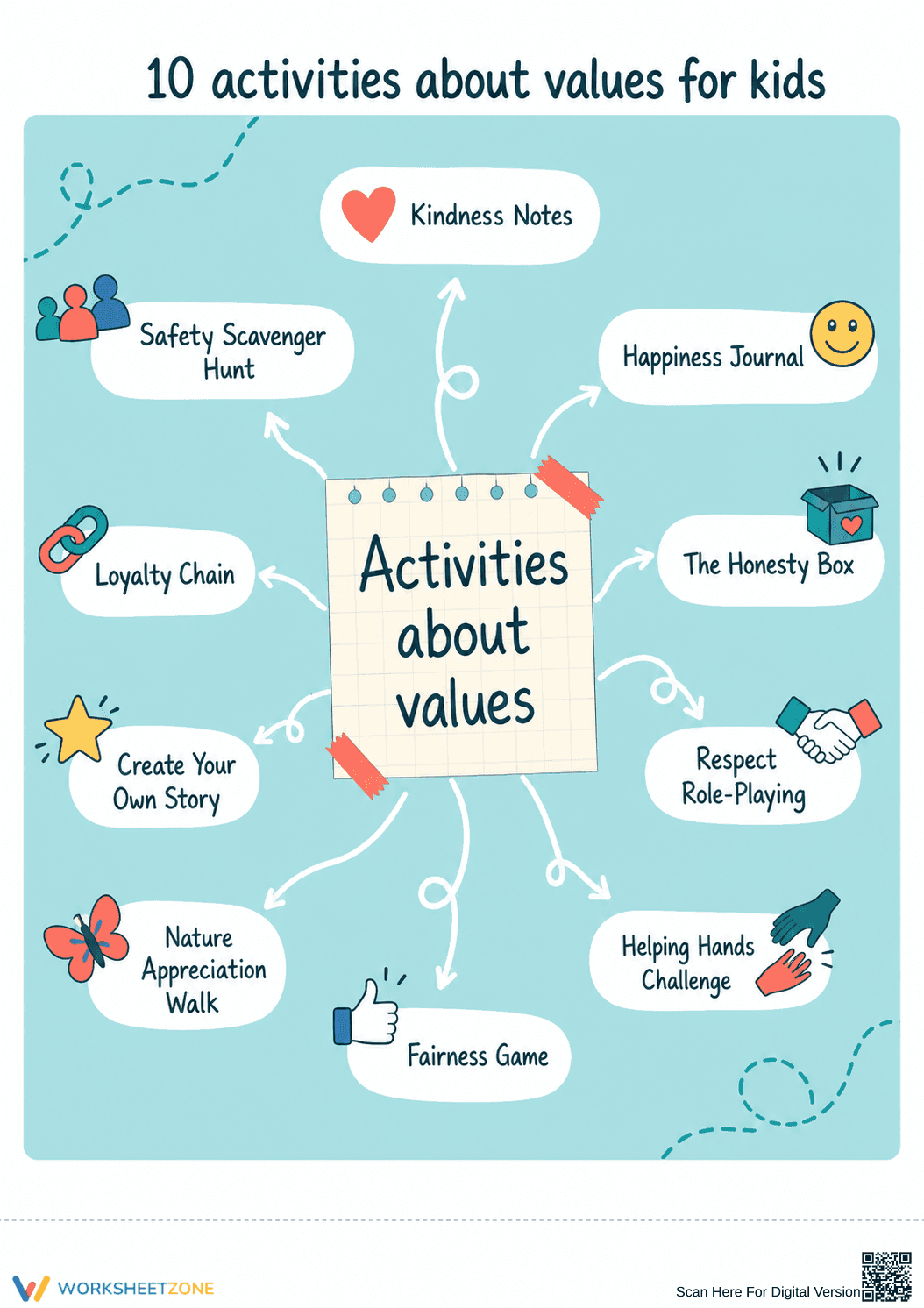

Grade 2 Core Values — Printable No-Prep Worksheet
Paste this activity's link or code into your existing LMS (Google Classroom, Canvas, Teams, Schoology, Moodle, etc.).
Students can open and work on the activity right away, with no student login required.
You'll still be able to track student progress and results from your teacher account.
This early elementary social skills resource provides students with ten engaging activities to practice core values like honesty, respect, and fairness. By participating in collaborative exercises, children actively build empathy and positive character traits. The visual format makes it easy to introduce foundational social-emotional concepts to young learners.
At a Glance
- Grade: 2 · Subject: Social Skills
- Standard:
CCSS.ELA-LITERACY.SL.2.1— Participate in collaborative conversations with peers- Skill Focus: Core Values and Character Education
- Format: 1 page · 10 activities · No answer key · PDF
- Best For: Morning meetings and SEL blocks
- Time: 15–30 minutes
This single-page visual guide features a mind map branching into ten character-building activities, ranging from a "Happiness Journal" to "Respect Role-Playing." The layout serves as an activity menu, allowing educators to select exercises based on daily social-emotional goals. No answer key is required, as prompts are open-ended to foster reflection and group discussion.
This resource requires minimal teacher preparation.
- Print (1 minute): Generate copies of the activity menu to display on a smartboard or distribute to student groups.
- Distribute (1 minute): Select one activity for the day and gather any basic classroom materials needed, such as paper for the "Kindness Notes" exchange.
- Review (3 minutes): Explain the chosen activity's rules and connect it to the target value before students begin.
Total teacher prep time is under five minutes, making this an excellent option for quick morning meetings, advisory periods, or emergency substitute plans.
This resource aligns with CCSS.ELA-LITERACY.SL.2.1: "Participate in collaborative conversations with diverse partners about grade 2 topics and texts with peers and adults in small and larger groups." By engaging in these value-based activities, students practice active listening, respectful communication, and taking turns during group discussions. Both standard codes can be copied directly into lesson plans, IEP goals, or district curriculum mapping tools.
Utilize this activity menu during morning meetings to set a positive tone. For example, introduce "The Honesty Box" on Monday and review submissions on Friday. Alternatively, use "Respect Role-Playing" during conflict resolution to practice appropriate responses. While observing, educators can formatively assess students' ability to articulate feelings and demonstrate empathy. Each activity requires 15 to 30 minutes to complete.
This resource is ideal for first through third-grade students developing foundational social-emotional skills. The visual nature of the menu supports early readers and English Language Learners by providing clear, simple titles with accompanying icons. Teachers can differentiate the experience by pairing students strategically during collaborative games or adjusting the complexity of the writing tasks in the "Happiness Journal." It pairs perfectly with read-aloud books focused on character education or classroom anchor charts defining respect and fairness.
Integrating structured social-emotional learning activities into the daily curriculum significantly impacts student behavior and academic readiness. This resource targets CCSS.ELA-LITERACY.SL.2.1, helping students participate in collaborative conversations with peers while exploring core values. According to a comprehensive CASEL framework review cited in RAND AIRS 2024, explicit instruction in character education and social skills reduces behavioral referrals and increases positive peer interactions in early elementary classrooms. By utilizing activities like role-playing and collaborative games, educators provide safe environments for children to practice empathy, honesty, and respect. These foundational competencies are critical for maintaining a supportive classroom climate and fostering long-term academic success. Regular engagement with value-based prompts ensures that students not only understand ethical concepts intellectually but can also apply them practically in their daily social interactions.


