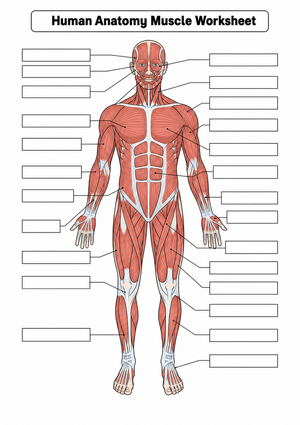
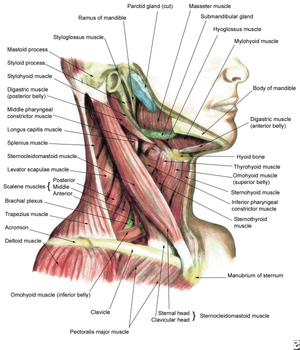
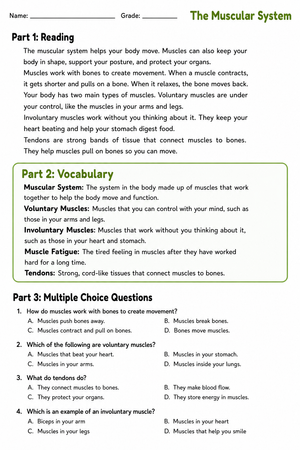
These 11th grade muscular system printable worksheets give biology teachers a ready set of structured practice activities that move students from naming body parts to explaining how muscle tissue actually functions. Each worksheet isolates a specific skill — labeling anatomical structures, distinguishing muscle types by location and control, or tracing how the muscular system coordinates with the skeletal, nervous, and circulatory systems. The set covers enough ground for a full unit, from initial introduction through review before a body systems exam.
What Each Worksheet Covers
The worksheets address the content areas that consistently show up in 11th grade human biology instruction and that students most frequently struggle to explain precisely:
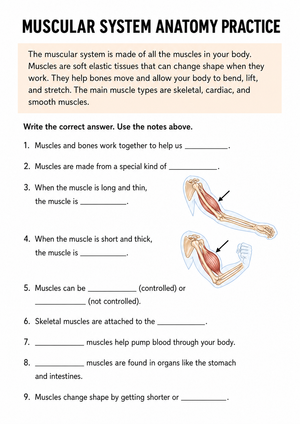
- Muscle type identification: skeletal, smooth, and cardiac — where each type is found, which system controls it, and why its structure suits its function
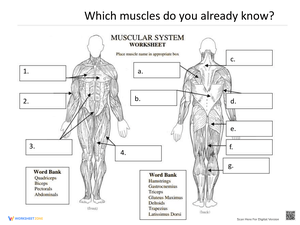
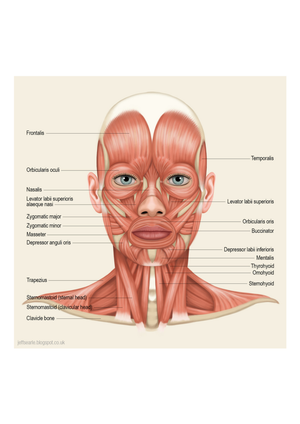
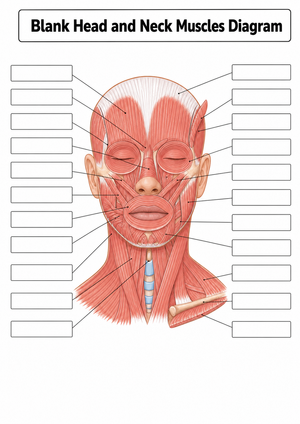
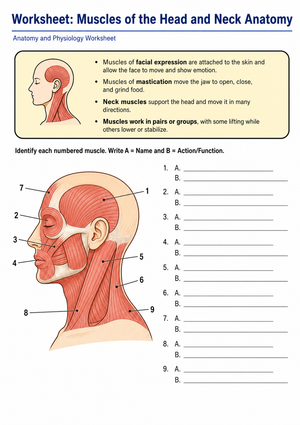
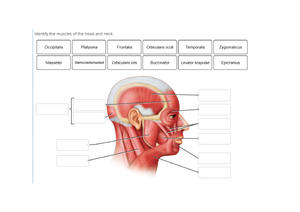
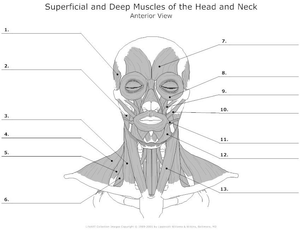
- Diagram labeling: major superficial muscles and anatomical landmarks including origin, insertion, tendon, and muscle belly
- Voluntary vs. involuntary control: sorting tasks where students assign each muscle type to its controlling system and explain that assignment in writing
- Functional roles: movement, posture maintenance, heat production, and organ motility
- Antagonistic muscle pairs: explanation tasks where students trace how paired muscles produce and reverse joint movement
- Cross-system connections: items that link muscle contraction to bone lever mechanics, motor neuron signals, and oxygen delivery through the circulatory system
- Short constructed response: prompts that require students to explain a process rather than name a structure — for example, why tendons are necessary, or how a sprinter's body coordinates multiple systems simultaneously
Frequent Student Errors Worth Watching For in This Unit
The muscular system unit produces a fairly predictable set of errors in student work, and these worksheets surface them efficiently. The most persistent one: students consistently write that muscles "push" bones. They can recite the definition of contraction, but they still draw diagrams showing a bicep muscle pressing the forearm upward rather than pulling it. This comes from everyday language — we push doors and shopping carts — and it takes targeted practice with diagrams and written explanation to correct it. The combination of a labeled diagram question followed immediately by a written explanation prompt is exactly the pairing that catches this mistake before a test.
Origin and insertion labels trip students up even after direct instruction. Students learn the definitions accurately — origin is the stationary attachment, insertion is the attachment on the moving bone — but then apply them in reverse on actual diagrams. They mark the distal end as the origin because it "looks like where the muscle ends." Having students annotate a diagram and then justify each label in a sentence exposes this confusion quickly.
Two vocabulary errors come up reliably across every class: students write that tendons connect bone to bone (that is a ligament), and students classify cardiac muscle as voluntary because they associate elevated heart rate with conscious effort during exercise. The short-answer items in this set ask students to address these distinctions explicitly, which forces those misconceptions into view where they can be corrected before a unit assessment.
Building These Worksheets Into the Unit Sequence
A practical sequence starts with a diagram-labeling worksheet as a bell ringer on day one — not as assessment, but as a quick read on what students already know about muscle location and terminology. After direct instruction on muscle types, a sorting worksheet where students categorize statements into skeletal, smooth, and cardiac columns works well as a ten-minute station activity or a homework assignment. The station format keeps students active: place each worksheet at a different table with a specific focus — vocabulary, diagrams, function questions, and cross-system application — and rotate groups every eight to ten minutes. No digital setup required.
Later in the unit, the short constructed response worksheets function as formative checks. Assign one before the nervous system connection lesson to see whether students can explain voluntary control accurately before adding motor neuron content on top of it. For sub plans, the labeling and matching worksheets give students a clear task path even without live instruction. The 11th grade muscular system printable worksheets also work well during the Friday review block — students draw on each worksheet type used across the week and spend the last portion of class explaining their answers to a partner before a brief whole-class share-out.
Standard Alignment
These worksheets connect directly to NGSS standard HS-LS1-2, which asks students to develop and use models to illustrate how interacting systems within multicellular organisms provide specific functions. In classroom terms, that means students must be able to explain not just what each muscle type is but how the muscular system fits into a coordinated, interdependent network — which is precisely what the cross-system connection questions on each worksheet ask students to do. Many states with anatomy and physiology standards at the 11th and 12th grade level also include objectives around organ system interaction, voluntary versus involuntary control, and structural-functional relationships in human tissue, all of which these worksheets address directly.
Adapting the Set for a Range of Learners
For students who need additional support, the diagram-labeling worksheets work well with a word bank printed alongside the diagram. Adding sentence frames to the constructed response items — Cardiac muscle differs from skeletal muscle because... or The tendon connects the muscle to... — lets those students focus on content accuracy rather than getting stuck on how to begin a sentence. Pairing a student who needs support with a stronger peer during station rotation also helps, particularly on the antagonistic muscle pair explanations, which require spatial reasoning that some students find harder than vocabulary recall.
For students who move through core content quickly, the cross-system connection questions extend the difficulty without requiring a separate worksheet. Ask them to explain the full sequence of events — from motor neuron signal through muscle contraction to bone movement — for a specific action like catching a thrown object or swallowing food. That kind of integrative explanation demands the same content knowledge but requires more precise reasoning and sequencing. The 11th grade muscular system printable worksheets include enough of these higher-order items that extension is built into the set rather than requiring additional teacher prep.
Frequently Asked Questions
Do these worksheets work for anatomy and physiology courses, or only general biology?
Both. The content — muscle type comparison, anatomical labeling, origin and insertion, antagonistic pairs, and cross-system connections — appears in 11th grade biology and in dedicated anatomy and physiology courses. Anatomy teachers may use the full set in sequence; general biology teachers can pull individual worksheets that match their unit scope.
Are answer keys included?
Each worksheet comes with a complete answer key. For the constructed response items, the key includes sample responses that show the level of explanation expected at this grade, not just a one-word answer. This speeds up grading across multiple class sections and gives teachers a reference point for providing feedback.
What formats are used across the set?
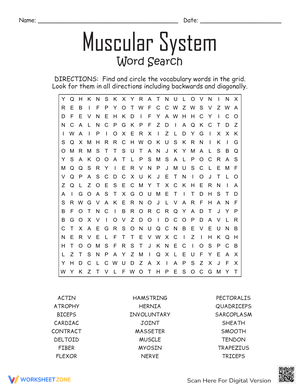
The set includes diagram labeling, matching and sorting, vocabulary review, and short constructed response. Each worksheet stands alone, so teachers can assign them in any order based on lesson goals. No worksheet depends on another to make sense.
Can these be used for test review before a human body systems exam?
The labeling and sorting worksheets work well as quick review materials the day before an exam. The short-answer worksheets are more useful two or three days out, when students still have time to address gaps in understanding. Combining a diagram review with a written explanation worksheet covers both recall and reasoning — the two skill levels most likely to appear on a body systems unit test. The 11th grade muscular system printable worksheets cover all the major content areas that appear on end-of-unit assessments, including muscle types, vocabulary, cross-system connections, and functional reasoning about movement and control.












 Interactive Worksheet Maker
 Quiz Maker
 Word Search Maker
 Crossword Puzzle Maker
 Word Scramble Generator
 Sentence Scramble Generator
 Handwriting Worksheet Generator
 Name Tracing Generator
 Fill In The Blank Generator