




























0
Views
0
Downloads

0.0
0
Save
0 Likes
Share
Exploring Muscles of the Neck
0 Views
0 Downloads

Paste this activity's link or code into your existing LMS (Google Classroom, Canvas, Teams, Schoology, Moodle, etc.).
Students can open and work on the activity right away, with no student login required.
You'll still be able to track student progress and results from your teacher account.
Information
Description
What It Is:
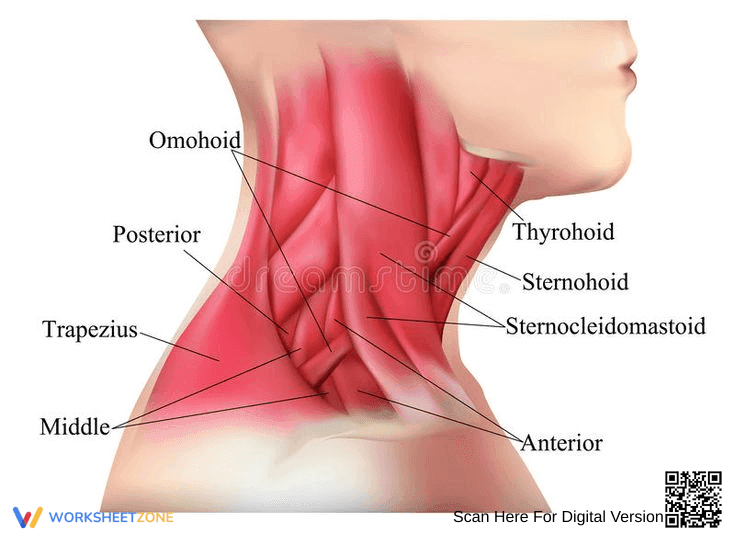
This is an anatomical diagram of the human neck muscles. It features a detailed illustration of the neck and upper shoulder area, with various muscles labeled, including the Omohyoid, Trapezius (with labels for Middle and Posterior portions), Sternocleidomastoid, Sternohyoid, Thyrohyoid, and other anterior muscles. Lines point from the labels to the corresponding muscle groups.
Grade Level Suitability:
This diagram is suitable for high school biology, anatomy and physiology courses, and introductory college-level anatomy. The detailed labeling and anatomical accuracy make it appropriate for students learning about the muscular system.
Why Use It:
This worksheet helps students learn the names and locations of the major muscles in the neck. It provides a visual aid for understanding the complex arrangement of muscles and their relationships to each other. It's a great resource for memorization and spatial understanding of anatomy.
How to Use It:
Use this diagram for studying, labeling practice, or as a reference during dissection. Students can use it to identify muscles on a model or in a real-life setting. Teachers can use it as part of a lecture or quiz.
Target Users:
This resource is intended for students studying anatomy, physiology, biology, and related fields. It is also useful for healthcare professionals and educators who need a clear and accurate visual representation of the neck muscles.
This is an anatomical diagram of the human neck muscles. It features a detailed illustration of the neck and upper shoulder area, with various muscles labeled, including the Omohyoid, Trapezius (with labels for Middle and Posterior portions), Sternocleidomastoid, Sternohyoid, Thyrohyoid, and other anterior muscles. Lines point from the labels to the corresponding muscle groups.
Grade Level Suitability:
This diagram is suitable for high school biology, anatomy and physiology courses, and introductory college-level anatomy. The detailed labeling and anatomical accuracy make it appropriate for students learning about the muscular system.
Why Use It:
This worksheet helps students learn the names and locations of the major muscles in the neck. It provides a visual aid for understanding the complex arrangement of muscles and their relationships to each other. It's a great resource for memorization and spatial understanding of anatomy.
How to Use It:
Use this diagram for studying, labeling practice, or as a reference during dissection. Students can use it to identify muscles on a model or in a real-life setting. Teachers can use it as part of a lecture or quiz.
Target Users:
This resource is intended for students studying anatomy, physiology, biology, and related fields. It is also useful for healthcare professionals and educators who need a clear and accurate visual representation of the neck muscles.


