




























Views
Downloads
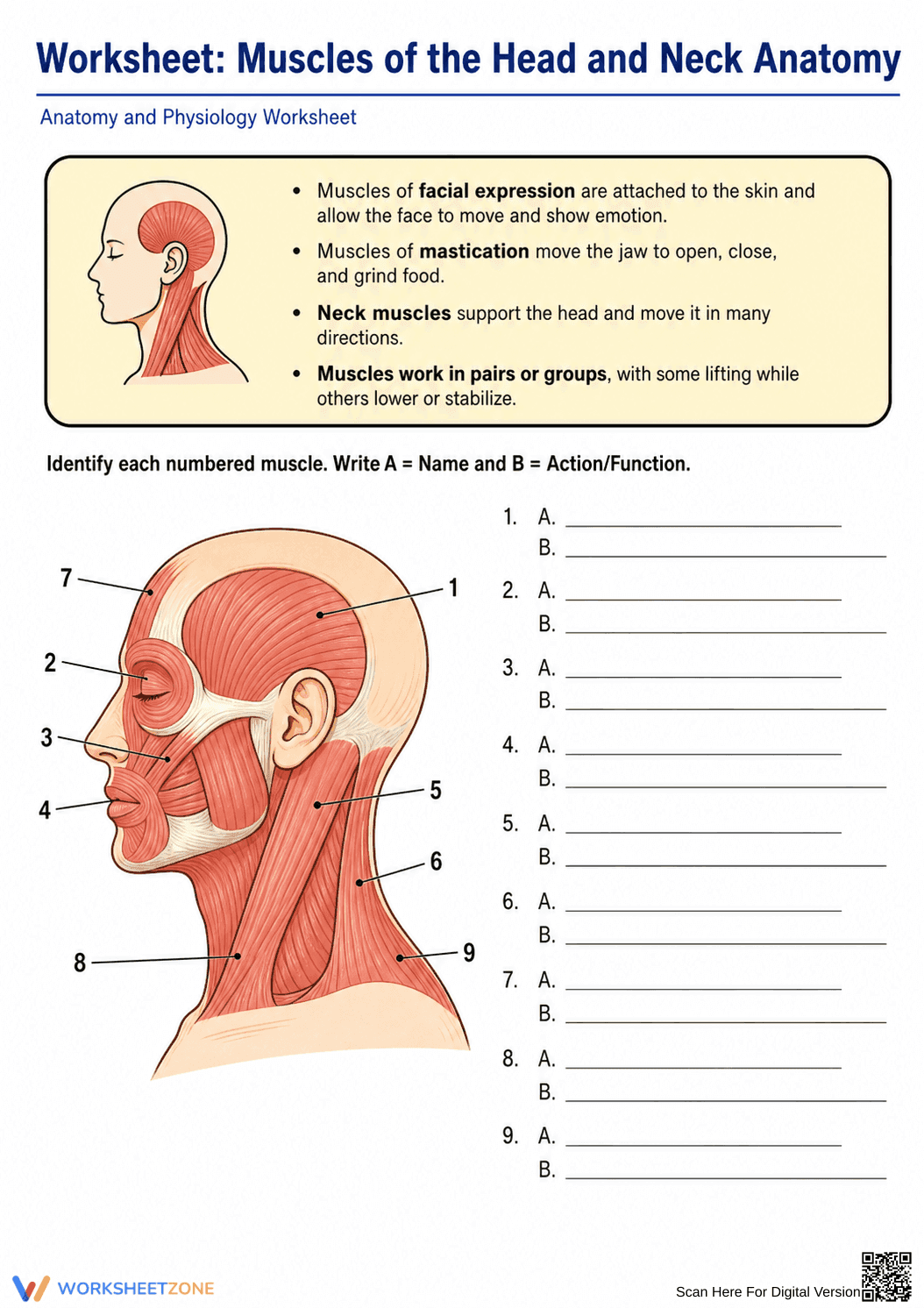

Grade 9-12 Muscle Anatomy — Printable No-Prep Worksheet

Paste this activity's link or code into your existing LMS (Google Classroom, Canvas, Teams, Schoology, Moodle, etc.).
Students can open and work on the activity right away, with no student login required.
You'll still be able to track student progress and results from your teacher account.
This high school biology worksheet helps students master the muscular system by identifying the muscles of the head and neck and describing their specific functions. By analyzing a detailed anatomical diagram, learners connect structural names to physiological actions, reinforcing their understanding of human body systems and movement.
At a Glance
- Grade: 9-12 · Subject: Biology
- Standard:
HS-LS1-2— Illustrate interacting systems providing specific functions in organisms- Skill Focus: Muscle identification and function
- Format: 1 page · 9 problems · Answer key included · PDF
- Best For: Independent practice or review
- Time: 15–20 minutes
This single-page resource features a clear, labeled side-view diagram of the human head and neck. It includes a brief introductory text box summarizing the roles of facial expression, mastication, and neck muscles. Students are tasked with completing nine two-part problems where they must provide both the anatomical name and the specific action or function for each numbered muscle. A complete answer key is included for accurate grading.
Designed for immediate classroom use, this resource requires minimal teacher setup:
- Print (1 minute): Simply print the PDF copies for your class. The high-contrast diagram ensures clear reproduction.
- Distribute (1 minute): Hand out the assignment. The built-in informational text box allows students to begin immediately.
- Review (3 minutes): Use the provided answer key to quickly check student responses or guide a whole-class review session.
With under two minutes of prep time, this worksheet is an excellent option for teachers or as a reliable biology sub plan.
This worksheet aligns directly with HS-LS1-2: Develop and use a model to illustrate the hierarchical organization of interacting systems that provide specific functions within multicellular organisms. By linking specific muscle structures to their mechanical functions (like mastication or facial expression), students demonstrate comprehension of system interactions. Both standard codes can be copied directly into lesson plans, IEP goals, or district curriculum mapping tools.
Deploy this worksheet during direct instruction as a guided note-taking tool, having students fill in names and functions as you present the muscular system. Alternatively, assign it as an independent post-lecture review. As a formative assessment tip, observe whether students struggle more with recalling anatomical names or describing physiological actions; this indicates if future lessons need to focus on memorization or biomechanics. Expected completion time is 15 to 20 minutes.
This resource is designed primarily for high school biology, anatomy, and physiology students in grades 9 through 12. To differentiate for learners who need extra support, provide a word bank of muscle names and a separate list of functions to match. It pairs perfectly with a 3D anatomical model demonstration or a comprehensive textbook chapter on the human muscular system.
Integrating visual models with functional descriptions is a highly effective strategy for teaching complex biological systems. This worksheet targets the core competency of HS-LS1-2, requiring students to illustrate interacting systems providing specific functions in organisms. According to a ScienceDirect TpT Analysis, instructional materials that combine spatial diagrams with active recall tasks significantly improve long-term retention of anatomical terminology. By prompting learners to simultaneously identify the muscle structure and articulate its mechanical action, this resource bridges the gap between rote memorization and functional comprehension. The dual-task format ensures that students do not just memorize locations, but actually understand how the muscular system facilitates movement, mastication, and expression. This evidence-based approach supports deeper cognitive processing, making it an essential tool for high school anatomy and physiology curricula.


