




























Views
Downloads
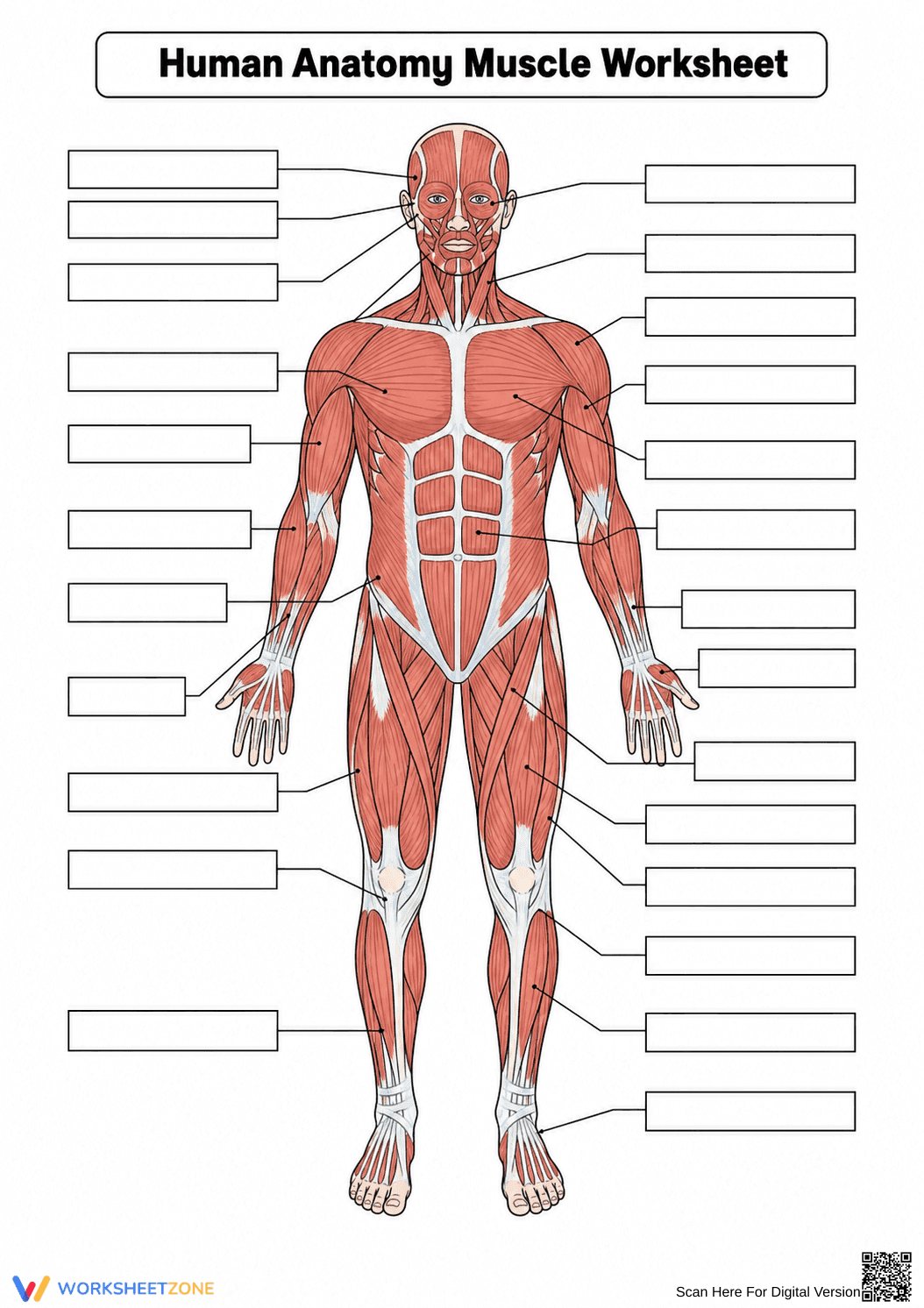

Essential Human Anatomy Muscle Worksheet | Grade 9-12

Paste this activity's link or code into your existing LMS (Google Classroom, Canvas, Teams, Schoology, Moodle, etc.).
Students can open and work on the activity right away, with no student login required.
You'll still be able to track student progress and results from your teacher account.
Students master the complex landscape of the human muscular system by identifying and labeling key muscle groups. This worksheet facilitates anatomical recall and spatial understanding, ensuring learners can pinpoint major superficial muscles from the head to the feet. It serves as a foundational tool for biology and health science curriculum.
At a Glance
- Grade: 9-12 · Subject: Biology
- Standard:
HS-LS1-2— Illustrate the hierarchical organization of interacting systems that provide specific functions- Skill Focus: Muscular system identification
- Format: 1 page · 22 problems · Answer key included · PDF
- Best For: Anatomy review and formative assessment
- Time: 15–20 minutes
The resource features a high-resolution anterior view of the human muscular system. It includes 22 distinct labeling boxes connected by precise leader lines to specific muscles, including the deltoids, pectorals, abdominals, and quadriceps. The single-page layout is optimized for clear printing and immediate student engagement without the need for complex instructions or teacher setup.
This resource is designed for a zero-prep classroom environment. Teachers can print the PDF in under 30 seconds, distribute it to the class in 1 minute, and conduct a collective review using a projector in 5 minutes. Total teacher preparation time is less than 2 minutes, making it an ideal choice for emergency sub plans or quick formative checks during a busy unit.
The primary standard addressed is `HS-LS1-2`. This standard requires students to illustrate the hierarchical organization of interacting systems. By identifying individual muscles as components of the muscular system, students demonstrate an understanding of how specialized cells and tissues form organs that provide specific functions. This standard code can be copied directly into lesson plans, IEP goals, or district curriculum mapping tools.
Use this worksheet as a "Do Now" activity at the start of a muscular system unit to gauge prior knowledge. Alternatively, assign it as a summative labeling quiz after direct instruction on muscle groups. During the activity, observe if students can distinguish between the various muscles of the torso versus the limbs. Expected completion time ranges from 15 to 20 minutes depending on student familiarity.
This worksheet is tailored for Grade 8 through Grade 12 students in Biology, Anatomy, or Physical Education courses. It is particularly effective for visual learners who benefit from spatial mapping. Pair this resource with a 3D torso model or a muscular system anchor chart to provide additional scaffolding for students who require visual cues or word banks.
According to research by Fisher & Frey (2014) on the gradual release of responsibility, visual labeling tasks serve as a critical bridge between guided instruction and independent mastery. This Grade 9-12 worksheet targets the HS-LS1-2 standard by requiring students to model the organization of the muscular system through 22 specific identification tasks. By engaging with a detailed anatomical diagram, students reinforce the vocabulary necessary for discussing human physiology and system interactions. The structured format reduces cognitive load while maximizing the retention of complex anatomical terms. Such fill-in-the-blank visual aids are proven to increase student confidence during introductory anatomy units. This resource provides the necessary repetition for long-term memory storage of muscle locations, a prerequisite for higher-order physiological analysis in advanced science courses. The clear leader lines and spacious text boxes ensure that the activity remains accessible while maintaining high academic rigor for high school learners.


