




























Views
Downloads

Muscular System Anatomy Practice | Essential Worksheet

Paste this activity's link or code into your existing LMS (Google Classroom, Canvas, Teams, Schoology, Moodle, etc.).
Students can open and work on the activity right away, with no student login required.
You'll still be able to track student progress and results from your teacher account.
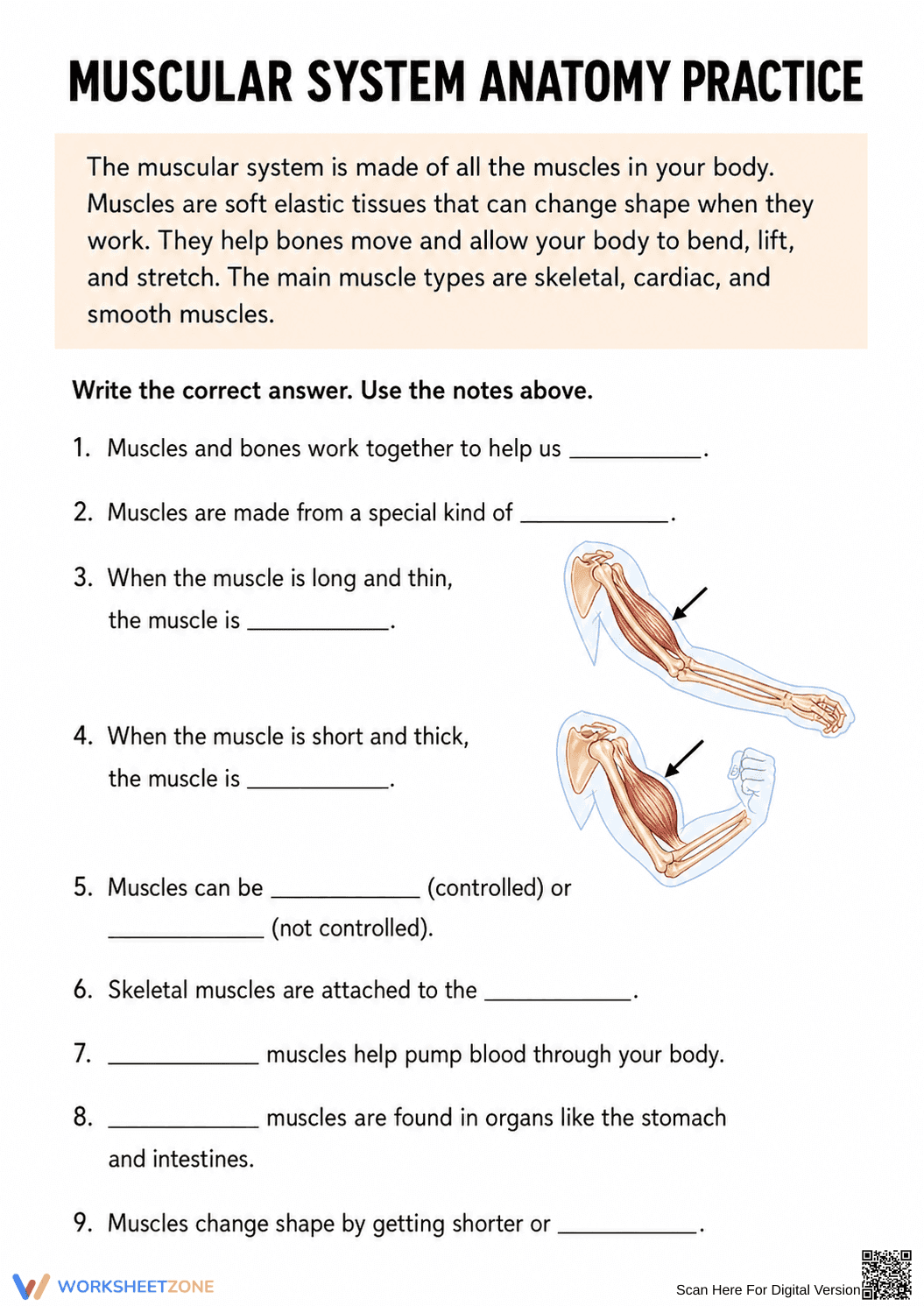
This muscular system anatomy practice worksheet provides a structured way for students to identify muscle types and understand mechanical functions. By connecting descriptive text with visual diagrams, learners master the differences between skeletal, cardiac, and smooth muscles. This resource ensures students can explain how muscles and bones collaborate to facilitate movement and maintain homeostasis.
At a Glance
- Grade: 8-11 · Subject: Biology
- Standard:
MS-LS1-3— Use evidence to explain how body systems interact to maintain function- Skill Focus: Muscular system anatomy and function
- Format: 1 page · 9 problems · Answer key included · PDF
- Best For: Quick review or introductory anatomy lesson
- Time: 15–20 minutes
The resource features a concise informational header that defines soft elastic tissues and the three primary muscle categories. Below the text, 9 targeted fill-in-the-blank questions require students to synthesize information about voluntary versus involuntary control. Two detailed anatomical diagrams of the human arm illustrate the physical changes in muscle shape during contraction and relaxation, providing essential visual support for the text-based questions.
Zero-Prep Workflow
- Print: Generate the single-page PDF in under 30 seconds for your entire class.
- Distribute: Hand out the sheets as a self-contained activity; no external textbooks are required.
- Review: Use the 9-question format for a 5-minute rapid-fire check for understanding at the end of the period.
This streamlined design makes it an ideal candidate for emergency sub plans or as a transition activity between lab stations.
Standards Alignment
Primary Standard: MS-LS1-3. Students use the provided evidence to describe how the muscular system interacts with the skeletal and circulatory systems to maintain body function. This alignment supports the understanding of multicellular organisms as a collection of subsystems. Both standard codes can be copied directly into lesson plans, IEP goals, or district curriculum mapping tools.
How to Use It
Assign this as a formative assessment immediately following a lecture on human body systems to gauge initial comprehension. It also serves as an excellent bell-ringer activity to activate prior knowledge. Teachers should observe if students correctly identify the short and thick state of a contracted muscle on the diagram to check for visual literacy. Expected completion time is 15 to 20 minutes.
Who It's For
This is ideal for middle and high school students requiring a foundational review of anatomy. It is particularly effective for English Language Learners or students with IEPs who benefit from the integrated text and visual aids. Pair this with a 3D torso model or a skeletal system anchor chart for a comprehensive instructional experience.
This muscular system practice worksheet aligns with the instructional frameworks described by Fisher & Frey (2014), emphasizing the importance of purposeful literacy in the science classroom. By integrating technical text with anatomical diagrams, the resource supports the gradual release of responsibility, moving students from reading definitions to applying concepts in a fill-in-the-blank format. Research from the NAEP indicates that students who engage with multi-modal representations—such as the contraction diagrams included here—demonstrate higher retention of complex biological processes. The worksheet specifically targets standard MS-LS1-3, requiring students to synthesize how muscular tissues function as a subsystem within the human body. This structured approach to anatomy ensures that Grade 8-11 learners build the necessary vocabulary and conceptual foundation for advanced biology. The inclusion of 9 specific tasks allows for quick data collection on student mastery of voluntary and involuntary muscle classification, facilitating immediate instructional adjustments.


