




























Views
Downloads
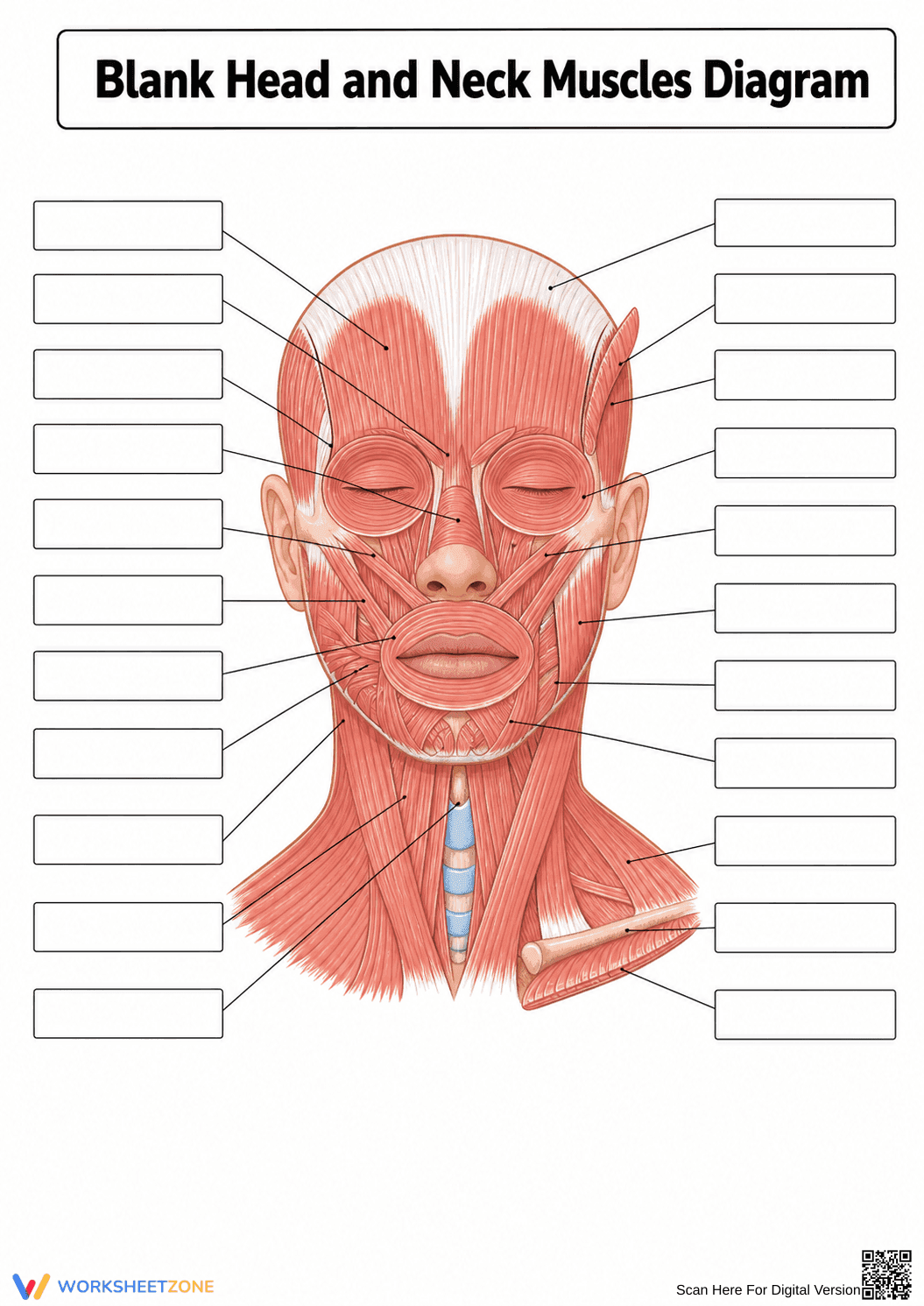

Grade 9-11 Head Muscles — Printable No-Prep Worksheet

Paste this activity's link or code into your existing LMS (Google Classroom, Canvas, Teams, Schoology, Moodle, etc.).
Students can open and work on the activity right away, with no student login required.
You'll still be able to track student progress and results from your teacher account.
This high school biology worksheet helps students master the complex anatomy of the muscular system by identifying and labeling specific head and neck muscles. By completing this detailed anatomical diagram, learners reinforce their spatial understanding of muscle locations and functions, building a strong foundation for advanced medical or physiological studies.
At a Glance
- Grade: 9-11 · Subject: Biology
- Standard:
HS-LS1-2— Illustrate interacting systems providing specific functions- Skill Focus: Anatomical labeling and identification
- Format: 1 page · 20 problems · Answer key included · PDF
- Best For: Independent practice or review
- Time: 15–20 minutes
Inside this resource, educators will find a high-quality, single-page anatomical illustration of the human head and neck. The diagram features 20 distinct pointing lines directed at key facial, cranial, and cervical muscles, each connected to a blank text box for student input. A comprehensive answer key is provided to ensure accurate grading and allow for immediate student self-correction. The clear, uncluttered layout minimizes visual distractions, allowing students to focus entirely on anatomical accuracy.
This resource is designed for maximum efficiency with a simple zero-prep workflow:
- Print (1 minute): Simply download the PDF and print a class set. The high-contrast illustration copies perfectly in black and white.
- Distribute (1 minute): Hand out the diagrams at the start of class as a bell-ringer or during the main lesson for immediate application.
- Review (3 minutes): Display the included answer key on your smartboard for rapid, whole-class checking.
Total teacher preparation requires under two minutes, making this an excellent, reliable option for emergency sub plans or last-minute review sessions.
This worksheet is aligned to the Next Generation Science Standards, specifically focusing on HS-LS1-2: Develop and use a model to illustrate the hierarchical organization of interacting systems that provide specific functions within multicellular organisms. By mapping the muscular system, students visualize how individual muscle tissues interact to facilitate facial expressions, mastication, and head movement. Both standard codes can be copied directly into lesson plans, IEP goals, or district curriculum mapping tools.
This diagram serves as an excellent formative assessment during a broader unit on the human muscular system. Assign it immediately after direct instruction on facial anatomy to solidify new vocabulary, or use it as a quiet, focused station activity during a lab rotation. As students work, teachers can circulate and observe which specific muscle groups are causing confusion, allowing for targeted reteaching. Most students will complete the labeling task within 15 to 20 minutes.
This resource is primarily designed for high school biology, anatomy, and physiology students in grades 9 through 11. It is easily adaptable for differentiated learning; teachers can provide a word bank for students requiring additional scaffolding, or challenge advanced learners to write the primary function of each muscle next to its name. It pairs perfectly with 3D anatomical models or textbook chapters detailing the musculoskeletal system.
Effective anatomical instruction relies heavily on visual-spatial mapping and active recall. According to research published in ScienceDirect TpT Analysis, students who engage in active diagram labeling demonstrate significantly higher retention rates of complex biological terminology compared to those who only read text descriptions. This worksheet directly supports that evidence-based practice by requiring learners to actively retrieve and place anatomical terms in their correct spatial context. Aligned with HS-LS1-2, the task asks students to illustrate interacting systems providing specific functions, moving beyond rote memorization to structural comprehension. By integrating this visual model into the curriculum, educators provide a rigorous, scientifically backed method for mastering the muscular system. The structured format ensures that cognitive load is focused entirely on the biological concepts rather than deciphering complex instructions.


