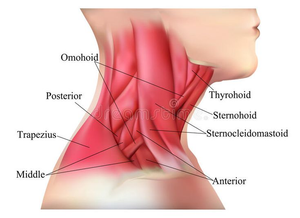
These muscles of the head and neck printable worksheets for 11th grade give anatomy teachers a focused set of resources for one of the most spatially challenging units in secondary biology — a region where two distinct muscle systems occupy nearly the same territory on the diagram and share adjacent nerve supply that students reliably mix up. Each worksheet addresses a specific skill: labeling anterior and lateral views, connecting muscle structure to mechanical action, and working through clinical scenarios that require students to identify which muscles are affected when a specific nerve is damaged. The worksheets do not cover the region all at once; each one isolates a functional cluster so teachers can assign selectively based on where the class stands in the unit.
The Three Muscle Clusters Students Work Through
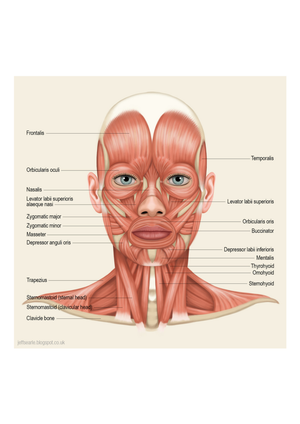
The facial expression cluster covers the frontalis, orbicularis oculi, orbicularis oris, buccinator, and zygomaticus. One worksheet specifically asks students to explain why these muscles insert into skin rather than bone — the structural feature that makes voluntary emotional expression mechanically possible, and the detail that most students skip over when reading through a list of muscle properties. The mastication cluster focuses on the masseter and temporalis. Students trace the fiber direction of the temporalis across the temporal fossa and explain how that broad, fan-like origin generates the force needed to raise the mandible during chewing. Students who work through that analysis stop treating the temporalis as a visual oddity on a diagram and start reading it as a mechanical solution to a specific problem.
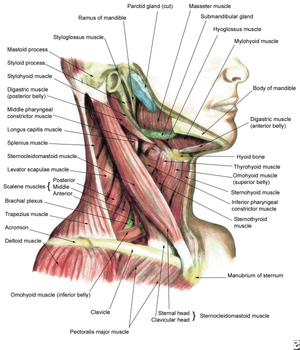
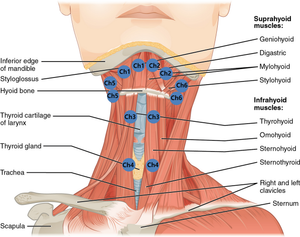
The cervical cluster is where most 11th graders need the most guided practice. Worksheets cover the sternocleidomastoid, the upper trapezius, the scalenes, the platysma, and the suprahyoid and infrahyoid muscle groups. One worksheet asks students to sort the infrahyoid muscles by their positional relationship to the hyoid — distinguishing those that pull from above from those that pull from below — which requires genuine anatomical reasoning rather than copying a label off a diagram.
Where These Worksheets Fit in Your Weekly Instruction
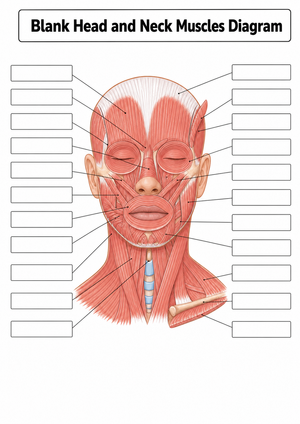
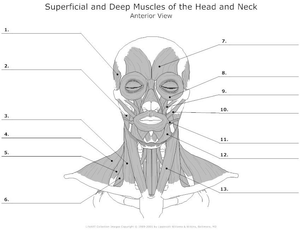
The labeling worksheets work best before formal instruction, not after. Assign the blank anterior-view diagram while students are still in their seats, ask them to mark whatever they already recognize, and use the results as a formative check before you start the slide deck. Students who have already struggled to place the masseter independently listen to your explanation of it with different attention — they are checking a prior guess, not passively receiving new information.
For the color-coding task — where students mark origins in one color, insertions in a second, then draw an arrow indicating the line of pull — about eight minutes without notes is right. The goal is productive struggle, not accuracy on the first try. After the time is up, have two or three students share their arrow directions aloud and let the class resolve disagreements before you confirm. In an 80-minute block, the mastication worksheets fit cleanly in the first half: fifteen minutes of direct instruction, twenty-five minutes of guided practice, then two minutes where students palpate their own masseter and temporalis by clenching and releasing their jaw. That physical moment improves retention of the names noticeably, and it costs almost nothing in class time.
Student Error Patterns Worth Addressing Before They Stick
The most persistent mistake is reversing the cranial nerve assignments. Students learn early that the facial nerve controls facial movement, then overapply that logic to include chewing. A specific example: a student asked to identify the nerve innervating the muscle that closes the jaw will write facial nerve — CN VII even immediately after the class has reviewed the trigeminal's motor branch. A comparison table that places CN V and CN VII side by side — listing each nerve, its muscle group, and its function — corrects this faster than re-teaching the nerve pathways from scratch.
A second reliable error: students place the sternocleidomastoid's origin at the mastoid process instead of the sternum and clavicle. The muscle's own name contains the answer — sterno-cleido-mastoid — but students reading a lateral diagram visually anchor to the mastoid process because it appears at the top of the visible pathway and looks like a natural point of origin. Parsing the name aloud takes under two minutes and closes this error for most of the class. A third pattern worth watching: students list only rotation when asked for the sternocleidomastoid's actions, consistently omitting lateral flexion. Both actions appear on most 11th-grade anatomy assessments, and the omission costs points reliably.
Standard Alignment
NGSS does not specify human muscular anatomy at the high school level by name, but the analytical tasks in muscles of the head and neck printable worksheets for 11th grade map directly onto HS-LS1-2, which asks students to develop and use models to illustrate how biological structures at various organizational levels are specialized for function. Students are not simply naming muscles — they are explaining how the broad origin of the temporalis across the temporal fossa produces the mechanical force required to raise the mandible. The clinical case worksheets connect to HS-LS1-3, which asks students to reason about how biological systems respond to disruption. A Bell's palsy scenario requires students to identify exactly which expression muscles lose function and explain why, moving the task from recall into applied reasoning. Teachers in states with dedicated anatomy and physiology frameworks will find that these worksheets align particularly well with learning objectives centered on structure-function relationships in the musculoskeletal system.
Adapting the Set for Mixed-Ability Anatomy Classes
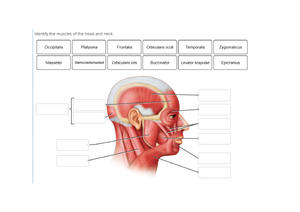
Students who are still building anatomical vocabulary do better when labeling worksheets include a word bank. The cognitive demand does not disappear — students still need to reason about muscle location and functional grouping to match a label to its structure — but the blank-recall barrier is removed so students can complete the task and build familiarity with the terms. For this group, assign the mastication worksheets first. The masseter and temporalis are palpable, they appear clearly in most diagrams, and they connect to an action students perform dozens of times a day. Getting those two right early creates momentum for the more demanding facial expression work.
For students who need greater challenge, the muscles of the head and neck printable worksheets for 11th grade include tasks where students generate their own clinical scenarios. Given a nerve and the muscle groups it supplies, they write two or three sentences describing what a patient would experience if that nerve were damaged. This requires knowing each muscle's actual function rather than just its name, and the finished responses work well as shared study material when discussed with the class.
Frequently Asked Questions
Do these worksheets require prior cranial nerve instruction to use?
No, but worksheets that include innervation tasks are most effective after students have at least a brief introduction to CN V and CN VII. If you teach head and neck muscles before the cranial nerve unit, use the labeling and origin-insertion worksheets first and assign the innervation tasks later. Each worksheet stands alone and can be sequenced to fit your course structure.
Do the diagrams show anterior view, lateral view, or both?
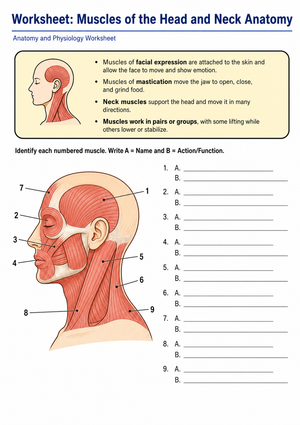
Both views are included. Anterior-view worksheets handle facial expression muscles clearly; lateral-view worksheets are better suited to the mastication and cervical groups. For students who have difficulty with spatial reasoning, pairing the same muscle across both views within the same class period builds the three-dimensional understanding that single-view practice rarely produces on its own.
Can these worksheets serve as quiz or test materials?
Teachers who use muscles of the head and neck printable worksheets for 11th grade as formative practice throughout the unit, then draw their assessment questions directly from the same tasks, see stronger retention — students recognize the task format even when the specific question is unfamiliar. Blank labeling diagrams without word banks function directly as identification quizzes. The short-answer clinical case questions translate well to free-response test items at the end of the unit.
How long does a typical worksheet take to complete in class?
Labeling worksheets generally run 12 to 18 minutes for a class that has had at least some prior exposure to the material. Matching and origin-insertion worksheets take closer to 20 minutes when students work independently. Clinical case worksheets need 25 minutes or more, particularly if you build in class discussion after the initial written response. A class coming in cold on the sternocleidomastoid will move noticeably slower through the cervical diagram than one that had even a brief preparatory discussion the day before.












 Interactive Worksheet Maker
 Quiz Maker
 Word Search Maker
 Crossword Puzzle Maker
 Word Scramble Generator
 Sentence Scramble Generator
 Handwriting Worksheet Generator
 Name Tracing Generator
 Fill In The Blank Generator