


























Views
Downloads

Essential Muscular System Anatomy Worksheet | Grade 8-11
Paste this activity's link or code into your existing LMS (Google Classroom, Canvas, Teams, Schoology, Moodle, etc.).
Students can open and work on the activity right away, with no student login required.
You'll still be able to track student progress and results from your teacher account.
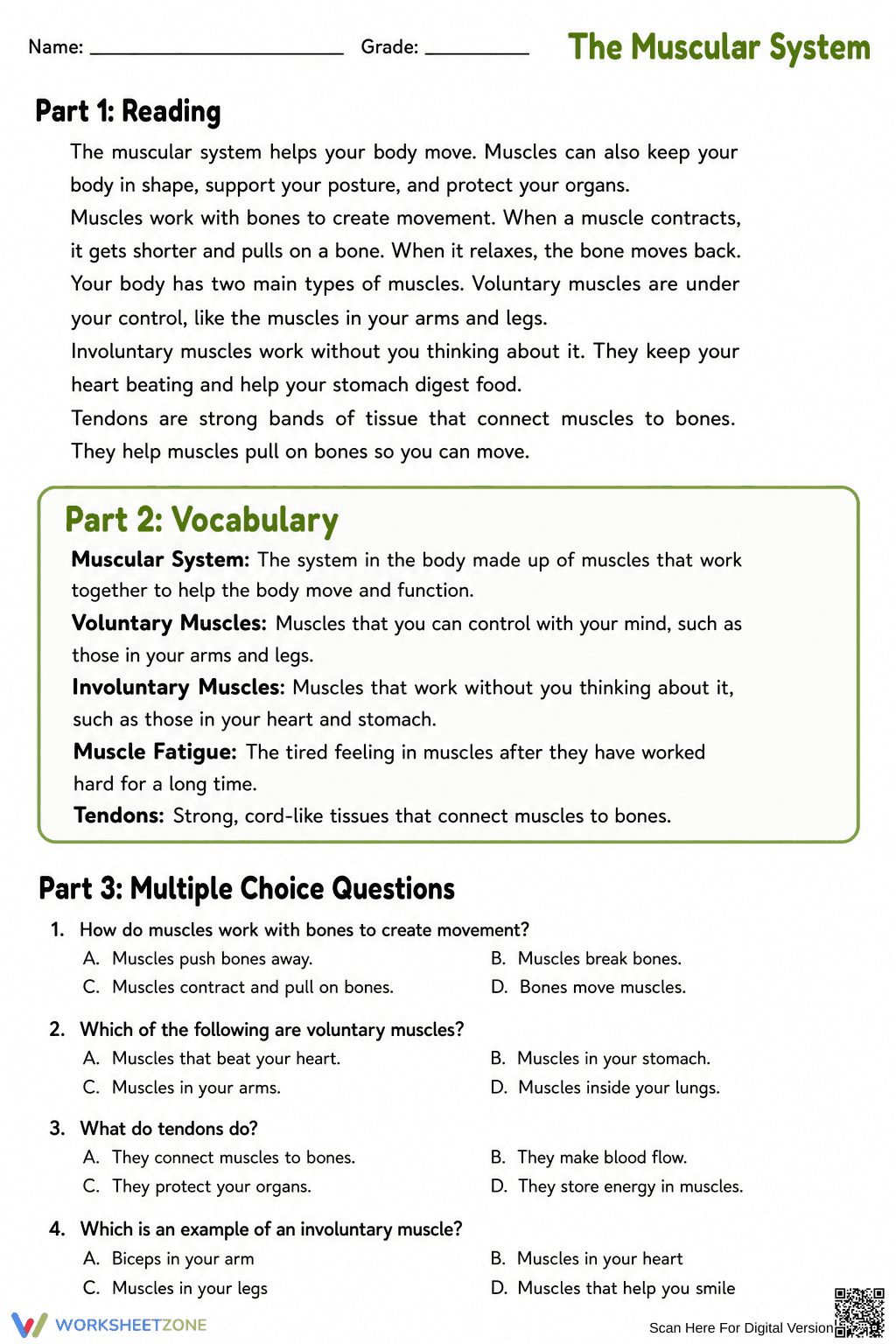
This muscular system worksheet provides a concise yet comprehensive overview of human anatomy, focusing on how muscles interact with the skeletal system to facilitate movement. Students analyze the differences between voluntary and involuntary muscles while identifying the critical role of tendons in bodily mechanics. It ensures students master foundational physiological concepts through integrated reading and assessment.
At a Glance
- Grade: 8-11 · Subject: Biology / Science
- Standard:
MS-LS1-3— Evidence of how the body is a system of interacting subsystems- Skill Focus: Muscular System Anatomy
- Format: 1 page · 9 problems · Answer key included · PDF
- Best For: Introductory anatomy lessons or sub plans
- Time: 15–20 minutes
The resource features a structured three-part layout on a single page. It begins with a detailed reading passage explaining muscle contraction and relaxation. A dedicated vocabulary box defines five essential terms, including muscle fatigue and involuntary muscles. The final section contains four multiple-choice questions designed to verify comprehension of the text and terminology.
This worksheet is designed for immediate classroom implementation. Teachers can print the single-page PDF in less than 30 seconds. Distribution takes approximately 1 minute, and the structured format allows for a 15-minute independent work session. Reviewing the four multiple-choice questions as a whole-class activity requires only 2 minutes, making the total teacher prep time under 2 minutes.
This resource aligns with `MS-LS1-3`: "Use argument supported by evidence for how the body is a system of interacting subsystems composed of groups of cells." It specifically addresses how the muscular and skeletal systems work in tandem. Both standard codes can be copied directly into lesson plans, IEP goals, or district curriculum mapping tools.
Use this as a high-interest bell ringer to activate prior knowledge before a lecture on human body systems. Alternatively, it serves as an excellent formative assessment tool following a lab on muscle fatigue. Teachers should observe if students can correctly distinguish between the heart (involuntary) and arm muscles (voluntary) during the independent practice phase. Expected completion time is 15 to 20 minutes.
This is ideal for Grade 8-11 biology or life science students who require a clear, focused introduction to anatomy. It is particularly effective for students who benefit from scaffolded reading passages and clear vocabulary definitions. Pair this with a 3D torso model or a skeletal system diagram for a complete physiological unit.
According to the RAND AIRS 2024 report on science literacy, the integration of domain-specific vocabulary with informational text significantly improves retention of complex biological systems. This worksheet addresses the MS-LS1-3 standard by requiring students to identify the functional relationships between muscle groups and skeletal structures. By utilizing a "read-define-test" sequence, the resource mirrors the evidence-based practices recommended by Fisher & Frey (2014) for disciplinary literacy. Research indicates that 15-minute focused interventions on specific body systems help bridge the gap between general life science knowledge and advanced physiological understanding. This printable resource provides the necessary scaffolding for students to transition from basic identification to conceptualizing the muscular system as a vital subsystem within the human body.


