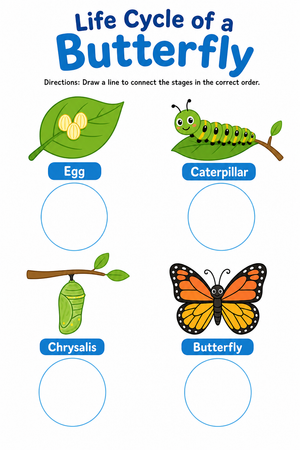
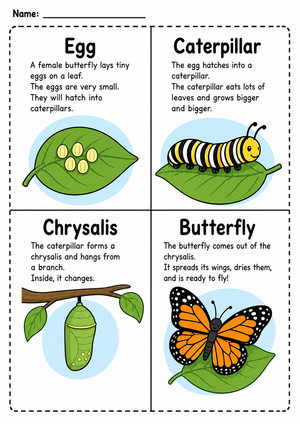
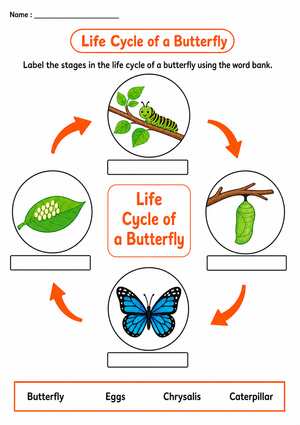
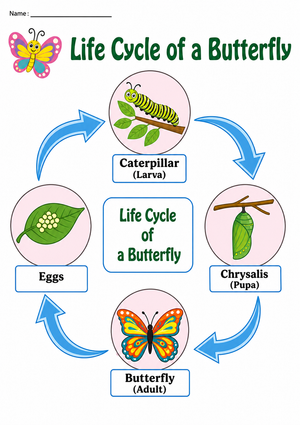
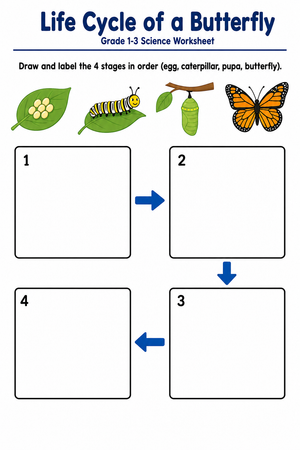
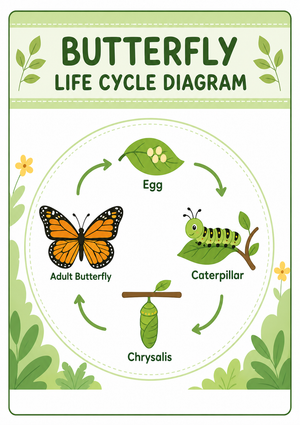
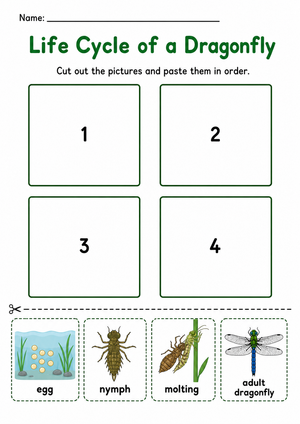
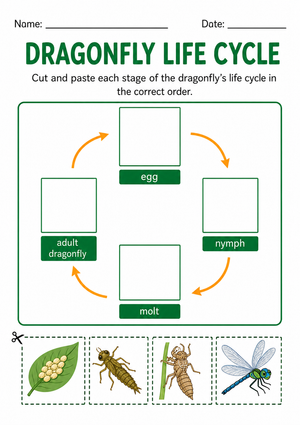
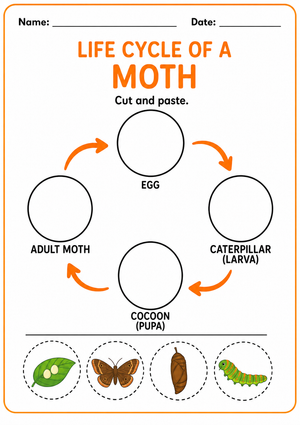
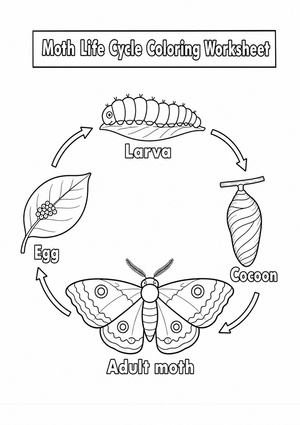
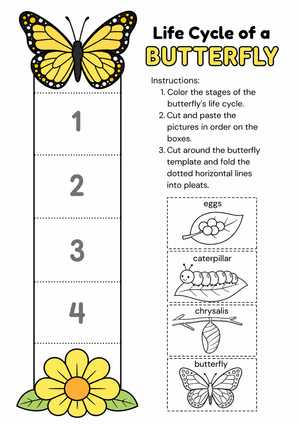
1st grade insect life cycle printable worksheets sets give teachers a concrete, repeatable way to build sequence reasoning and early science vocabulary without asking young students to read long passages. Each worksheet in this collection centers on one focused visual task — cut-and-paste sequencing, diagram labeling, image matching, or a coloring activity paired with stage identification — so students encounter the same science idea through different demands across the unit. Butterfly and ladybug cycles are both represented, which matters more than it might seem at first.
What Each Worksheet Targets
A strong set of 1st grade insect life cycle printable worksheets resources keeps every task visual and discrete, and this collection follows that principle throughout. Students sequence four-stage picture cards from egg to adult, write or match labels onto blank diagram lines, sort stage images between two insect examples, and complete cycle arrows to show that the sequence loops back to the beginning. These are not interchangeable tasks — each one presses on a different kind of understanding.
Alongside the science content, students practice fine motor control during cutting and gluing tasks, left-to-right directionality when scanning word bank labels, and academic vocabulary production in a low-stakes written format. A student who colors the larva card and then locates the matching printed word has done something more cognitively demanding than checking a box: they have connected a visual representation to print and to meaning, all three at once.
Why the Cut-and-Paste Format Works Here
Grade 1 is the developmental window when children can hold a multi-step sequence in mind and represent it on paper, but still benefit from having steps made visible and moveable. Physically placing a chrysalis card between the caterpillar card and the adult butterfly card does something a fill-in-the-blank question cannot: it makes students act out the order before they record it. The physical movement functions as working memory support — the sequence lives outside the student's head for a moment, which reduces cognitive load enough for the science idea to register.
The worksheets separate labeling from sequencing rather than stacking both demands into one worksheet. That decision matters in a Grade 1 classroom. Students who are still developing reading fluency see a page loaded with images to place, words to write, and arrows to draw — and many of them shut down at the visual complexity, not because the science is too hard. One main demand per worksheet keeps both tasks accessible and keeps you informed about what students actually understand.
The Misconceptions That Surface, and Why They Appear
The most consistent error in Grade 1 life cycle work is placing the pupa or chrysalis last. Students associate stillness and enclosure with completion — the chrysalis looks finished to them, so it becomes the endpoint. The cut-and-paste format surfaces this immediately: you see the adult butterfly card sitting unused on the table while the chrysalis occupies the final slot. The cycle arrow built into the worksheet — the one that loops back to the egg — makes the error visible in student work rather than invisible in a hand-raise.
A second pattern emerges once students move from the butterfly worksheets to the ladybug set: they add a pupa stage that isn't there. They have internalized the four-stage butterfly pattern thoroughly enough that they assume all insects follow it. One worksheet places both insect diagrams side by side, which forces that comparison before the assumption hardens. You will also see students write "baby bug" in the larva label box even when the word card is right in front of them — they are reaching for familiar vocabulary over science vocabulary, and catching that in writing gives you precise information for small-group follow-up that a verbal check-in rarely produces.
Where These Worksheets Fit in the School Day
The cut-and-paste sequencing worksheets land best the day after a read-aloud or short video clip, when images are still fresh and the class has already discussed the stages together. Use the labeling pages as morning work the following day — the 10 minutes before morning meeting gives students something independent and quiet that reviews vocabulary without requiring new instruction. By mid-unit, the coloring-and-matching worksheets make a natural Friday block: they take about 8 minutes, call up the vocabulary one more time, and need no setup from you.
For science centers, laminate the card-sort versions and set them out with small sorting mats and both insect sets. While pairs work through the cards independently, you can pull students for a reteach group without losing the class. The notebook pages function best as unit closures: students glue in a completed sequence, then tell a partner what each stage is called before writing one sentence about what changes. That oral step before the writing lowers the language demand without reducing the science expectation.
One Set, Multiple Entry Points
For students who freeze when they see a page with multiple images and decision points, pre-cutting the stage cards removes a barrier that has nothing to do with science understanding. A sentence frame posted at the table — First it is a ___, next it becomes a ___, last it is an adult ___ — lets those students engage the sequencing task without the added cognitive cost of generating academic language from scratch. That is a structural support, not a reduction in the science content being asked.
Students who move quickly through the standard labeling pages are ready to do something the core worksheets don't ask: compare two insects in writing. A blank two-column table with the prompt "How is the life cycle different?" pushes them toward analysis rather than recall. That extension requires no separate printable — a sticky note and two minutes of discussion accomplish it, and the student's written response tells you something about conceptual depth that a filled-in label page cannot.
For multilingual learners, the 1st grade insect life cycle printable worksheets format offers a genuine advantage. The visual-first design means students can demonstrate sequence understanding before they control the English vocabulary. Point to each image, say the stage name, have the student repeat and place the card — print becomes meaningful after meaning is already established in context.
Frequently Asked Questions
Which insects are covered in the set?
The worksheets cover butterfly and ladybug life cycles. Butterflies give students a clear four-stage complete metamorphosis to work with; ladybugs provide a three-stage comparison that prevents students from treating the butterfly pattern as a universal rule for all insects. Having both in the set makes the side-by-side comparison worksheet possible and developmentally necessary.
Can these worksheets be used in kindergarten?
The sequencing and picture-matching tasks work for kindergarteners with teacher support during small-group instruction. The labeling pages, which require print matching and basic word recognition, are better suited to Grade 1 students who have developed some print awareness. A kindergarten teacher could use the card-sort materials in a guided group and save the labeling worksheets for spring, when print skills are stronger.
How do these worksheets function as a formative assessment tool?
Because students write or physically place labels rather than select from a list, the worksheets surface specific misunderstandings. The student who writes "butterfly egg" for the larva card is communicating something different from the student who leaves the label blank. Review completed work the same day you collect it — errors cluster in predictable ways and point directly to what the next small-group session should address. These 1st grade insect life cycle printable worksheets pages give you that specificity in student evidence that multiple-choice formats simply cannot.
Do these print clearly in black and white?
Yes. Sequencing, labeling, and matching worksheets use clean line art that reads clearly in grayscale. The coloring tasks work best when students have crayons available, but the science content on those worksheets is not lost in black-and-white printing — the images remain clear enough to label, sequence, and match accurately.












 Interactive Worksheet Maker
 Quiz Maker
 Word Search Maker
 Crossword Puzzle Maker
 Word Scramble Generator
 Sentence Scramble Generator
 Handwriting Worksheet Generator
 Name Tracing Generator
 Fill In The Blank Generator




 BACK TOSCHOOL