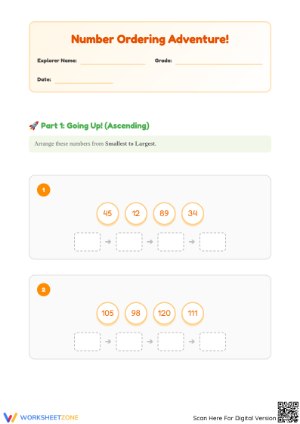
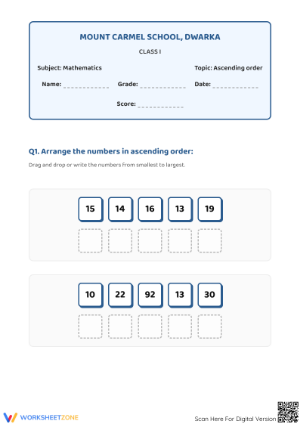
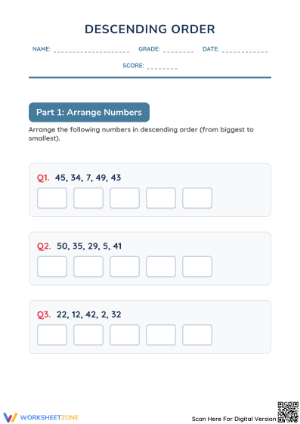
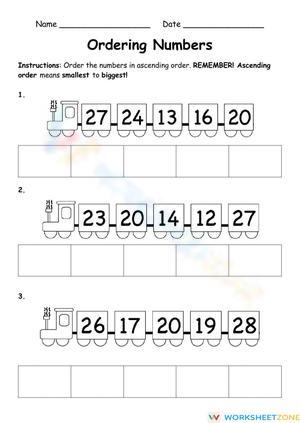
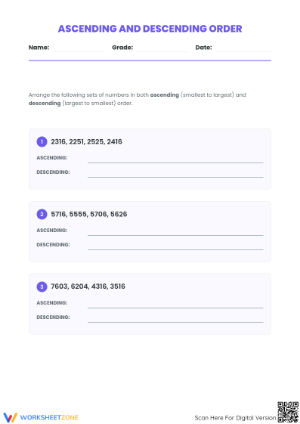
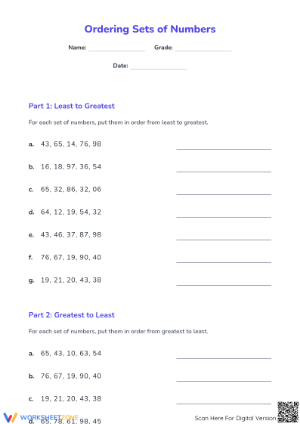
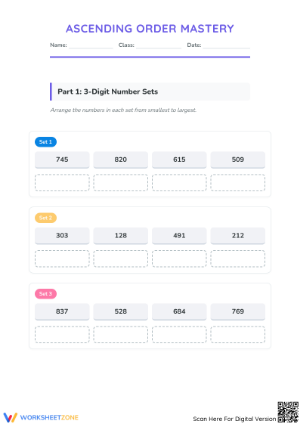
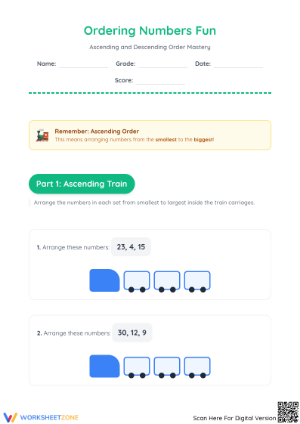
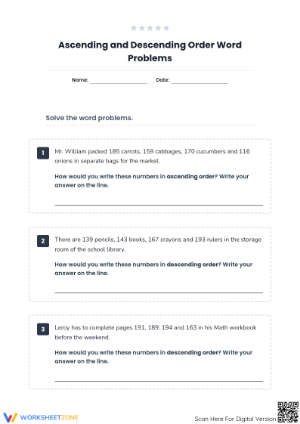
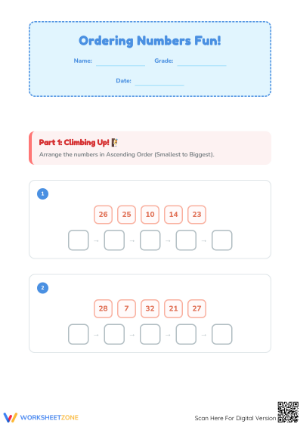
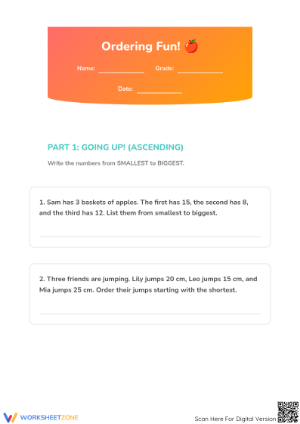
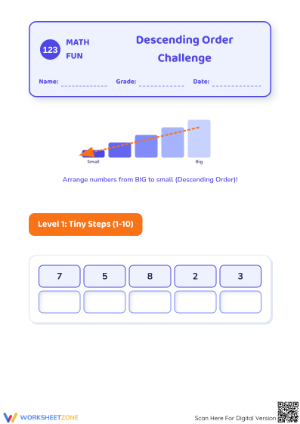
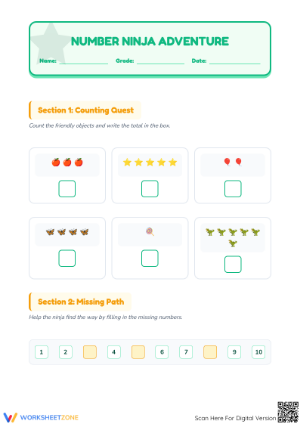
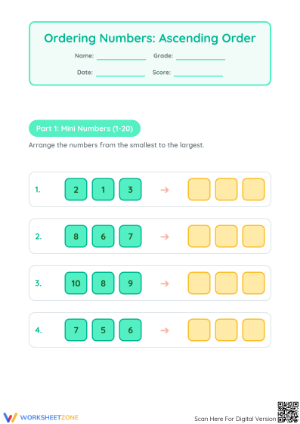
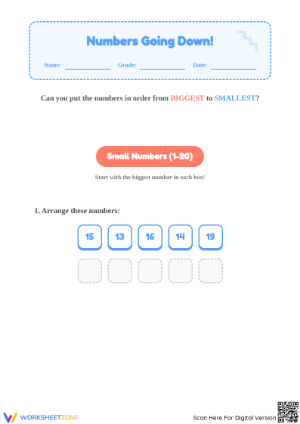
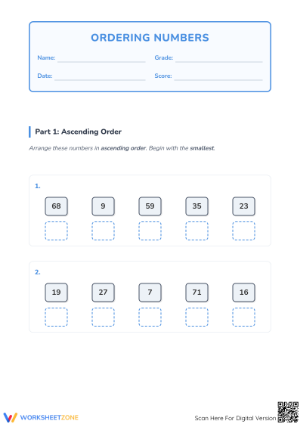
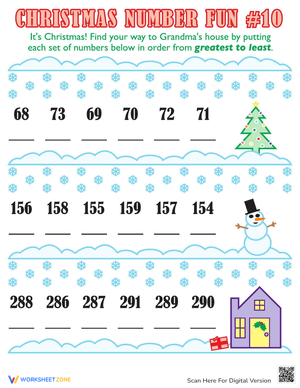
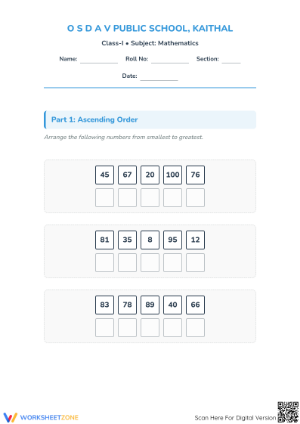
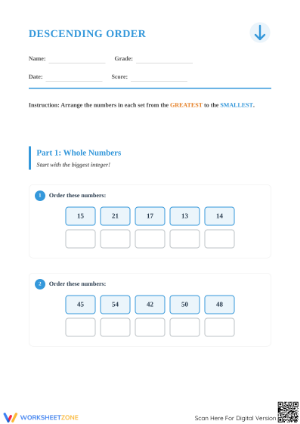
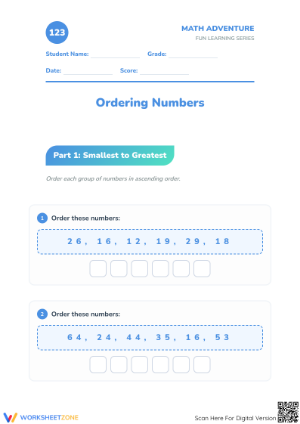
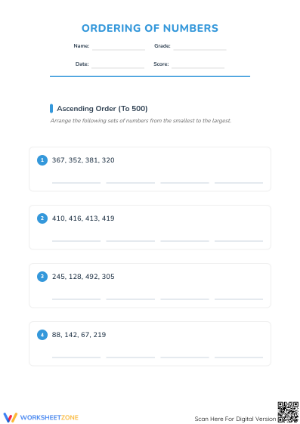
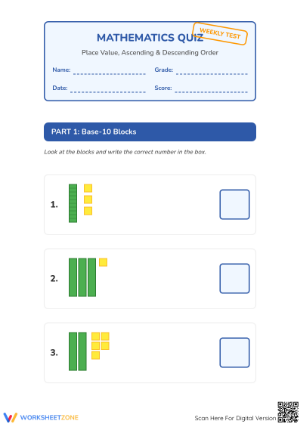
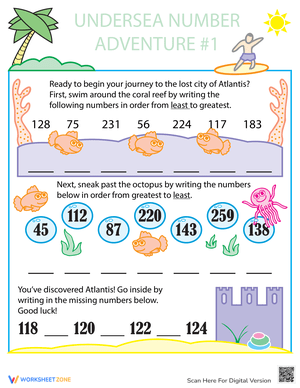
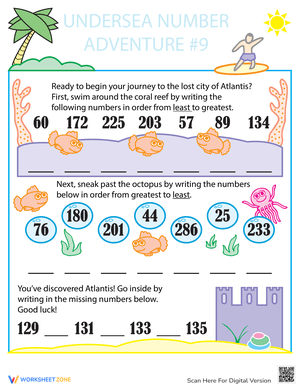
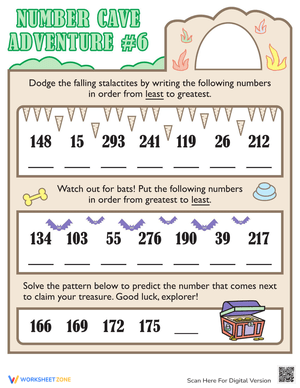
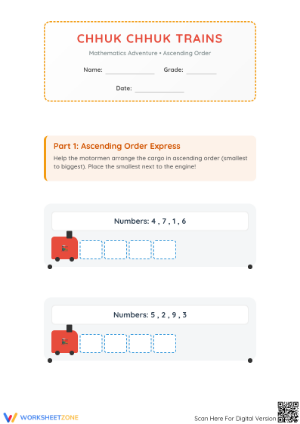
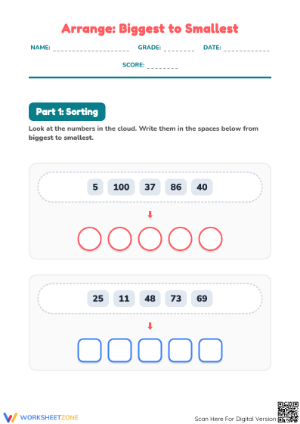
When grade 1 students arrange numbers in ascending order, they are placing them from smallest to largest. When they arrange numbers in descending order, they are placing them from largest to smallest. These two terms sound abstract on their own, but for six- and seven-year-olds, the concept becomes concrete the moment it is tied to something they can see and touch, such as counters lined up on a desk or numbers written on sentence strips. Before students can order numbers confidently, they need a secure sense of which number is bigger and which is smaller, so ordering tasks work best once basic number comparison has already been introduced.
Why This Skill Matters for CCSS.1.NBT.B.3
Ordering practice is not a standalone worksheet activity. It directly supports CCSS.MATH.CONTENT.1.NBT.B.3, which asks students to compare two two-digit numbers based on the meaning of the tens and ones digits, using the symbols greater than, equal to, and less than. A student who can consistently place a set of numbers in ascending or descending order is demonstrating the same underlying reasoning the standard requires: understanding relative magnitude, not just reciting number names in sequence. Framing ordering worksheets as comparison practice, rather than a separate skill, helps teachers connect this activity to formal grade 1 assessment expectations.
Connecting the Less Than and Greater Than Symbols to Order
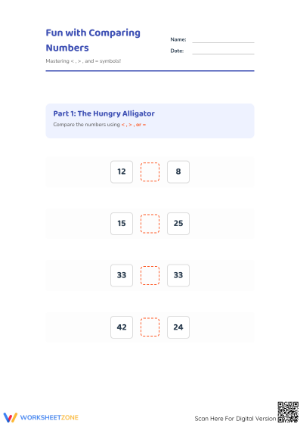
Grade 1 students are also learning to use the less than and greater than symbols as part of CCSS.1.NBT.B.3, and ordering practice is a natural bridge to that symbol work. Ascending order lines up naturally with a repeated less than pattern, since each number is smaller than the one that follows it. Descending order lines up with a repeated greater than pattern for the same reason. Once students have ordered a set of numbers correctly, asking them to insert the correct symbol between each pair reinforces both skills in a single activity and gives teachers a built-in extension for students who finish early.
Classroom Implementation
Start with sets of five to seven single-digit numbers for on-level grade 1 learners, since larger sets increase working memory demands beyond what many students can manage independently. Advanced students can move to two-digit numbers, which keeps the ordering skill connected to the two-digit focus of CCSS.1.NBT.B.3. Use manipulatives before moving to paper: number cards that students can physically slide into a line make errors visible and easy to correct, and they let a teacher catch a reversed order before it becomes a habit. Once students are ready for independent worksheets, keep the staircase or slide icon printed at the top of the page as a standing visual reminder, and rotate between ascending-only, descending-only, and mixed-practice sheets across the week so students do not simply memorize a single fixed pattern.
Frequently Asked Questions
1. What is the difference between ascending and descending order for grade 1 students?
Ascending order means arranging numbers from smallest to largest, while descending order means arranging numbers from largest to smallest. Teachers commonly use a staircase image for ascending order and a slide image for descending order to help students remember the direction each term represents.
2. Which Common Core standard covers ordering numbers in grade 1?
Ordering practice supports CCSS.MATH.CONTENT.1.NBT.B.3, which focuses on comparing two two-digit numbers using the greater than, less than, and equal to symbols based on the value of the tens and ones digits.
3. What are simple memory tricks to help students remember ascending versus descending?
The staircase-and-slide pairing is the most widely used trick: a staircase goes up, matching ascending order, while a slide goes down, matching descending order. Pairing each term with the matching greater than or less than symbol pattern reinforces the same idea using the comparison symbols students are already learning.
4. How can teachers assess whether a student truly understands number order versus just memorizing a worksheet pattern?
Mix up the format regularly. Alternate between ascending-only, descending-only, and mixed sets, and occasionally ask students to label an already-ordered set as ascending or descending rather than always asking them to do the ordering themselves. A student who can only perform one direction or one format is likely pattern-matching rather than reasoning about magnitude.
5. How many numbers should a grade 1 ordering worksheet include for appropriate difficulty?
Five to seven single-digit numbers is an appropriate starting range for on-level grade 1 students, since larger sets place heavy demands on working memory. Advanced learners can move to two-digit numbers, which also keeps the practice aligned with the two-digit comparison work required by CCSS.1.NBT.B.3.













 Interactive Worksheet Maker
 Quiz Maker
 Word Search Maker
 Crossword Puzzle Maker
 Word Scramble Generator
 Sentence Scramble Generator
 Handwriting Worksheet Generator
 Name Tracing Generator
 Fill In The Blank Generator