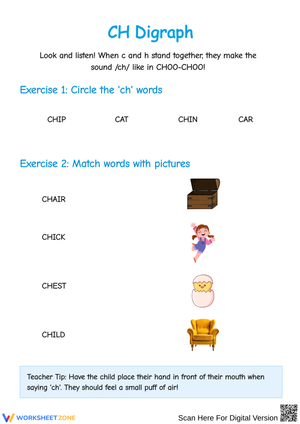
1st grade ch digraph printable worksheets give teachers a concrete tool for one of the trickier early phonics patterns — two letters, one sound, and a position that shifts depending on the word. Students encounter ch at the start of chip and chat and at the end of much and lunch, and they need practice in both positions before the pattern sticks in their reading and spelling.
Mistakes Students Make That These Worksheets Help You Catch
The most common error with ch is treating it as two separate letters rather than a single unit. Students who are just entering digraph territory often pause on the c, attempt to add the h sound independently, and land on something closer to /k/-/h/ than the target /ch/. On worksheets with word lists, this shows up as visible hesitation or a consistent mispronunciation of words like chin and chop that students otherwise know by sight.
Ending ch causes more trouble than beginning ch. A student who reads chin without hesitation will still write muc when asked to spell much. This is a spelling-retrieval problem, not a reading one — the digraph at word endings carries less auditory weight than the initial sound, so students hear something soft and reach for a single letter. Worksheets that pair a reading column with a write-back task in the same sitting let you see whether decoding and encoding are equally secure or whether one lags behind the other.
A smaller but persistent confusion is between ch and sh. Both are two-letter combinations that produce one sound, and students still sorting out digraphs in general sometimes swap them — writing shop for chop or placing chip in the sh column during a sort. When this happens, the fix is almost always oral rather than written: have the student say both sounds clearly, feel the physical difference, and then return to the worksheet. Repeated written drilling alone will not resolve that confusion.
What's Inside the Set
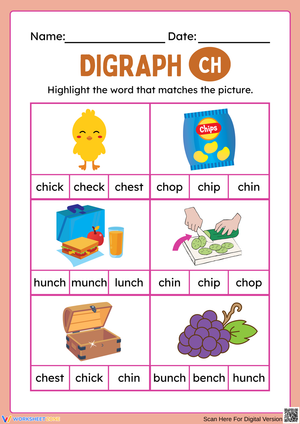
The worksheets cover the ch pattern across several task types because reading a digraph and spelling it are not the same skill — students need practice in both directions. Across the set, students work through tasks that move from recognition toward production:
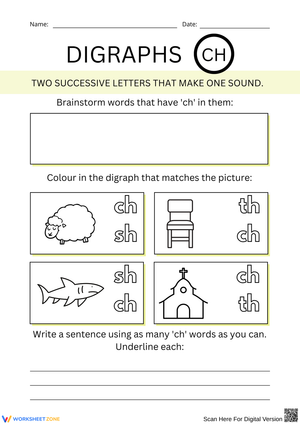
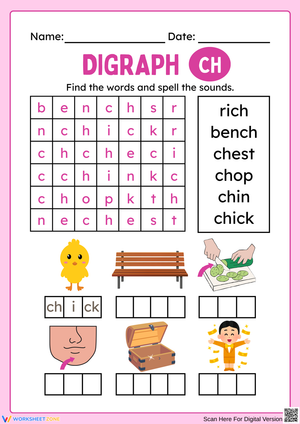
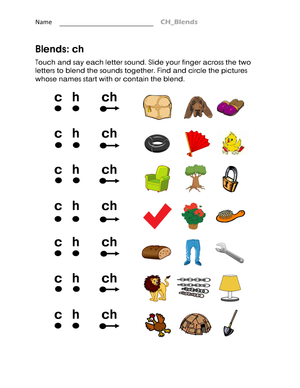
- Underline or circle ch within mixed letter strings and real words
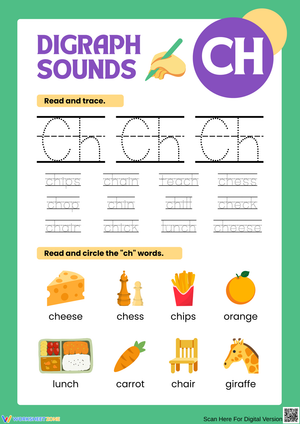
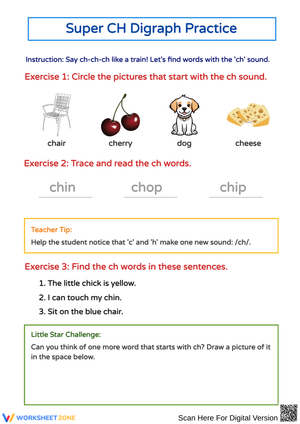
- Match pictures to printed words — chin, chick, bench, lunch, and other high-utility first-grade vocabulary
- Sort words by whether ch falls at the beginning or end of the word
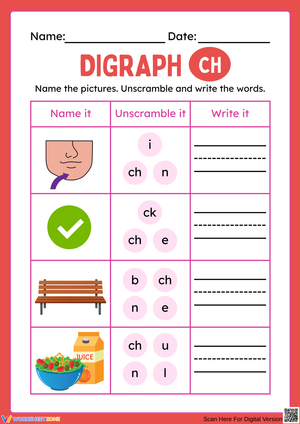
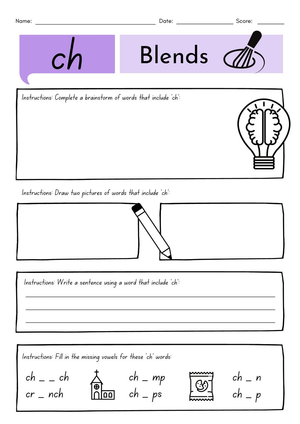
- Fill in missing letters to complete ch words, with and without picture support
- Trace and write target words to build the letter sequence in muscle memory
- Read short decodable sentences built around words students have already practiced
That sentence-level task carries more instructional weight than it might appear. Students who decode chip cleanly on a word list sometimes stumble when the same word appears inside a sentence because attention is now split between word recognition and meaning. Even two or three words per sentence gives students practice applying the pattern under more realistic reading conditions — which is where the skill actually has to perform.
Building These Worksheets Into Your Phonics Block
1st grade ch digraph printable worksheets fit into many parts of the reading block, but the most reliable approach starts before any paper is handed out. Spend 90 seconds doing oral work first: say four or five ch words aloud, have students repeat them, and ask where they hear the sound — beginning or end. Students who arrive at the worksheet already knowing what they are listening for move through the task more productively than those still figuring out the sound from the directions.
A three-day rhythm works well for a weekly sequence. Introduce the pattern on Monday with the recognition or matching worksheet. Use midweek small-group time — typically Wednesday — for the fill-in-the-blank and sorting worksheets, which ask students to produce the pattern rather than just find it. Save the sentence-reading worksheet for Thursday or Friday, after students have had time to absorb the core word set. Returning to the same words — chin, chat, much, bench — across different task formats across the week is spaced retrieval in action, and it builds stronger retention than completing several similar worksheets in a single session.
Literacy centers are a natural home for this set. A cut-and-paste sort or a coloring identification worksheet works well as an independent task because the directions are self-contained and the endpoint is clear. Students who finish early can flip the worksheet over and write two ch words from memory — a quick extension that requires no additional materials and gives you something observable when you circulate.
Standard Alignment
These worksheets address CCSS RF.1.3, which requires first graders to know the spelling-sound correspondences for common consonant digraphs. In classroom terms, that bar means students are expected to decode ch words independently — not just recognize the letters when prompted. The tasks in this set move from teacher-supported recognition toward that independent application, which is the progression the standard describes for Grade 1 phonics instruction. A student who can complete the sentence-reading worksheet without assistance is demonstrating exactly the kind of transfer the standard targets.
Tailoring the Set for Different Learners
Students still working on CVC patterns alongside digraphs benefit from starting with the picture-supported matching and recognition worksheets. Moving to a worksheet where only the printed word appears — no picture beside it — is itself a meaningful increase in demand that does not require pulling a different resource. That transition is worth making deliberately rather than assuming picture support is no longer needed just because a student seems comfortable.
For students who decode ch words accurately but consistently misspell them, pairing the fill-in-the-blank worksheet with a quick oral-rehearsal step helps. Have the student say the word, tap the sounds on their fingers, then write. That sequence slows the impulse to guess at word endings. Students moving comfortably through grade-level phonics can be asked to generate their own sentence using a target word after completing each worksheet — a small extension that shifts from reproduction into genuine compositional use of the pattern.
1st grade ch digraph printable worksheets also support students who need more repetition before a pattern consolidates. Rather than moving the whole class forward, keep one or two worksheets from earlier in the sequence available for students who need another pass. Having a student return to the same sorting or matching task three days later — without any prompting — gives you real information about whether the pattern has settled into long-term memory or is still fragile.
Frequently Asked Questions
Which ch words work best for Grade 1 practice?
Words like chin, chip, chop, chat, chick, much, rich, bench, inch, and lunch are solid choices. They are short, easy to illustrate with pictures, and frequent enough in early readers that students will encounter them beyond the worksheet. Avoid words where ch produces the /k/ sound — school, chorus, chord — since those represent a separate spelling pattern and introduce confusion students are not ready to sort out at this stage.
Can these worksheets work for kindergarteners who are ahead in phonics?
The recognition and picture-matching worksheets are accessible for kindergarteners who have already worked through short-vowel CVC patterns and are ready to move into digraphs. The sentence-reading worksheets assume more reading stamina and are better reserved for students who can already process a simple phrase without support, regardless of grade level.
How many worksheets should I assign in a week?
Two to three, spread across the week, is usually the right amount. Assigning one every day tends to produce mechanical completion rather than genuine retrieval — students finish the task rather than think about the sound. Three well-spaced sessions targeting recognition, then spelling, then sentence reading do more for long-term retention than five consecutive drills on the same skill with no variation in format.
Are these useful for take-home practice?
The picture-matching, coloring, and tracing worksheets translate well to homework because families can understand the task without teacher explanation. Fill-in-the-blank and sentence-reading worksheets are better used in class, where you can hear how students are processing the sound. For 1st grade ch digraph printable worksheets sent home in take-home folders, the matching and tracing options travel most successfully — and including a short note naming the target sound and listing two example words makes a real difference in whether the practice stays productive once students are out of the classroom.












 Interactive Worksheet Maker
 Quiz Maker
 Word Search Maker
 Crossword Puzzle Maker
 Word Scramble Generator
 Sentence Scramble Generator
 Handwriting Worksheet Generator
 Name Tracing Generator
 Fill In The Blank Generator