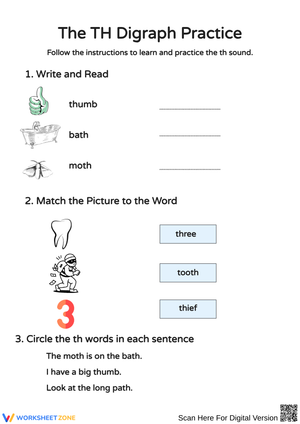
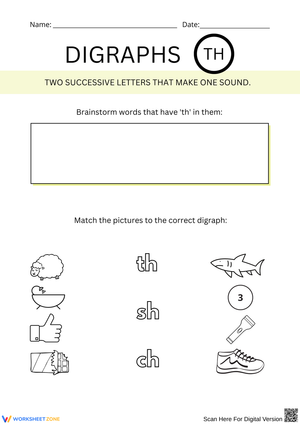
These 1st grade th digraph worksheets address the one consonant digraph in English that produces two distinct phonemes from a single spelling — and that distinction trips up both students and teachers more than most people expect. The set covers voiced "th" (as in this, they, then) and unvoiced "th" (as in thin, bath, thumb), with practice formats that move from picture sorts and articulation awareness into word-level writing and decodable connected text. Because dozens of high-frequency words appearing in week-two first-grade readers use the voiced form, students who haven't sorted out these two sounds carry a real decoding gap into early independent reading.
Two Sounds, One Spelling — Why This Digraph Earns Its Own Unit
Most digraphs first graders encounter make a single sound: sh always says /sh/, ch always says /ch/. The "th" combination breaks that pattern. Teachers who move past the voiced/unvoiced split too quickly find that students can read thin and bath correctly in isolation and still misread they in a sentence because they're applying the wrong phoneme. The voiced sound requires vocal cord vibration — students can confirm this by placing two fingers lightly on their throats while saying them or that. The unvoiced sound uses the same tongue position between the teeth but releases only air. Sorting these two categories explicitly before moving into connected reading prevents a lot of confusion that would otherwise surface weeks later, buried inside fluency errors that are harder to diagnose.
Skills These Worksheets Build
The activities across a 1st grade th digraph worksheets set target four distinct phonics skills rather than cycling through the same format repeatedly.
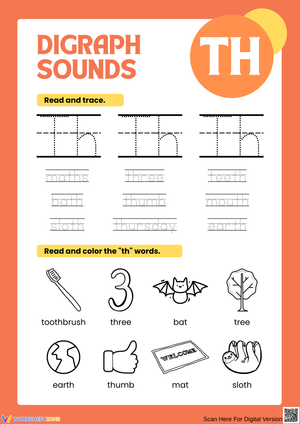
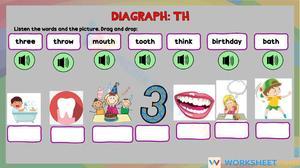
- Voiced and unvoiced sound sorting: Students examine pictures or printed words and sort them into two columns based on whether the "th" they hear vibrates or not. This builds the auditory discrimination that decodable reading requires before spelling instruction can land cleanly.
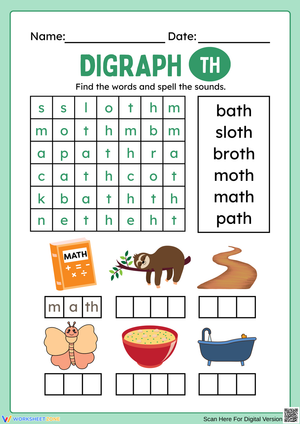
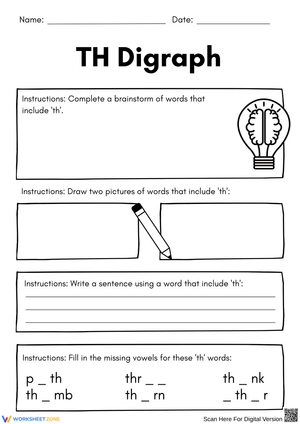
- Position identification: Each worksheet asks students to mark whether "th" appears at the beginning or end of a word — underlining it, circling it, or coding it with a symbol. Think and path might appear on the same worksheet, so students analyze each word rather than applying a blanket rule.
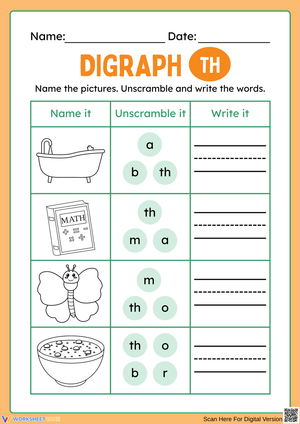
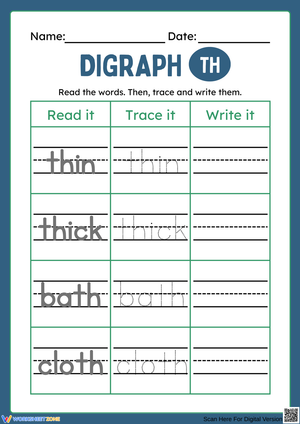
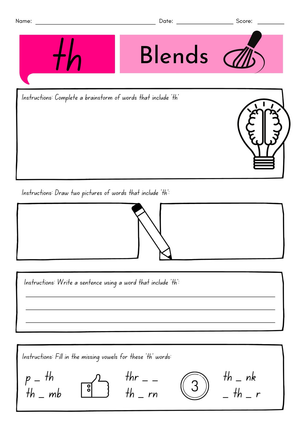
- Word building with short vowel patterns: Students write letters into segmented boxes or arrange letter cards to construct words like thin, then, math, and with. The format reinforces that "th" functions as a single unit, not two letters producing separate sounds in sequence.
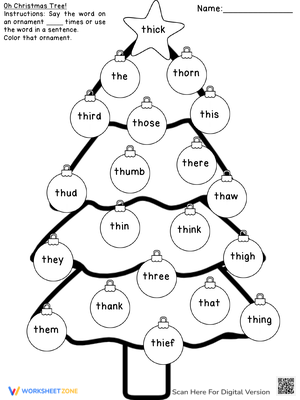
- Decodable passage reading: Short connected texts loaded with target words let students encounter the digraph in context. After reading, students underline every "th" spelling they find — a quick task that reveals whether they've internalized the pattern or are still moving through it letter by letter.
Student Error Patterns That Show Up Early and Often
Three substitution errors appear consistently in first-grade work with this digraph. The most common replaces voiced "th" with /d/: students write "dis" for this and "dem" for them. This isn't carelessness — it's a developmental phonological pattern found across many dialects and language backgrounds, and it won't resolve through phonics drills alone. Students need explicit feedback that ties the spelling back to physical articulation: tongue positioned between the teeth, not tucked behind them.
The second substitution swaps unvoiced "th" for /f/: "fink" for think, "baf" for bath. A hand mirror is more useful here than any worksheet. The student needs to see that the /f/ sound involves the upper teeth pressing against the lower lip, while "th" requires the tongue to break the plane of the teeth entirely. Once they see the difference, the correction tends to stick faster than repeated oral correction does.
The third error is structural rather than articulatory. Some students segment "th" words letter by letter and assign two separate sounds, producing something like "tihink" when attempting to spell think. These students haven't grasped that neither letter individually produces the target phoneme. Sorting exercises that require bracketing the digraph as a unit — [th]ink, [th]en, ma[th] — reframe the concept faster than additional spelling repetition.
Building These Worksheets Into a Phonics Block
The most effective entry point is a whole-group lesson built around physical articulation before any worksheet reaches a desk. Spend five to eight minutes having students stand, place fingers on their throats, and contrast voiced pairs — they/thin, this/thick. When students can feel the difference before they see it in print, the sorting worksheets become confirmatory rather than introductory, which reduces the processing demand that the worksheet itself places on students.
For small groups, these work well as a two-minute warm-up before opening a guided reading text that contains "th" words. Brief word sorting primes students to notice the pattern in running text rather than treating every encounter as a new problem. At the end of the week, using one worksheet as a quick exit task gives teachers a clear read on who has internalized both phonemes and who is still defaulting to a single sound across all "th" spellings. That sorting takes under two minutes to evaluate and tells you exactly which students to pull for a small-group reteach on Monday morning.
Standard Alignment
These resources align directly with CCSS.ELA-LITERACY.RF.1.3.A, which requires first graders to know spelling-sound correspondences for common consonant digraphs. In practical classroom terms, this standard surfaces before students encounter decodable readers that rely on high-frequency words like the, they, this, and then — typically in the first quarter of the school year. Schools using structured literacy programs such as CKLA or 95 Percent Group's phonics sequence introduce consonant digraphs as a cluster, and "th" usually leads because of its high-frequency word load. The worksheets support direct instruction of RF.1.3.A and give teachers documented student practice to reference during data team meetings or phonics scope-and-sequence reviews.
Adjusting the Set for Different Learners in the Same Room
The 1st grade th digraph worksheets in this set accommodate students at different print-readiness levels without requiring teachers to create parallel materials from scratch. Students still working on CVC word fluency can complete the picture sorts and position-identification tasks without needing to read or spell the words independently — those activities rest on phonemic awareness more than print decoding. For those students, pairing the worksheet with a small set of manipulative letter tiles keeps the concept accessible without removing the core phonics goal.
Students who have already secured basic "th" reading and are ready for more challenge benefit most from the decodable passage worksheets followed by a short writing extension: after reading, they write two sentences using words from the text. This moves the skill from recognition into production. For English learners whose home languages don't include dental fricatives — Mandarin, Korean, and many others — additional articulation modeling before independent seatwork matters more than modifications to the worksheet format itself. The physical production challenge needs direct attention before print practice becomes genuinely useful.
Frequently Asked Questions
Do voiced and unvoiced th sounds need to be introduced at the same time?
Not necessarily. Many phonics sequences introduce the unvoiced form first because it appears in more decodable CVC-pattern words at the earliest reading level (thin, math, bath). The voiced sound follows quickly because words like the, this, and they appear in sight word lists from the first weeks of school. In practice, most first-grade teachers find that students encounter both sounds so rapidly in early readers that treating them as a two-part lesson — voiced and unvoiced introduced a few days apart rather than weeks apart — works better than a long gap between the two.
What if a student reads th words correctly but consistently misspells them?
This gap between decoding and encoding is common with digraphs because reading and spelling draw on overlapping but distinct cognitive processes. A student who reads bath correctly may still write "baf" because the spelling retrieval pathway isn't as reinforced as the reading pathway yet. The word-building tasks in these worksheets — where students construct words from segmented boxes rather than copying from a model — target this gap more directly than straightforward write-and-copy formats do.
Are these worksheets meant to replace direct phonics instruction?
No. The 1st grade th digraph worksheets in this set function as practice and consolidation after teacher-led instruction, not as the initial teaching vehicle. First graders need to hear the contrast modeled, feel the articulation, and watch a teacher mark the digraph as a single unit before independent practice produces genuine phoneme-grapheme mapping. Using a worksheet before that foundation is in place tends to generate guessing rather than learning.
How do the sorting and passage worksheets function in a literacy center without a teacher present?
Place the sorting and position-identification worksheets inside dry-erase sleeves. Students mark their responses with a whiteboard marker, copy their answers onto a small recording strip, then erase so the next student can use the same worksheet. For the decodable passage tasks, pair the worksheet with a simple reference card — a set of "th" words sorted into voiced and unvoiced columns — so students can self-check their underlining after finishing. This setup runs independently without adult oversight and keeps any single worksheet usable across a full center rotation cycle.












 Interactive Worksheet Maker
 Quiz Maker
 Word Search Maker
 Crossword Puzzle Maker
 Word Scramble Generator
 Sentence Scramble Generator
 Handwriting Worksheet Generator
 Name Tracing Generator
 Fill In The Blank Generator