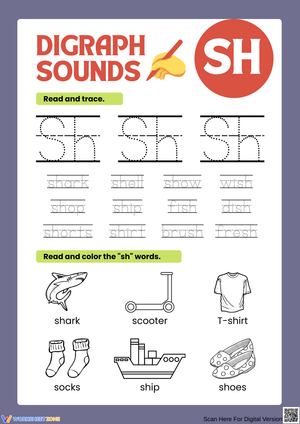
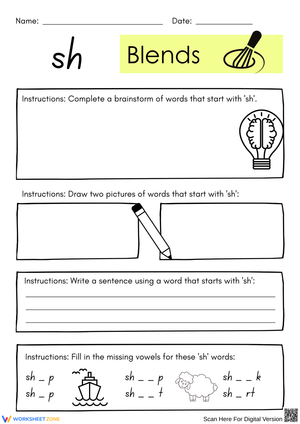
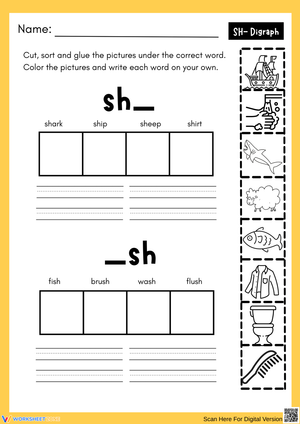
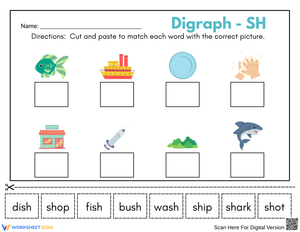
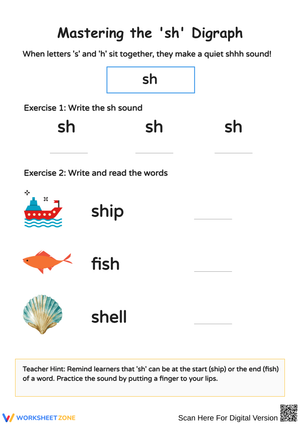
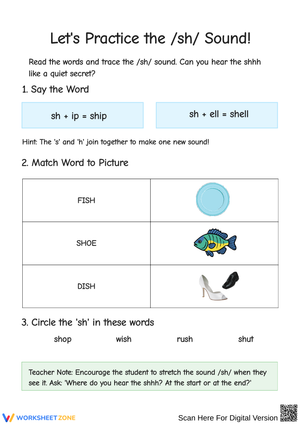
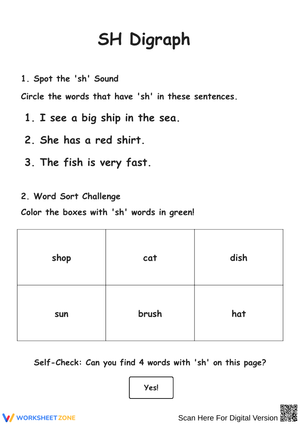
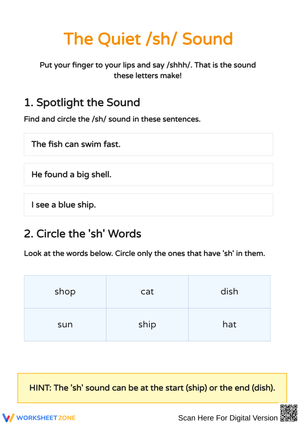
These sh digraph printable worksheets for 1st grade give teachers a focused set of phonics practice resources covering one of the most common two-letter sound spellings students encounter after moving past basic CVC words. The set targets both initial and final positions — "sh" in "shell" and "sh" in "fish" — which most phonics sequences teach together because students need to recognize and produce the sound regardless of where it lands in a word.
The Specific Skills Targeted
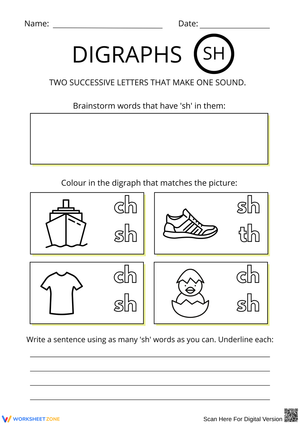
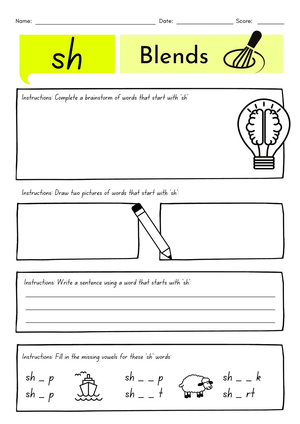
Each worksheet focuses on one core task rather than bundling everything into a single activity. Students work through picture-sort exercises where they mark whether the /sh/ sound falls at the beginning or the end of a word. On other worksheets, they rewrite words with a missing digraph, filling in "sh" to complete spellings like "_ip" or "di_." Several worksheets ask students to underline the digraph within a sentence and then read the sentence aloud — a step that builds automaticity without adding cognitive load from unfamiliar vocabulary. Word-building activities have students arrange letter pieces to form target words, making the point concrete that "s" and "h" operate as a single unit rather than two competing sounds.
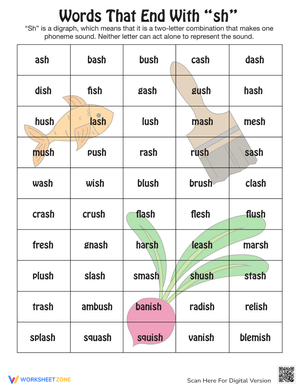
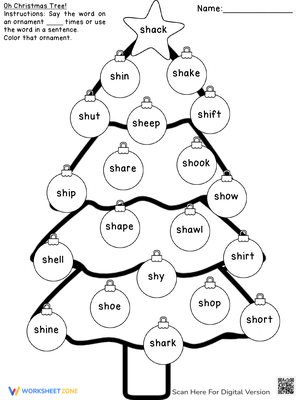
The vocabulary across the set stays deliberately simple: ship, shop, shed, shell, shut, fish, dish, wish, brush, rush. Those are not filler words — they are the words students most frequently encounter in early decodable readers, and quick fluency with them pays off almost immediately in independent reading.
Frequent Student Errors Worth Watching For
The most reliable error pattern is writing the final /sh/ as just "s." A student who can correctly read "fish" will still write "fis" in a sentence because her ear locks onto the hissing quality of the sound and her hand reaches for the single letter that makes that hiss. This is not carelessness — it reflects a genuine perceptual problem where the two-letter spelling feels redundant. Pointing directly at the "sh" in a model word and saying, "these two always travel together, like partners," tends to land better than restating the rule in abstract terms.
A second consistent problem is confusing "sh" with "ch" in both reading and writing. The sounds are produced close to the same place in the mouth, and students who learned "ch" first may over-apply it. The practical distinction worth teaching directly: /sh/ is a sustained breath you can hold out for several seconds, while /ch/ cuts off sharply. Worksheets that sort "sh" and "ch" words side by side help students feel that contrast in real time rather than try to memorize an abstract description. A hand held loosely near the mouth can actually show the difference — the steady stream of air for /sh/ versus the quick burst for /ch/.
A third pattern — less common but worth recognizing — is students who read the final "sh" cluster as two separate sounds, producing something like "fiss-h." This almost always resolves with additional oral practice and rarely needs direct correction beyond more listening repetitions.
How to Build These Worksheets Into Your Lesson Plans
Most teachers introduce the /sh/ sound with five to eight minutes of direct whole-group instruction followed by shared reading of a small set of target words. The picture-sort and underline worksheets work well immediately after that lesson: students are still holding the new pattern in working memory, and a low-stakes task gives them a chance to consolidate it before that memory fades. Using them the same day as the initial lesson — rather than the next morning — makes a noticeable difference in how many students retain the pattern.
For literacy centers, the word-building and cut-and-paste worksheets run well independently because the task directions are embedded in the worksheet format itself. Students can self-monitor without constant teacher check-ins, which matters when a guided reading group is running at the same table. The fill-in-the-blank sentence worksheets are better positioned mid-week, after students have had at least one encounter with the digraph in isolation. Jumping straight to sentence-level work on day one splits attention in ways that often undercut the phonics goal rather than reinforce it.
Using sh digraph printable worksheets for 1st grade as a brief Monday warm-up — one worksheet per week across two or three weeks after the initial lesson — extends exposure without consuming new instructional time. Spaced retrieval at that scale meaningfully improves long-term retention compared to massing all practice into a single day.
Standard Alignment
These worksheets address CCSS.ELA-LITERACY.RF.1.3b, which requires first graders to decode regularly spelled one-syllable words, and more directly CCSS.ELA-LITERACY.RF.1.3, the broader phonics and word recognition standard that explicitly names common consonant digraphs. In practical classroom terms, this standard typically lands in the second semester of first grade under a traditional scope and sequence, after short vowel patterns are stable. Teachers using structured literacy programs such as UFLI or Fundations will find these worksheets fit the digraph unit that appears roughly six to ten weeks into the school year, depending on pacing. The sh digraph printable worksheets for 1st grade also serve kindergartners who are ahead of grade-level expectations and need early digraph exposure, mapping to CCSS.ELA-LITERACY.RF.K.3d.
Adjusting the Set for Different Student Levels
Students still shaky on CVC words need the digraph introduced with the fewest possible moving parts. For those students, begin with recognition-only tasks — the picture-sort and matching worksheets — and hold off on anything requiring independent spelling production. Asking a student to encode a digraph before she can reliably decode it is a reliable way to create confusion that is harder to undo than it was to prevent.
Students who move through the set quickly can extend their work by generating their own "sh" sentences using the target vocabulary, or by hunting for "sh" words in their independent reading books and recording them in a small journal. Neither extension requires additional printed materials. For English language learners, the picture-supported worksheets carry the most value early on because they reduce dependence on English vocabulary knowledge and keep the focus squarely on the phoneme-grapheme connection — the actual phonics goal — rather than word meaning.
Frequently Asked Questions
When in first grade is the "sh" digraph typically introduced?
Most phonics sequences place consonant digraphs after short vowel CVC words are stable, which generally falls in mid-fall through winter of first grade. In kindergarten programs that move quickly, some students encounter digraphs before the year ends. The clearest readiness marker is CVC decoding fluency — if a student still labors through "dog" or "pan," digraph instruction is premature regardless of where the calendar lands.
How do these worksheets differ from what's already in a basal reader program?
Basal programs typically include one or two practice activities per digraph. These worksheets give teachers more format variety — sorting, matching, word building, sentence completion — so students who need additional repetitions work through different task types rather than repeating the same activity. The sh digraph printable worksheets for 1st grade also work as standalone resources for teachers who aren't using a basal at all, or whose program moves through digraphs quickly without enough practice built in.
Can these double as a formative assessment?
The word-completion and sentence fill-in worksheets function well as quick formative checks. Reviewing a finished worksheet takes about thirty seconds: a teacher can see immediately whether a student is confusing "sh" with "s," omitting the digraph in the final position, or substituting "ch" throughout. That is faster than a formal assessment and produces specific information about which error type to address in the next small-group session.












 Interactive Worksheet Maker
 Quiz Maker
 Word Search Maker
 Crossword Puzzle Maker
 Word Scramble Generator
 Sentence Scramble Generator
 Handwriting Worksheet Generator
 Name Tracing Generator
 Fill In The Blank Generator