


























Views
Downloads
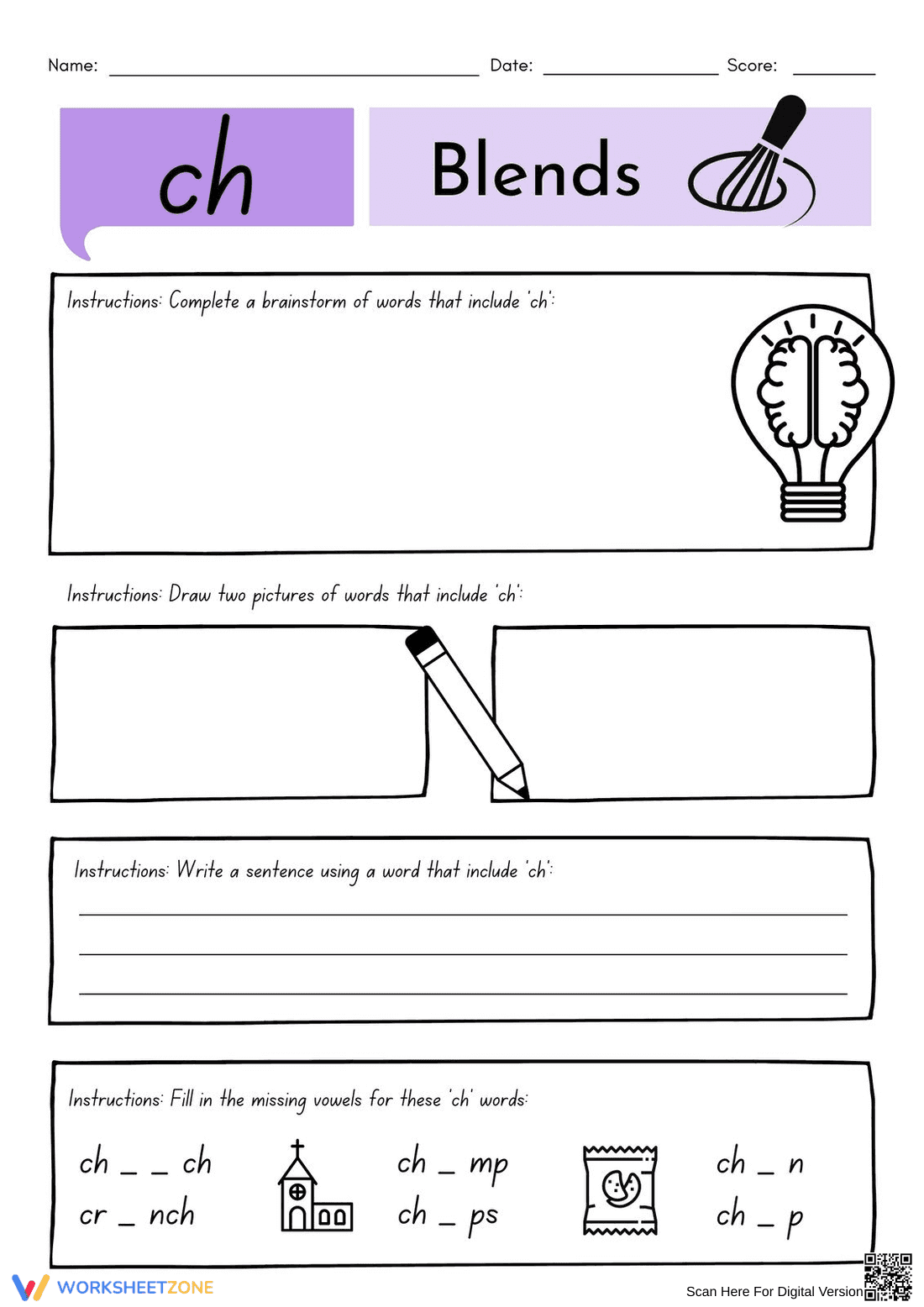

Grade 1 ch Digraphs — Printable No-Prep Worksheet
Paste this activity's link or code into your existing LMS (Google Classroom, Canvas, Teams, Schoology, Moodle, etc.).
Students can open and work on the activity right away, with no student login required.
You'll still be able to track student progress and results from your teacher account.
This Grade 1 phonics worksheet gives students targeted practice with the "ch" consonant digraph. By completing four distinct activities, early readers will strengthen their spelling-sound correspondence and vocabulary. Students brainstorm, illustrate, write, and complete words containing "ch," building essential foundational reading skills in a highly engaging format.
At a Glance
- Grade: 1 · Subject: ELA
- Standard:
CCSS.ELA-LITERACY.RF.1.3.A— Know spelling-sound correspondences for common consonant digraphs.- Skill Focus: ch blends and digraphs
- Format: 1 page · 4 tasks · Answer key included · PDF
- Best For: Independent practice or morning work
- Time: 10–15 minutes
This single-page printable features four varied tasks. It begins with an open-ended brainstorming box for students to recall words with the target sound. Next, they draw two pictures representing "ch" words. The third section requires writing a complete sentence using a "ch" word, integrating grammar. Finally, a fill-in-the-blank section challenges students to supply missing vowels for six illustrated words (like church and chimp). An answer key is provided.
This resource requires virtually zero teacher setup. Print (1 minute): Download the PDF and print a class set. The black-and-white design saves ink. Distribute (1 minute): Hand out the sheets during literacy centers. Instructions are simple enough for independent work. Review (3 minutes): Use the answer key to check the fill-in-the-blank section, or review creative responses together. Total prep time is under two minutes, making it an excellent sub plan.
This activity is directly aligned to CCSS.ELA-LITERACY.RF.1.3.A: Know the spelling-sound correspondences for common consonant digraphs. It also supports basic sentence-level writing and vocabulary development. Both standard codes can be copied directly into lesson plans, IEP goals, or district curriculum mapping tools.
Deploy this worksheet during literacy centers after your direct instruction on consonant digraphs. It serves as an excellent independent activity while the teacher pulls small guided reading groups. Alternatively, use it as a formative assessment at the end of the week to check for mastery of the "ch" sound. As students work, observe whether they can successfully generate their own words in the brainstorm section without relying on the pictures at the bottom of the page. Most students will complete the activities within 10 to 15 minutes.
This resource is ideal for first-grade students mastering foundational phonics skills. It also works well for kindergarteners who are reading above grade level, or second graders needing a quick phonics intervention. The varied task types—ranging from drawing to sentence writing—provide natural differentiation for diverse learning styles. Pair this worksheet with a "ch" digraph anchor chart or a decodable reading passage focusing on the same sound to reinforce the concept in context.
Mastering foundational phonics elements like the "ch" digraph is a critical milestone in early literacy development. According to Fisher & Frey (2014), providing students with varied, multimodal opportunities to interact with new phonetic patterns significantly increases retention and reading fluency. This resource targets CCSS.ELA-LITERACY.RF.1.3.A, ensuring students know spelling-sound correspondences for common consonant digraphs. By combining brainstorming, illustrating, and writing, the worksheet moves beyond rote memorization, allowing learners to process the digraph in multiple contexts. Research consistently shows that when students actively generate their own examples and apply phonics rules to sentence writing, their decoding and encoding skills improve simultaneously. This targeted practice ensures that early readers build the automaticity required for fluent reading and confident writing, laying a strong foundation for future academic success across all subject areas.


