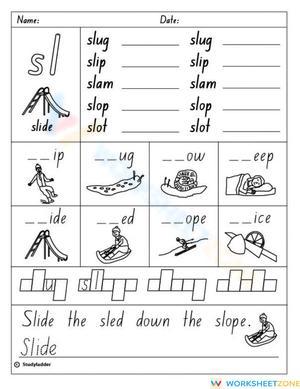
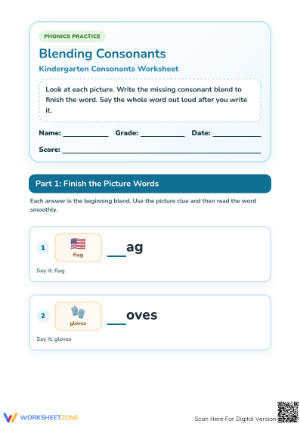
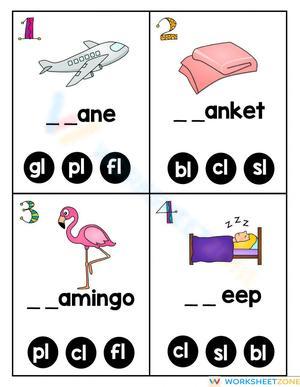
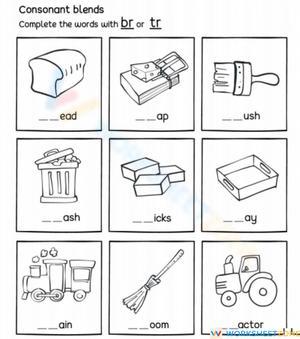
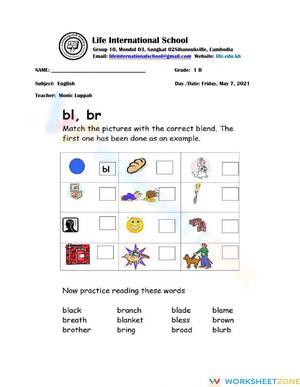
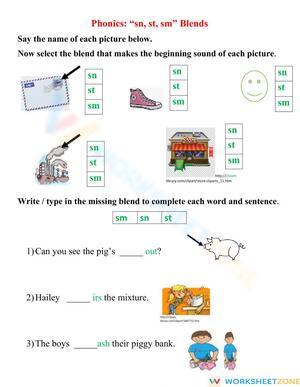
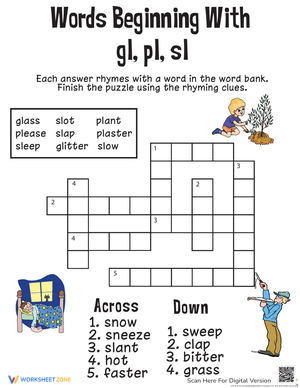
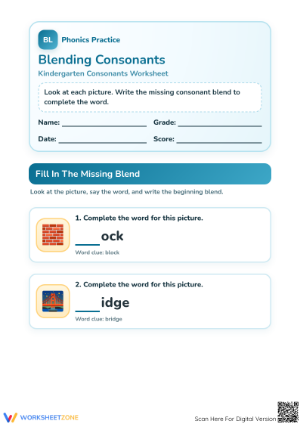
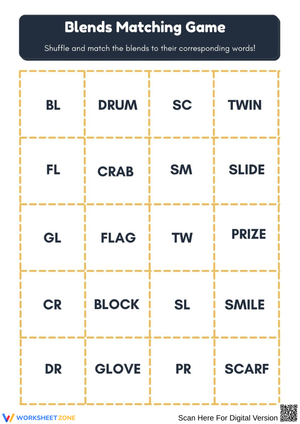
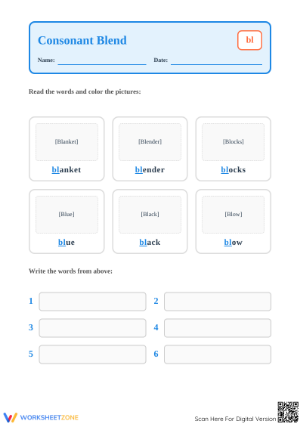
These 1st grade consonant blends printable worksheets give early readers targeted repetition with the consonant clusters that most first graders begin encountering in October — the point in the year when simple CVC words no longer cover what students see in their reading. The set addresses initial L-blends, R-blends, and S-blends alongside final blends (-nd, -st, -mp, -nk, -nt) that appear constantly in decodable texts but rarely receive their own focused practice time.
What's Covered Across the Set
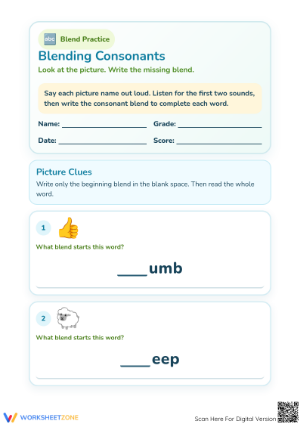
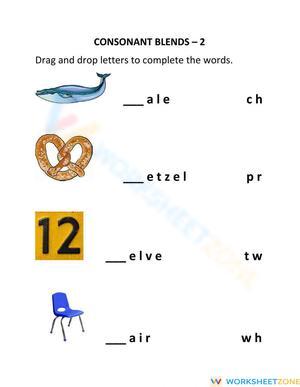
Each worksheet isolates a single blend category rather than mixing everything at once — a deliberate choice that reduces cognitive load during initial instruction. Students underline the blend at the start of a word, write missing letters to complete a word beneath a picture, sort words into two columns by blend family, or read short sentences and circle every blend they encounter. Formats rotate so that no single skill goes untouched.
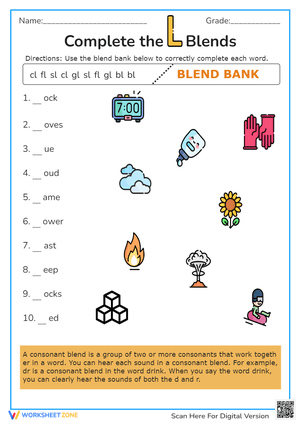
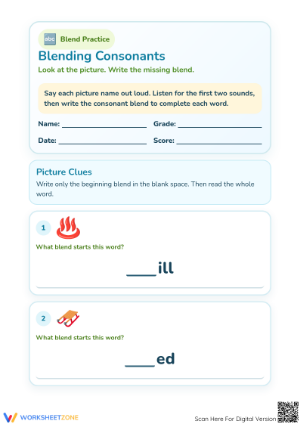
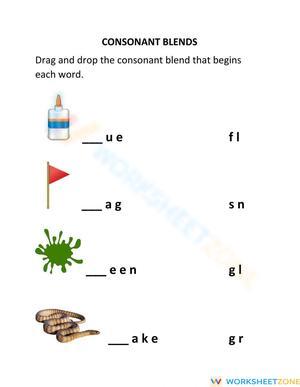
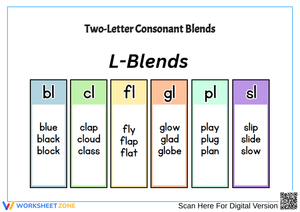
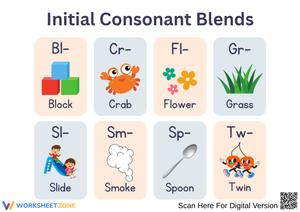
- Initial L-blends (bl, cl, fl, gl, pl, sl): Picture-word matching activities use images like a clock, a flag, and a sled — objects with unambiguous pronunciations that prevent students from guessing the blend from context alone.
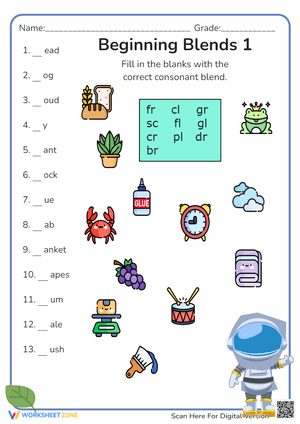
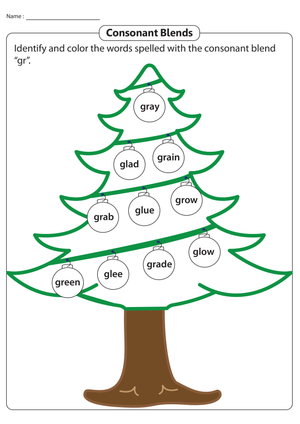
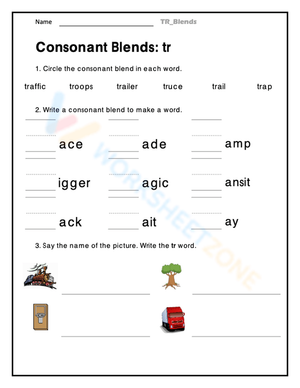
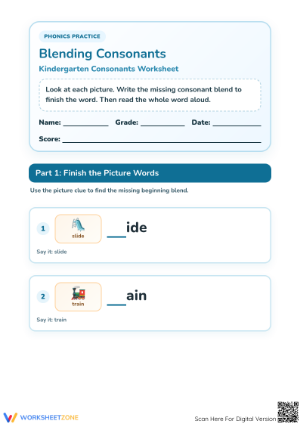
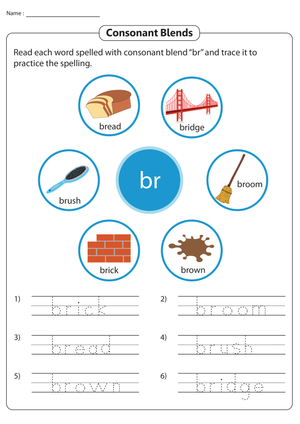
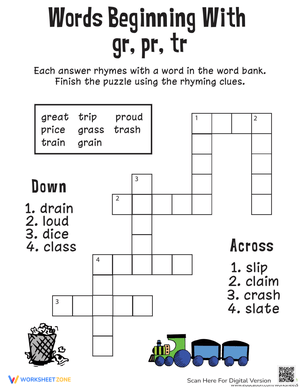
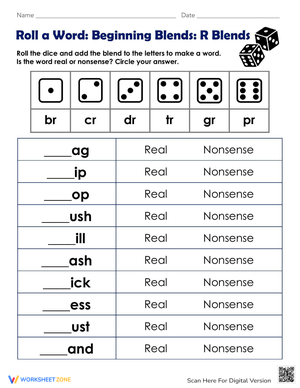
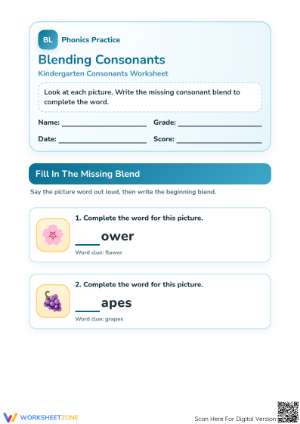
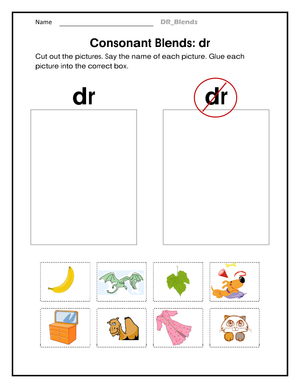
- Initial R-blends (br, cr, dr, fr, gr, pr, tr): Fill-in activities present partial words like "_og" and "_um," requiring students to supply the correct R-blend after hearing the word said aloud, mirroring exactly how dictation works in small-group sessions.
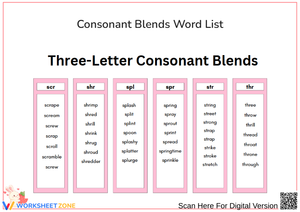
- Initial S-blends (sc, sk, sm, sn, sp, st, sw): Because /s/ is a continuant, students can stretch it and hear the second consonant more distinctly, which makes S-blends a productive entry point before R-blends, where the two sounds fuse much faster in natural speech.
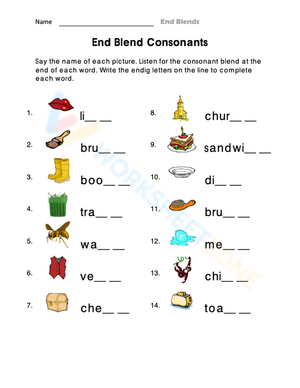
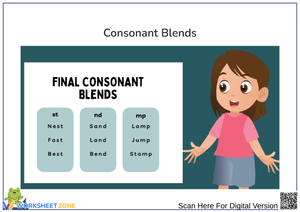
- Final blends (-nd, -st, -mp, -nk, -nt): Word sort and sentence completion exercises direct students' attention to word endings rather than word beginnings — a focus shift that many first graders find genuinely harder than they expect.
What Student Work Actually Reveals About Blend Errors
The most persistent error is blend reduction: a student hears "frog" and writes "fog," dropping one consonant entirely. This is not carelessness — it reflects how quickly adjacent sounds fuse in fluent speech. A student who reads "flag" correctly in isolation will often decode it as "fag" or "lag" in connected text, because surrounding words pull attention away from word-internal detail. Worksheets that ask students to locate and circle blends inside full sentences target exactly this — reading blends under the mild cognitive pressure of sentence-level processing, not just isolated word recognition.
Final blends produce a different set of errors. Students who write "san" for "sand" or "bes" for "best" are not mishearing — they are processing the word's rime chunk and stopping at the vowel rather than tracking through both final consonants. A word completion worksheet, where students hear the whole word and must write both final consonants, makes this pattern visible within the first two or three attempts. Two worksheets from a student who consistently drops the final consonant tell you exactly what your next small-group lesson needs to address.
How to Build These Worksheets Into Your Literacy Block
The most effective placement for 1st grade consonant blends printable worksheets is immediately after whole-group phonics instruction, while the blend pattern is fresh but students have not yet encountered it in reading. Work through the first two or three items together on a projected copy, narrating the decision process aloud ("I see a picture of a drum, I hear /d/ and /r/ before the vowel, so I write d-r"). Then release students to complete the rest independently or in pairs. That transition from guided to independent practice within a single period produces noticeably cleaner student work than sending worksheets home after a lesson ends.
During small-group time, word sort worksheets work best as a warm-up rather than as the main activity. Spending the first four or five minutes having students sort a set of words by blend family focuses attention on the phoneme pattern before any oral reading begins — and the sort doubles as a quick informal check. You can see within two minutes whether a student is confusing R-blends with L-blends or moving through the sort without hesitation.
Dictation-format worksheets work well in independent centers only when the word list is printed on a self-check key at the bottom. Without that, students spend the center time either guessing and reinforcing errors or raising their hands and waiting. Neither outcome is useful. Build the check in, and the center runs cleanly.
Standard Alignment
These worksheets align directly with CCSS ELA-Literacy.RF.1.2b, which requires students to orally produce single-syllable words by blending phonemes, consonant blends included. RF.1.2b sits within the phonological awareness strand, but its connection to print makes it functionally a decoding standard — students who cannot blend consonant sounds in speech cannot decode consonant blends on the page. The worksheet format makes that oral-to-print link explicit by pairing sound work (say the word, identify the blend) with written response (write the letters, complete the word). RF.1.3b, which addresses decoding regularly spelled one-syllable words, is the natural companion standard, and these worksheets support both simultaneously.
Adjusting the Worksheets for a Range of Learners
Students who have not yet consolidated CVC words need a modified entry point before attempting blend work. For these learners, use only the picture-matching worksheets and have them say the blend aloud with a partner before writing anything — the oral production step reduces encoding pressure without removing the phonemic awareness demand. Students reading above grade level can use the same 1st grade consonant blends printable worksheets with an added layer: after completing each worksheet, they write two original sentences using words from the page, which shifts the practice from pattern-matching into generative, contextual use.
For students who freeze when a worksheet presents an unfamiliar picture, keeping a class-built blend chart posted near the workspace gives them a reference point without giving away answers. The chart doesn't complete the worksheet — it tells students which blend families exist, so they are choosing from a bounded set rather than an open-ended one. That small structural support often breaks the paralysis without softening the actual skill requirement.
Frequently Asked Questions
What is the difference between a consonant blend and a digraph, and do I need to teach that distinction explicitly?
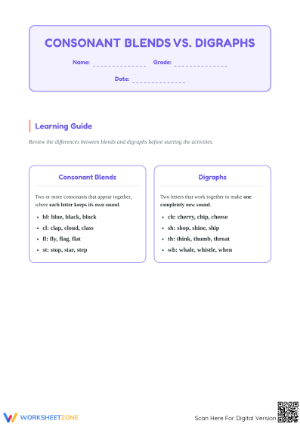
Yes, and it is worth teaching through direct contrast rather than just a definition. In "ship," the /sh/ is a digraph: two letters produce one new sound. In "slip," the /sl/ is a blend: two letters, two distinct sounds that are both audible. Students who internalize this distinction decode more accurately because they know whether to produce one phoneme or two when they meet an unfamiliar letter pair. A worksheet that groups digraphs and blends side by side, asking students to mark how many sounds they hear, makes the contrast tangible rather than theoretical.
Which blends should I introduce first?
Start with L-blends. The /l/ is slow and easy to hold, so students can literally hear the two consonants when a word like "clap" is stretched out. R-blends fuse more quickly in natural speech — "frog" sounds close to a single onset to many first graders — so they benefit from coming second, once students already have a working model of what a blend sounds like. S-blends can follow either group; the continuant quality of /s/ makes them accessible regardless of placement. Final blends come last in most programs and benefit most from an Elkonin box approach, where students tap out each phoneme individually before writing.
Can these worksheets serve as formative assessment, or are they strictly practice tools?
The dictation-format worksheets function cleanly as formative assessments when collected and reviewed right after a lesson. Scanning three students' completed worksheets takes about ninety seconds and tells you which specific blends are solid and which need re-teaching before the week ends. Word sort worksheets are harder to use as assessment because students often self-correct their sorts before handing them in — use those for practice and reserve dictation for data collection. A set of 1st grade consonant blends printable worksheets completed across one instructional week gives a readable arc of how blend mastery is developing, especially when kept in a dated folder rather than sent home immediately.












 Interactive Worksheet Maker
 Quiz Maker
 Word Search Maker
 Crossword Puzzle Maker
 Word Scramble Generator
 Sentence Scramble Generator
 Handwriting Worksheet Generator
 Name Tracing Generator
 Fill In The Blank Generator