


























Views
Downloads
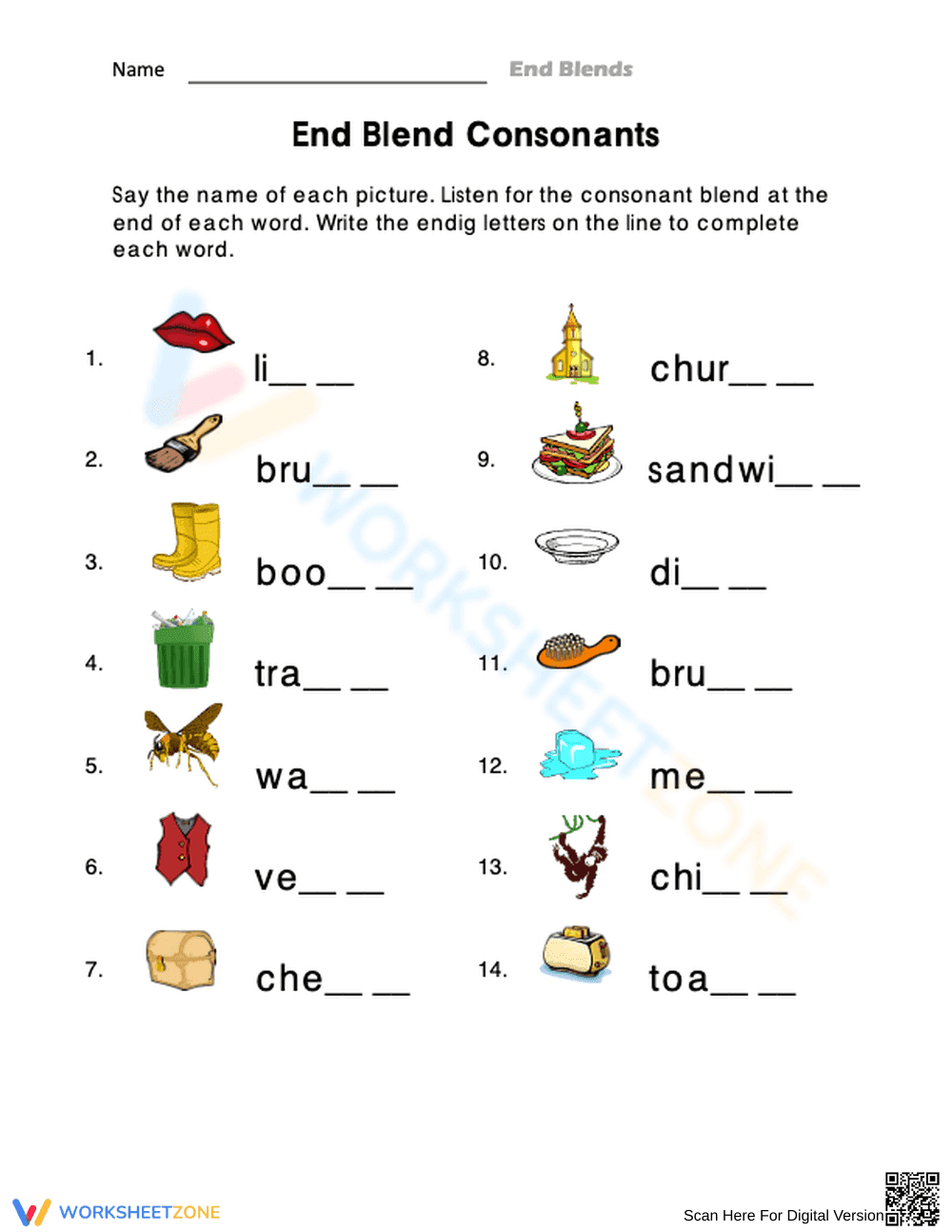

Essential End Blend Consonants Worksheet | Grade 1 Phonics
Paste this activity's link or code into your existing LMS (Google Classroom, Canvas, Teams, Schoology, Moodle, etc.).
Students can open and work on the activity right away, with no student login required.
You'll still be able to track student progress and results from your teacher account.
This Essential End Blend Consonants worksheet provides students with targeted practice in identifying and writing final consonant blends. By matching high-frequency vocabulary images with phonetic completion tasks, learners strengthen their phonemic awareness and orthographic mapping skills. This resource is designed to bridge the gap between hearing final sounds and accurately representing them in written form during independent work.
At a Glance
- Grade: 1 · Subject: English Language Arts
- Standard:
CCSS.ELA-LITERACY.RF.1.3— Apply grade-level phonics and word analysis skills in decoding words- Skill Focus: End Blend Consonants
- Format: 1 page · 14 problems · Answer key included · PDF
- Best For: Phonics centers and quick formative assessment
- Time: 15–20 minutes
What's Inside: This single-page PDF includes 14 structured tasks where students must observe a picture, say the word aloud, and fill in the missing end blend consonants. The worksheet features clear, recognizable illustrations such as a sandwich, a chest, and a toaster to provide meaningful context. A comprehensive answer key is included to allow for quick grading or student-led self-correction during independent rotations.
Zero-Prep Workflow
- Print (30 Seconds): Select the page and print enough copies for your small group or entire class.
- Distribute (30 Seconds): Hand out the sheets with pencils; the clear instructions mean students can begin working immediately.
- Review (1 Minute): Use the included answer key to check for common phonetic misconceptions after the session.
This streamlined process ensures that teacher prep time is kept under two minutes, making it an excellent option for morning work or emergency sub plans.
Standards Alignment: The primary focus is CCSS.ELA-LITERACY.RF.1.3, which requires students to know and apply grade-level phonics and word analysis skills in decoding words. Specifically, it targets the isolation and production of final consonant blends in single-syllable words. This standard code can be copied directly into lesson plans, IEP goals, or district curriculum mapping tools.
How to Use It: This worksheet is best utilized during the "independent practice" phase of a phonics lesson after the teacher has modeled how to stretch out the sounds in a word. For a formative assessment observation tip, walk around as students work and listen for those who are struggling to articulate the final phoneme before writing. It also serves as a perfect reinforcement activity following an anchor chart review of common end blends.
Who It's For: This resource is ideal for first-grade students or second graders who require additional intervention in foundational literacy. It is particularly effective for English Language Learners who benefit from the visual cues provided by the illustrations. Pair this worksheet with a decodable text focused on final blends to provide a complete instructional cycle.
According to the ScienceDirect TpT Analysis of successful primary literacy tools, targeted phonics intervention through discrete skill practice significantly improves orthographic mapping in early readers. This Grade 1 worksheet focuses on CCSS.ELA-LITERACY.RF.1.3 by requiring students to isolate and apply ending consonant blends—a critical milestone for decoding fluency. By pairing visual stimuli with phonetic completion tasks, learners bridge the gap between phonemic awareness and written production. The 14 structured exercises provide the repetition necessary for mastery without causing cognitive overload, making it an ideal resource for tier-one instruction or targeted intervention. Educational research emphasizes that explicit instruction in final blends prevents future spelling deficits by ensuring students perceive all sounds within a syllable. This resource offers a high-impact, low-prep method for assessing student readiness for more complex multi-syllabic decoding. Educators can use these results to inform small-group placements or to track progress toward foundational literacy benchmarks throughout the school year.


