


























Views
Downloads

Printable Consonant Blends Worksheet | Grade 1 Phonics
Paste this activity's link or code into your existing LMS (Google Classroom, Canvas, Teams, Schoology, Moodle, etc.).
Students can open and work on the activity right away, with no student login required.
You'll still be able to track student progress and results from your teacher account.
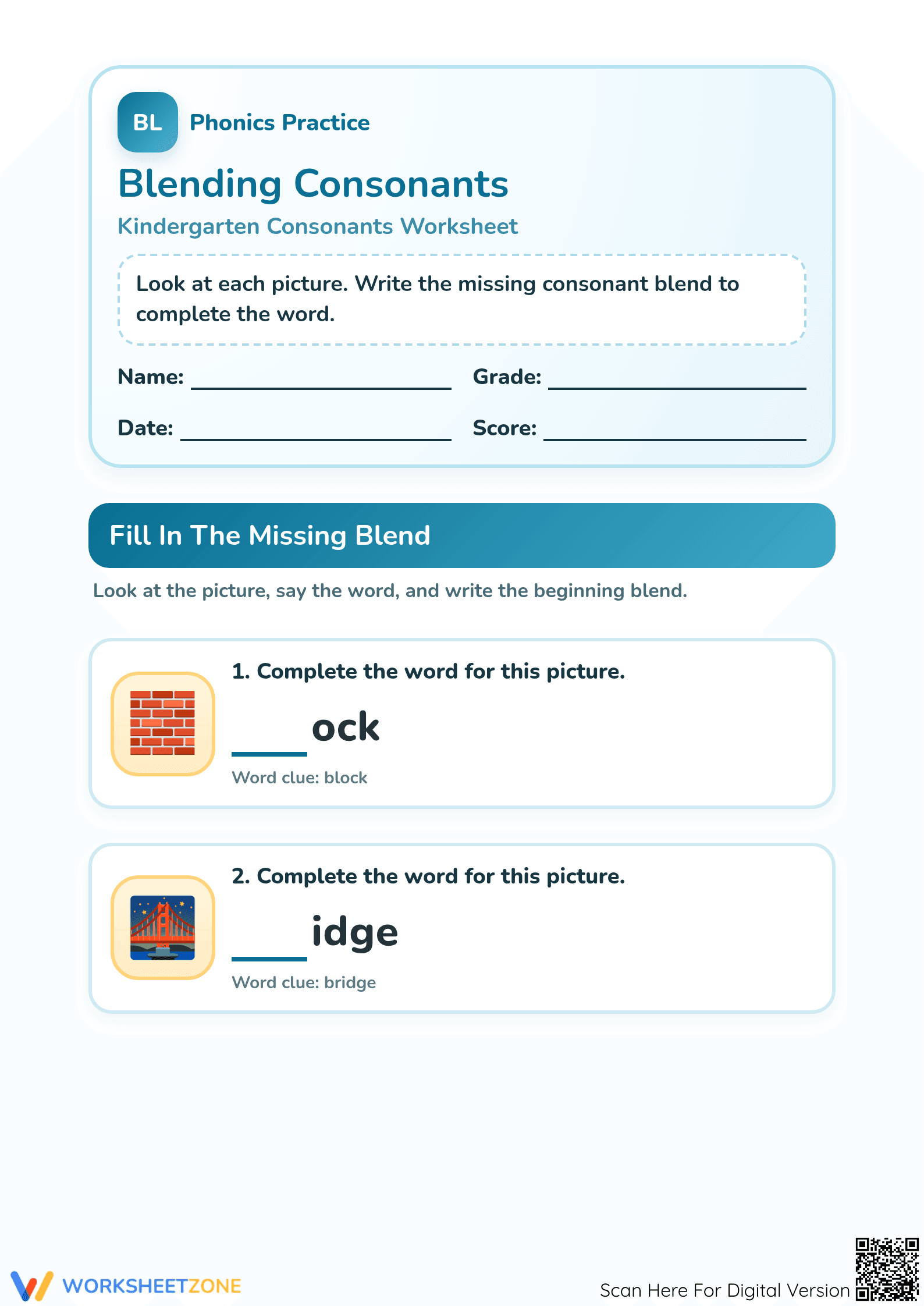
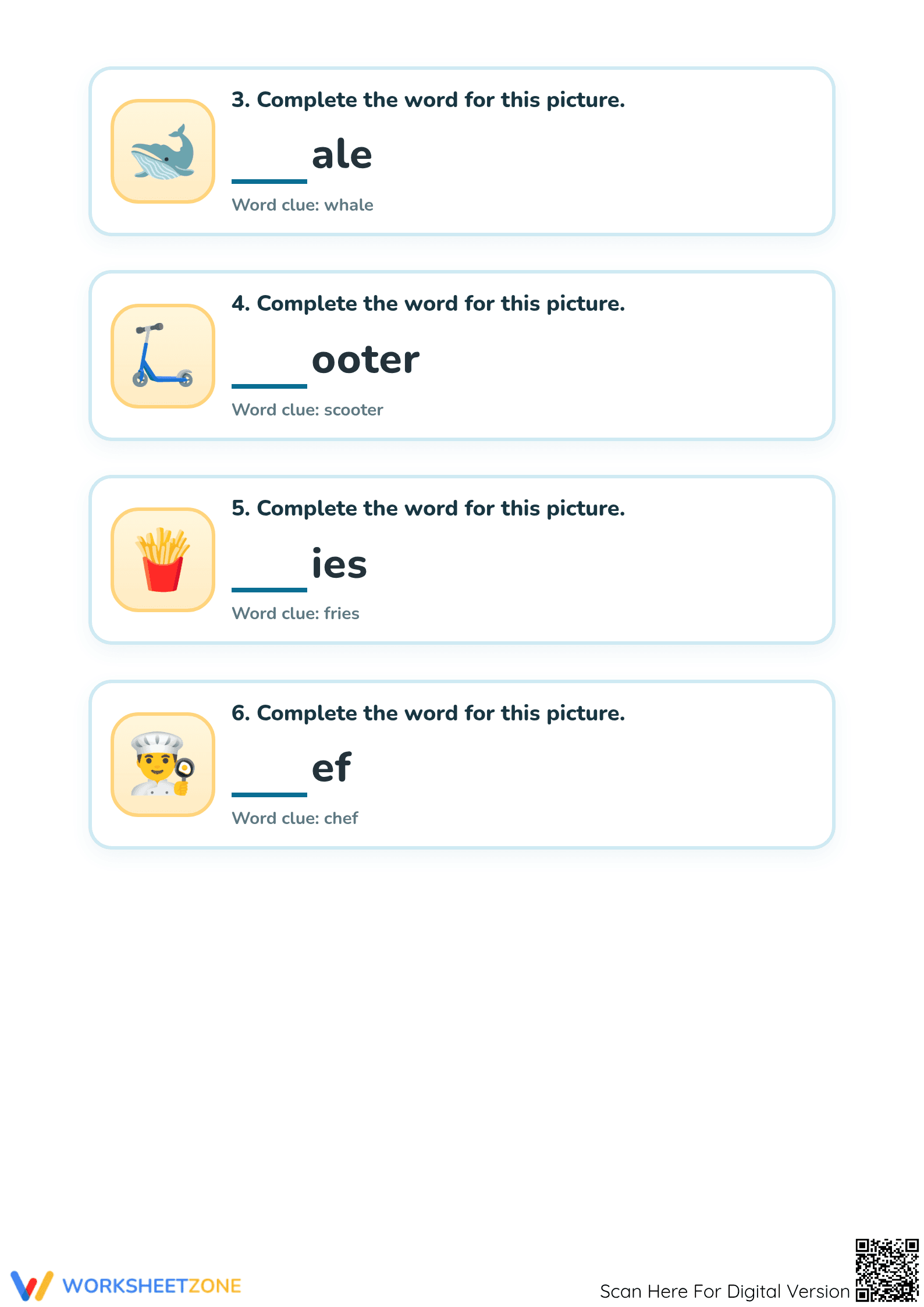
This printable phonics worksheet helps young learners master beginning consonant blends through visual identification and writing practice. Students look at high-quality images, identify the objects, and complete words by writing the missing initial blends. By connecting auditory sounds with written graphemes, children build the foundational decoding skills necessary for early reading fluency and spelling accuracy.
At a Glance
- Grade: 1 · Subject: ELA Phonics
- Standard:
CCSS.ELA-LITERACY.RF.1.2.B— Blend and segment onsets and rimes of single-syllable spoken words accurately- Skill Focus: Initial Consonant Blends
- Format: 2 pages · 6 problems · Answer key included · PDF
- Best For: Independent phonics centers and morning work
- Time: 10–15 minutes
The resource contains two pages of focused phonics practice featuring six distinct word-completion tasks. Each problem includes a vibrant color illustration, a partial word with a missing prefix, and a "word clue" to provide scaffolding. The layout is clean and spacious, providing room for early writers to practice letter formation while identifying initial blends. A full answer key is included for quick grading.
Skill Progression
- Guided practice: The first two tasks introduce the concept with common blends ("bl" and "br") supported by clear visual cues to ensure initial success and build student confidence.
- Supported practice: Middle problems increase complexity by requiring students to distinguish between similar-sounding consonants while utilizing the provided word clues for context.
- Independent practice: The final tasks challenge students to apply their knowledge of digraphs and blends autonomously to complete the word set and demonstrate mastery.
This progression follows the gradual-release model, moving from teacher-supported identification to independent phonemic application.
Standards Alignment
This resource is directly aligned with CCSS.ELA-LITERACY.RF.1.2.B, which requires students to demonstrate understanding of spoken words by blending and segmenting onsets and rimes of single-syllable words. It also supports basic knowledge of letter-sound correspondences. Both standard codes can be copied directly into lesson plans, IEP goals, or district curriculum mapping tools.
How to Use It
Use this worksheet as a formative assessment after a direct instruction lesson on beginning blends. Observe students as they say the words aloud; if a student struggles, prompt them to "stretch the word" to hear the individual sounds in the initial cluster. This activity also serves as an excellent morning work task or a literacy center rotation. Expect students to complete both pages within 15 minutes depending on their writing speed.
Who It's For
Designed primarily for first-grade students, this worksheet is also suitable for kindergarteners ready for extension or second-grade students needing remedial phonics support. It provides essential scaffolding for English Language Learners through the inclusion of visual aids and word clues. Pair this resource with a blending board or a set of magnetic letters for a multi-sensory learning experience that reinforces the grapheme-phoneme connection.
The systematic identification of initial consonant clusters is a critical component of phonological awareness, as highlighted in the RAND AIRS 2024 report on early literacy interventions. By isolating the onset (the blend) from the rime, students develop the phonemic sensitivity required for orthographic mapping—the process the brain uses to store words for immediate retrieval. Research from Fisher & Frey (2014) emphasizes that combining visual scaffolds with written production accelerates the transition from decoding to automaticity. This worksheet addresses the specific demands of CCSS.ELA-LITERACY.RF.1.2.B by providing six targeted opportunities for students to bridge the gap between auditory blending and written grapheme representation. The inclusion of word clues ensures that the cognitive load remains focused on phonics rather than vocabulary retrieval, making it a highly effective tool for Tier 1 instruction or Tier 2 interventions.


