


























Views
Downloads
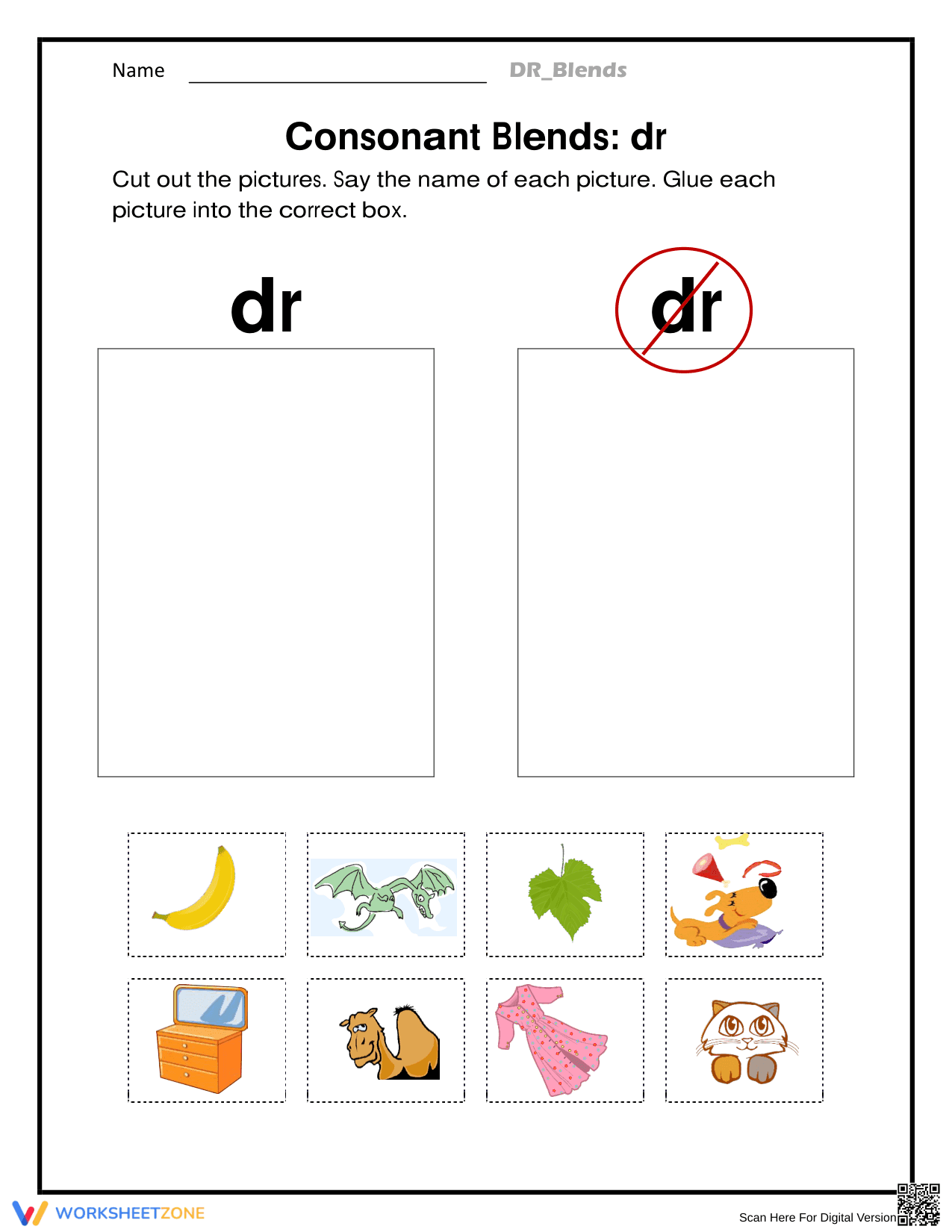

Essential dr Consonant Blends Worksheet | Grades 1-3
Paste this activity's link or code into your existing LMS (Google Classroom, Canvas, Teams, Schoology, Moodle, etc.).
Students can open and work on the activity right away, with no student login required.
You'll still be able to track student progress and results from your teacher account.
This essential Grade 1 consonant blends worksheet focuses on the "dr" sound through an interactive cut-and-paste activity. Students strengthen their phonemic awareness and phonics skills by identifying, saying, and sorting images that start with the initial blend "dr." This hands-on approach ensures students can distinguish specific sounds within spoken words, a critical foundation for early reading success.
At a Glance
- Grade: 1 · Subject: English Language Arts
- Standard:
CCSS.ELA-LITERACY.RF.1.3— Know and apply grade-level phonics and word analysis skills in decoding words- Skill Focus: Initial Consonant Blends (dr)
- Format: 1 page · 8 problems · Answer key included · PDF
- Best For: Independent phonics practice and literacy centers
- Time: 10–15 minutes
This single-page PDF includes a structured sorting task featuring eight distinct images (including a dragon, dress, and dresser). Students are provided with dashed cutting lines for the image tiles and two large landing zones: one for "dr" words and one for words starting with other sounds. The worksheet also features a clear header for student names and a visual cue for the "not dr" category to support independent work.
Implementing this phonics activity requires minimal teacher involvement. First, Print the worksheet and distribute it in less than 30 seconds. Next, Distribute scissors and glue sticks; students can begin immediately as instructions are self-explanatory. Finally, Review completed sorts in under a minute per student or use the answer key. This resource is perfect for emergency sub plans or quiet seatwork.
This resource is aligned to CCSS.ELA-LITERACY.RF.1.3, which requires students to know and apply grade-level phonics and word analysis skills in decoding words. Specifically, it targets the ability to recognize common consonant blends in the initial position of words. This standard code can be copied directly into lesson plans, IEP goals, or district curriculum mapping tools.
Use this worksheet as a follow-up to a direct instruction lesson on consonant blends. After modeling the "dr" sound with the class, assign this as independent practice to observe how students apply their learning. A great formative assessment tip is to walk around and ask students to "say the name of the picture" before they glue it, ensuring they are correctly identifying the phonemes rather than guessing.
This activity is designed for first-grade students, but it is also highly effective for second and third graders who need remedial phonics support. It is particularly useful for English Language Learners (ELLs) as the pictorial representation of vocabulary words helps bridge the gap between spoken and written language. Pair this with a "dr" word anchor chart or a decodable reader focused on initial blends.
According to the RAND AIRS (2024) report on foundational literacy, multi-sensory activities like cut-and-paste sorting are vital for cementing phonemic awareness in early learners. This worksheet targets the CCSS.ELA-LITERACY.RF.1.3 standard by requiring students to perform phonological processing on common consonant blends. By engaging in the tactile process of sorting "dr" sounds, students move beyond rote memorization toward authentic decoding mastery. This specific skill of recognizing initial consonant blends serves as a gateway to reading more complex, multi-syllabic words. Research from Fisher & Frey (2014) emphasizes that "doing" the work—such as physical sorting—significantly increases retention rates compared to passive observation. This Grade 1 resource provides the structured, high-repetition practice necessary for students to internalize phonics rules. By utilizing this printable, educators can ensure that their phonics instruction is both evidence-based and classroom-ready.


