


























Views
Downloads

Grade 1 Consonant Blend "bl" — Printable No-Prep Worksheet
Paste this activity's link or code into your existing LMS (Google Classroom, Canvas, Teams, Schoology, Moodle, etc.).
Students can open and work on the activity right away, with no student login required.
You'll still be able to track student progress and results from your teacher account.
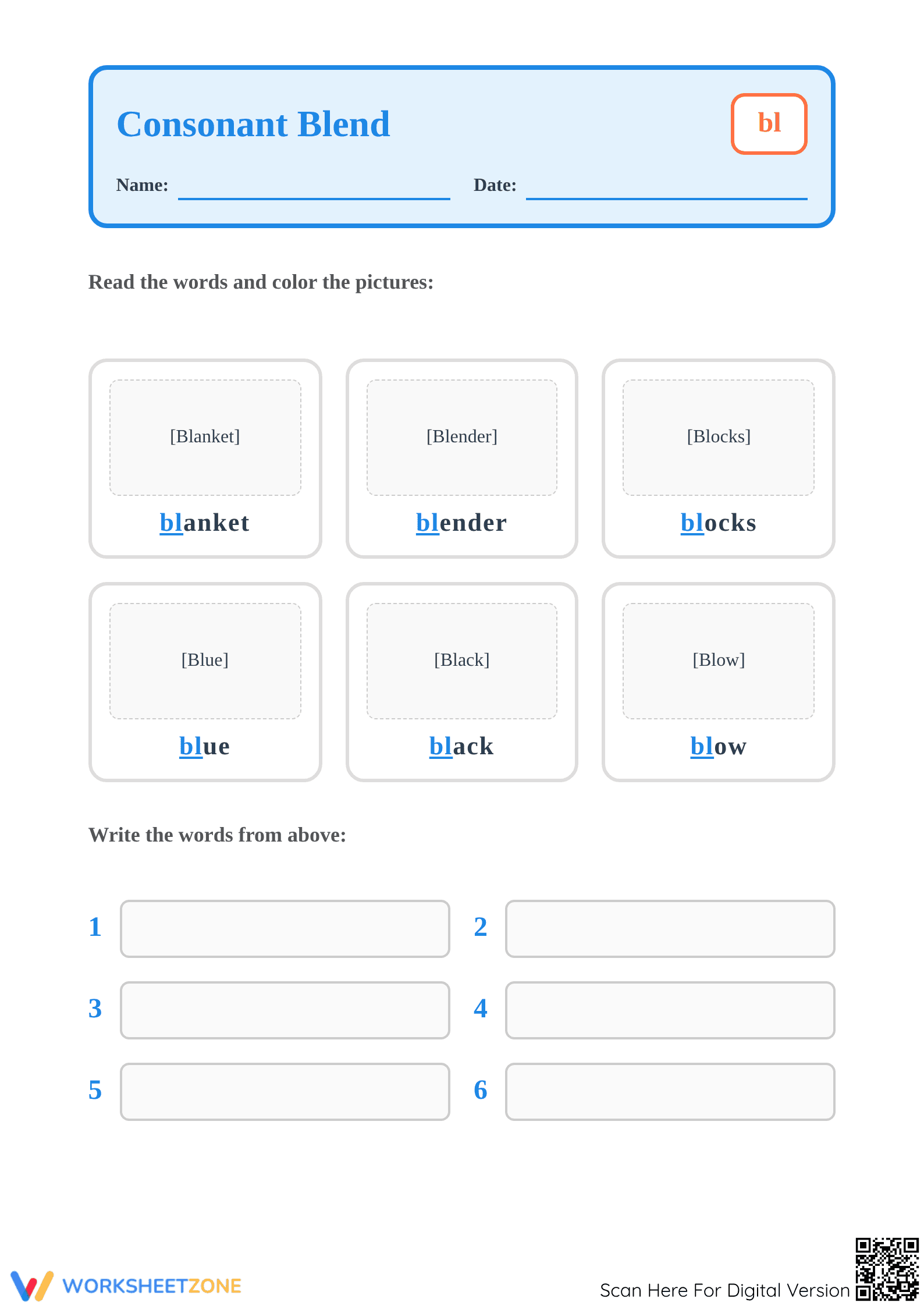
This Grade 1 phonics worksheet helps students master the "bl" consonant blend through targeted reading and writing practice. By connecting visual cues with spelling patterns, early readers build essential decoding skills and improve reading fluency. The clear layout ensures students confidently tackle each phonics challenge.
At a Glance
- Grade: 1 · Subject: English
- Standard:
CCSS.ELA-LITERACY.RF.1.3— Apply grade-level phonics and word analysis skills- Skill Focus: Consonant blend "bl"
- Format: 2 pages · 11 problems · Answer key included · PDF
- Best For: Independent practice and literacy centers
- Time: 15–20 minutes
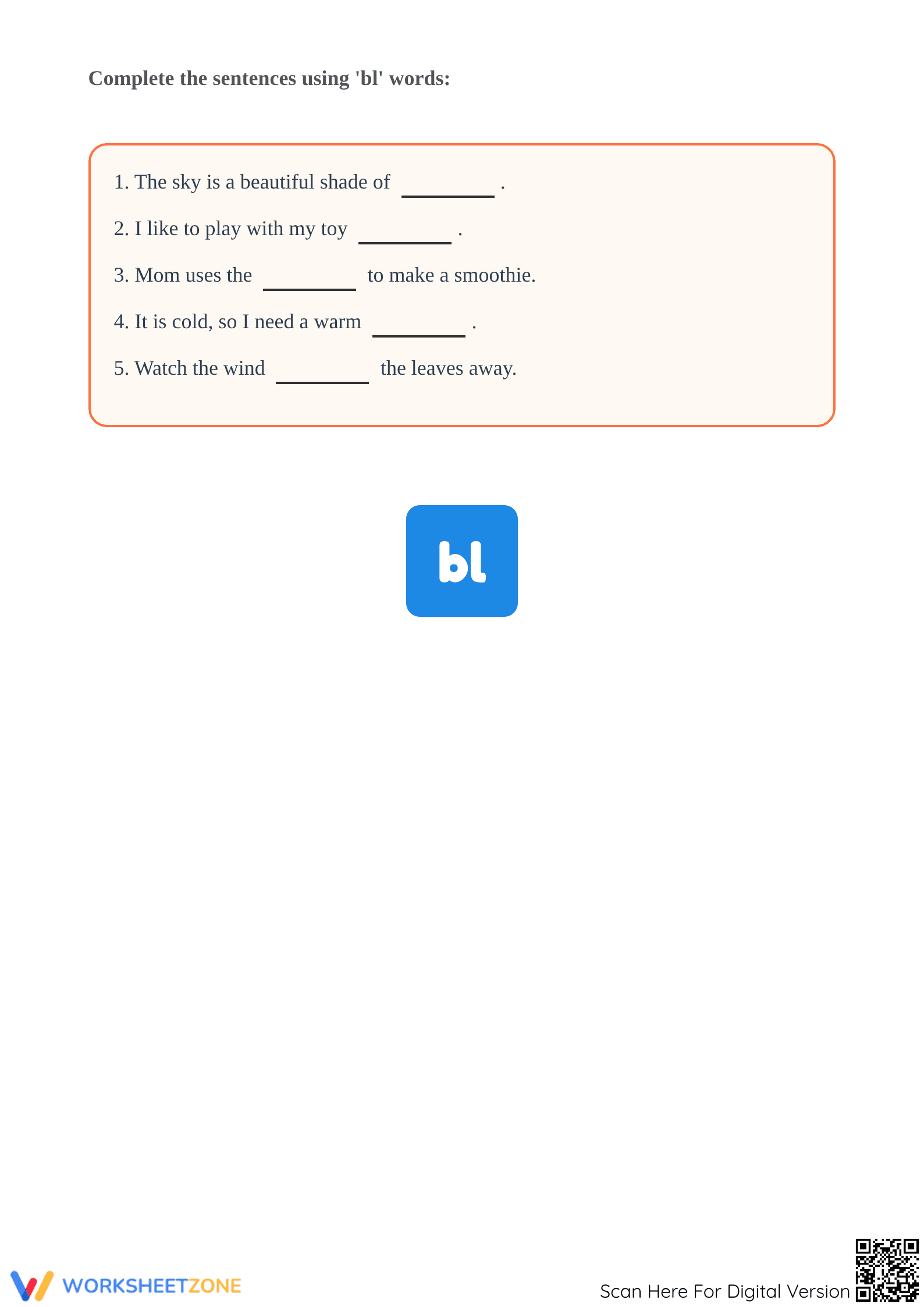
This two-page resource features 11 structured tasks designed to reinforce the "bl" consonant blend. The first page introduces six target words (blanket, blender, blocks, blue, black, blow) with corresponding pictures for students to color and write. The second page challenges learners to apply their knowledge by completing five fill-in-the-blank sentences. A complete answer key is provided for quick grading.
Zero-Prep Workflow
This resource is designed for immediate classroom use with minimal teacher preparation:
- Print (1 minute): Simply download the PDF and print the two-page student worksheet alongside the answer key.
- Distribute (1 minute): Hand out the worksheets during literacy blocks or place them in independent center folders.
- Review (3 minutes): Use the provided answer key to quickly check student responses or guide a whole-class review session.
With under two minutes of total teacher prep time, this worksheet is an excellent addition to emergency sub plans or busy morning routines.
Standards Alignment
This worksheet is directly aligned to CCSS.ELA-LITERACY.RF.1.3, requiring students to know and apply grade-level phonics and word analysis skills in decoding words. By focusing on the initial consonant blend "bl," learners strengthen their spelling-sound correspondences. Both standard codes can be copied directly into lesson plans, IEP goals, or district curriculum mapping tools.
How to Use It
Literacy Centers: Place this worksheet in a phonics station after direct instruction on consonant blends. Students can independently read the words, color the pictures, and complete the sentences while the teacher works with small groups.
Formative Assessment: Assign the second page as a quick check for understanding. Observe whether students can accurately select the correct "bl" word to complete each sentence using context clues. Expect students to complete both pages within 15 to 20 minutes.
Who It's For
This worksheet is primarily designed for Grade 1 students developing their foundational reading skills. It serves as an effective intervention tool for second graders needing extra phonics support or a challenge for advanced kindergarteners. Pair this activity with a decodable reading passage featuring "bl" words or a classroom anchor chart displaying common consonant blends to maximize student retention.
Mastering consonant blends is a critical milestone in early literacy development and foundational reading success. According to Fisher & Frey (2014), explicit phonics instruction combined with immediate, structured application in both reading and writing tasks significantly improves students' decoding automaticity and overall reading fluency. This targeted worksheet aligns directly with CCSS.ELA-LITERACY.RF.1.3, prompting learners to apply grade-level phonics and word analysis skills in a meaningful context. By isolating the "bl" consonant blend and providing multimodal practice—including visual identification, handwriting repetition, and sentence-level context application—educators can effectively bridge the gap between isolated sound recognition and fluent reading. Structured, independent practice opportunities like these ensure that early readers build the essential orthographic mapping skills necessary for long-term reading comprehension, spelling accuracy, and academic confidence across all subject areas.


