


























Views
Downloads
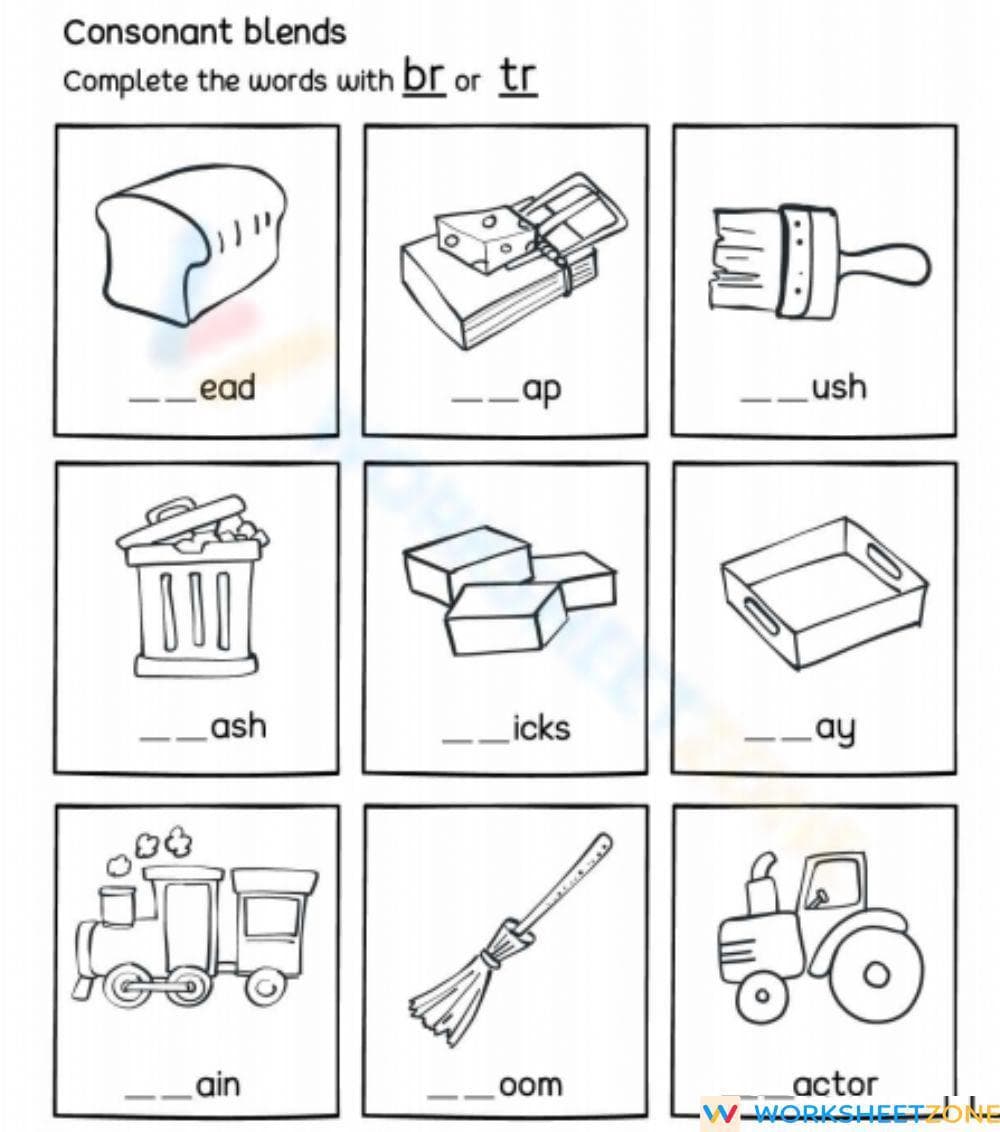

Essential R-Blends Phonics Worksheet | Grades K-3 Printable
Paste this activity's link or code into your existing LMS (Google Classroom, Canvas, Teams, Schoology, Moodle, etc.).
Students can open and work on the activity right away, with no student login required.
You'll still be able to track student progress and results from your teacher account.
This Kindergarten through Grade 3 phonics worksheet provides students with 12 structured problems to master initial R-consonant blends including br, tr, and dr. By matching clear visual illustrations with the correct beginning blend, students build the essential phonological awareness required for fluent decoding and reading success. An answer key is included to facilitate immediate feedback.
At a Glance
- Grade: K–3 · Subject: ELA Phonics
- Standard:
CCSS.ELA-LITERACY.RF.1.2.B— Orally produce single-syllable words by blending sounds including consonant blends- Skill Focus: Initial R-consonant blends
- Format: 1 page · 12 problems · Answer key included · PDF
- Best For: Independent morning work or literacy centers
- Time: 10–15 minutes
Inside this resource, you will find a single-page PDF focused on high-frequency R-blends. The worksheet features 12 distinct tasks where students identify a picture—such as a tree, bread, or drum—and circle the corresponding blend from three options. The layout is clean and distraction-free, making it ideal for young learners. A comprehensive answer key is provided at the bottom of the page for teacher or student use.
This worksheet follows a zero-prep workflow designed for busy educators. Step 1: Print the single-page PDF (30 seconds). Step 2: Distribute to students for independent or guided practice (1 minute). Step 3: Review the 12 answers using the built-in key (1 minute). Total teacher prep time is under two minutes, making this an excellent choice for emergency sub plans or quick transitions.
The primary alignment for this activity is `CCSS.ELA-LITERACY.RF.1.2.B`, which requires students to orally produce single-syllable words by blending sounds, including consonant blends. By visually identifying the blend that starts the word, students bridge the gap between phonemic awareness and grapheme recognition. This standard code can be copied directly into lesson plans, IEP goals, or district curriculum mapping tools.
To use this effectively, assign it during the "Independent Practice" phase after a direct instruction lesson on R-blends. It also serves as a sharp formative assessment; observe which students struggle with the "tr" vs "dr" distinction, as these are common phonological hurdles. Expect most students to complete the 12 items within a 15-minute window during your literacy block.
This resource is specifically designed for students in Kindergarten, Grade 1, Grade 2, and Grade 3 who are developing foundational reading skills. It is particularly helpful for English Language Learners who need visual cues to anchor new vocabulary. For a complete lesson, pair this worksheet with a short decodable passage that features the same br, tr, and dr word families.
Foundational literacy research, such as the Fisher & Frey (2014) framework for gradual release of responsibility, emphasizes the necessity of targeted practice in phonological processing. This R-blends worksheet aligns with evidence-based practices by requiring students to isolate initial sounds (CCSS.ELA-LITERACY.RF.1.2.B) through a clear, repeatable task structure. By engaging with 12 specific visual-to-blend matches, learners reinforce the neural pathways responsible for rapid word recognition. The inclusion of an answer key supports the feedback loops identified in the RAND AIRS 2024 reports as critical for early reading intervention success. Whether used as a primary teaching tool or a supplementary reinforcement, this printable ensures that the jump from isolated sounds to blended words is supported by clear visuals and structured demands. It provides a reliable metric for student mastery in early phonics instruction and phonemic awareness development.


