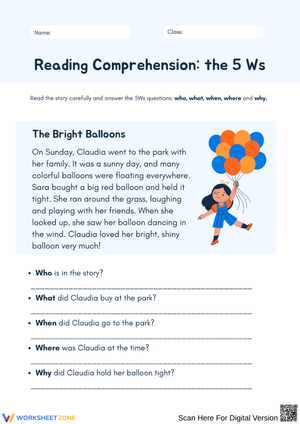
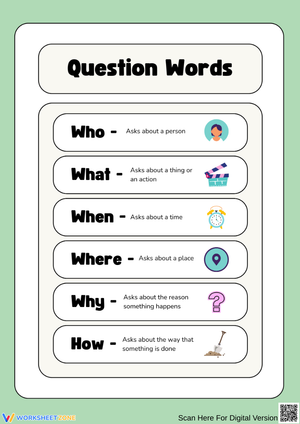
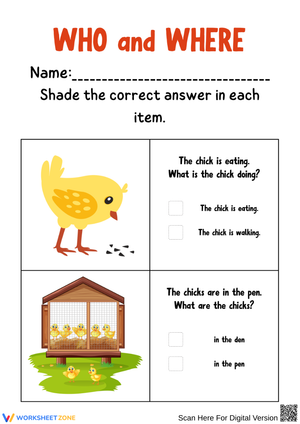
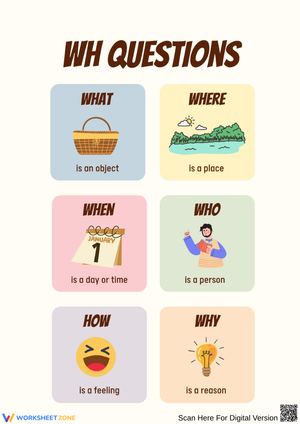
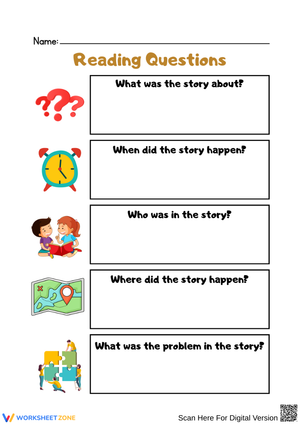
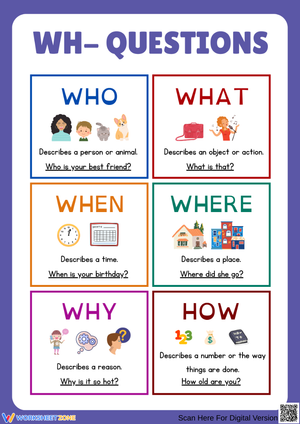
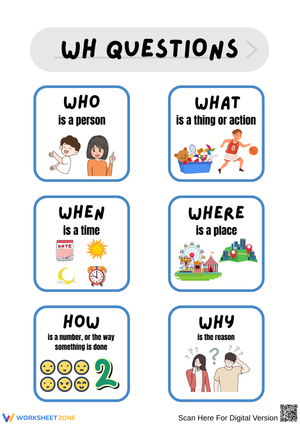
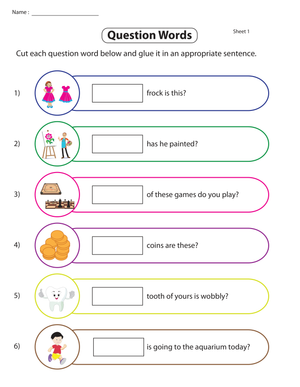
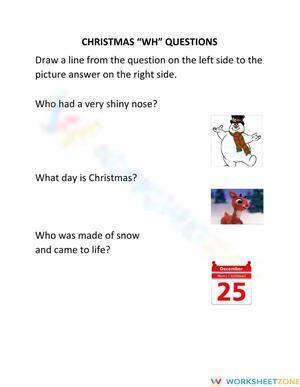
Wh questions printable worksheets for 1st grade give teachers a direct line into what students actually understood from a passage — not just whether they decoded the words, but whether they processed the meaning. The five question types — Who, What, Where, When, and Why — mark the first formal layer of comprehension instruction, and Grade 1 is precisely the year students make the shift from sounding out text to thinking about it. These worksheets build that thinking habit systematically, using short passages and focused prompts that train students to return to the text rather than guess from memory.
What Each Worksheet Targets
The five Wh questions are not equally demanding, and a well-designed set reflects that difference. Who and What questions anchor students to literal information — they underline a character's name, circle the correct event, or copy a sentence that answers the question. Where questions ask them to identify the setting, which most first graders manage once they understand the term. When questions add a layer of abstraction: students must recognize time markers like "in the morning" or "after recess" as valid answers, which is harder than it sounds for students who are still learning what counts as a "when" and what counts as a "what happened."
Why questions stand apart from the rest. They require a student to interpret motivation or explain a cause — to read between the lines of a text that may only hint at reasoning. Each worksheet targets one question type before moving into mixed practice, a sequencing decision that matters at this age. Splitting a first grader's attention across all five question types at once produces blank faces far more reliably than useful answers. The passages run four to eight sentences, keeping the reading load manageable so that comprehension — not fluency — is what's actually being assessed.
Frequent Comprehension Mistakes Worth Anticipating
The most predictable error with Why questions is students restating the action instead of explaining the cause. Asked "Why did Mia run home?" a student writes "Mia ran home fast" — they found the event but stopped short of the reason. This is a language-structure problem more than a comprehension failure: first graders are still internalizing the idea that "why" calls for a because-clause, not a summary of what happened. The worksheets include a sentence frame for Why answers ("___ because ___") that surfaces this structure without doing the thinking for the student.
With Where questions, a common pattern is listing every location mentioned in the text rather than identifying the primary setting. If a story moves between a kitchen, a yard, and a park, an uncertain student will write all three. They found the right category of information — places — but couldn't evaluate which one answered the question. Watching for this pattern during independent work reveals something specific: the student understands what a setting is but hasn't yet learned to weigh relevance. That's a narrower instructional target than "doesn't understand Where," and these worksheets make the distinction visible.
How to Work These Worksheets Into Your Weekly Literacy Plan
The most natural placement is the fifteen minutes of independent written response that follows a read-aloud or shared reading. Students have already heard the text once, which lowers decoding pressure and lets them focus entirely on answering. One worksheet per session is the right amount — two in the same sitting pushes past the attention window most first graders have for written response. Wh questions printable worksheets for 1st grade fit well into this window because the passages are short enough to re-read quickly when a student needs to check an answer before writing.
During small-group guided reading, these worksheets work well as a silent write-before-discuss protocol. Students answer one or two questions independently, then the group talks through what they wrote. That sequence — quiet writing before oral conversation — surfaces disagreements that whole-class formats consistently miss. One classroom moment worth watching for: a student writes "outside" for a Where answer and, when pressed, points to the illustration rather than the text. That single exchange tells you more about where her comprehension process is breaking down than any running record will.
Standard Alignment
These worksheets address RL.1.1 and RI.1.1, both of which require first graders to ask and answer questions about key details in literary and informational texts. In classroom terms, wh questions printable worksheets for 1st grade sit at the precise transition point where phonics instruction hands off to comprehension instruction — typically the second half of first grade for on-level readers, though many teachers introduce Who and What questions as early as October once students have enough decoding automaticity to read a short passage without laboring over every word. RI.1.1 often receives less instructional time than its literary counterpart, and including informational passages in the set ensures students practice the skill with both text types, which the standard explicitly requires.
Adjusting the Worksheets for a Range of Learners
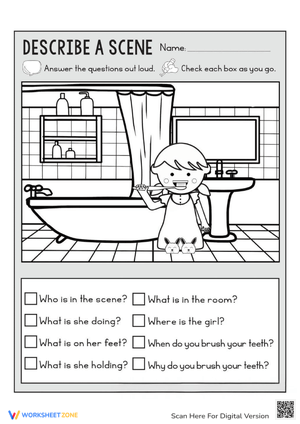
For students who are still building decoding skills, the passage itself becomes a barrier to comprehension practice. One practical adjustment: read the passage aloud while the student follows along, then have them complete the written questions independently. This keeps the comprehension task intact while removing the fluency obstacle. Some worksheets in the set include a small picture icon next to each question type — a person icon for Who, a map icon for Where — which helps students who can't yet read the question word reliably still orient to what they're being asked rather than guessing at random.
For students who answer the literal questions without effort, the adjustment is not more questions but harder follow-through. Add an oral extension: after they write the answer to a Why question, ask them to find and point to the sentence in the passage that supports it. That text-evidence move is the bridge toward the work they will do in second grade, and it costs nothing in terms of paper or prep. Keeping the written worksheet consistent while varying the oral follow-up means no student needs a visibly different assignment, which simplifies management considerably in a mixed-ability classroom.
Frequently Asked Questions
Which question type should teachers introduce first?
Start with Who and What. These are anchored to characters and events — the most concrete information in any story — and students can often locate the answer in the illustrations before they find it in the text. Where follows naturally, since setting is introduced as a story element around the same time. When and Why come last and benefit from explicit class discussion before students attempt them in writing on their own.
How long does a typical session with one of these worksheets take?
For most first graders, reading a four-to-six-sentence passage and writing answers to two or three questions takes eight to twelve minutes. Students who are still building writing stamina may need closer to fifteen. A single worksheet fits comfortably within a literacy center rotation without running into the next block, which makes session planning straightforward.
Can these work as assessment tools in addition to practice?
Yes, and the narrow focus of each worksheet is what makes that possible. Because each one targets one or two question types, the results give you a clean picture of a specific skill rather than a blended comprehension score. Collecting completed wh questions printable worksheets for 1st grade over three or four weeks produces a portfolio record that shows movement — or the absence of it — across individual question types, which is more instructionally actionable than a general score from a unit test.












 Interactive Worksheet Maker
 Quiz Maker
 Word Search Maker
 Crossword Puzzle Maker
 Word Scramble Generator
 Sentence Scramble Generator
 Handwriting Worksheet Generator
 Name Tracing Generator
 Fill In The Blank Generator