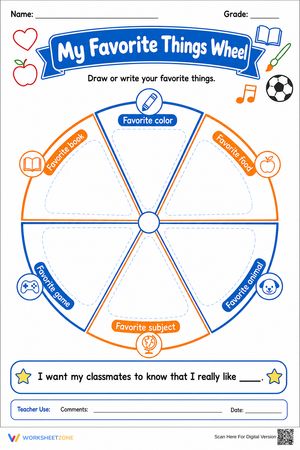
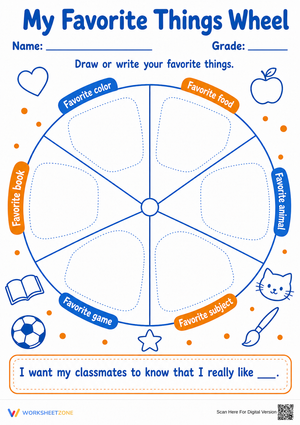
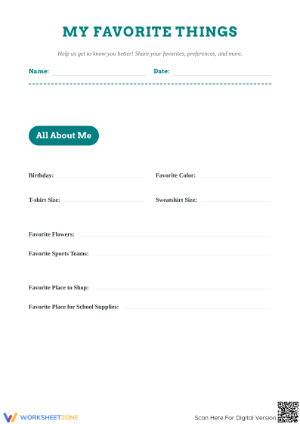
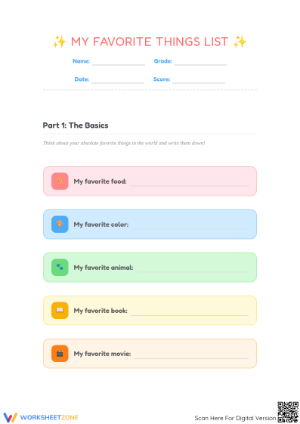
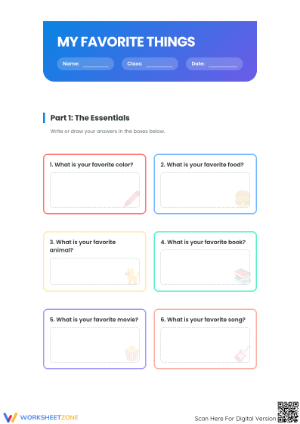
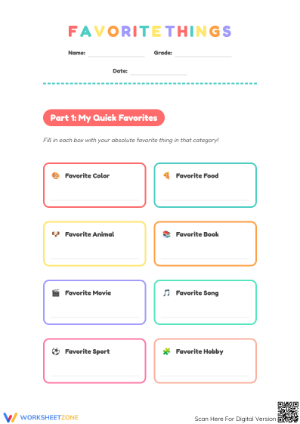
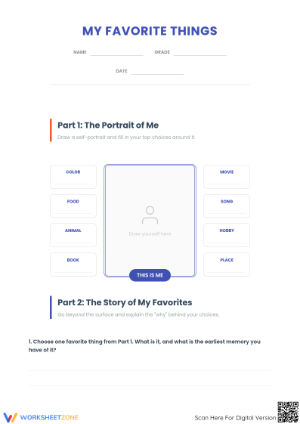
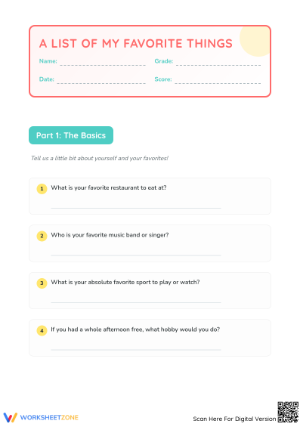
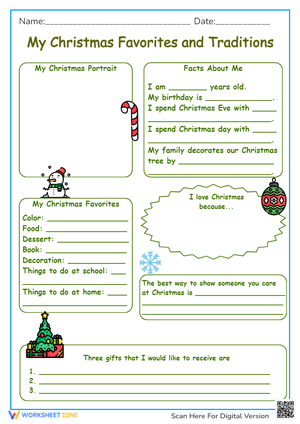
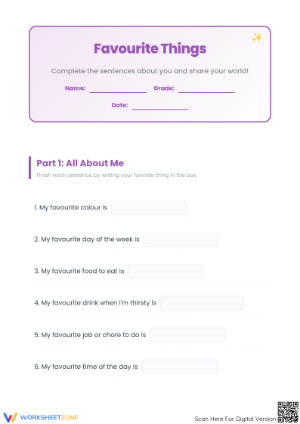
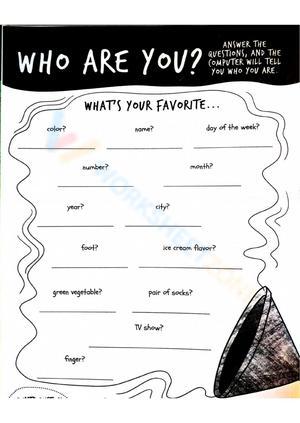
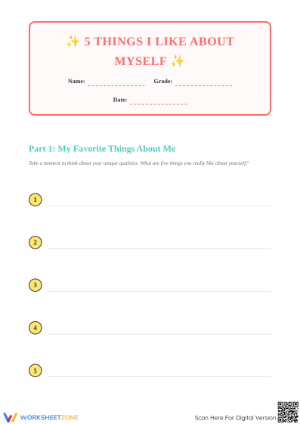
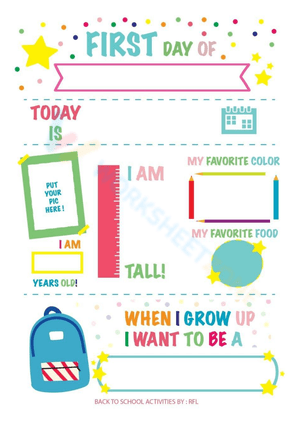
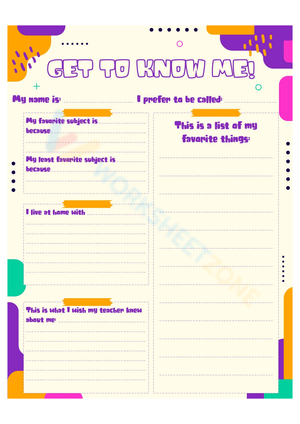
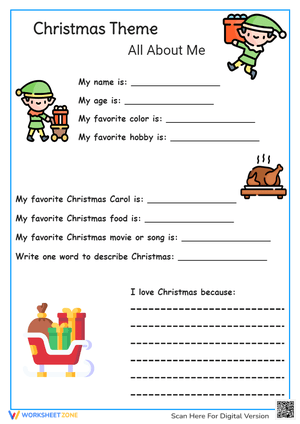
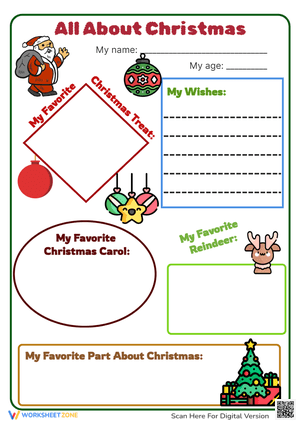
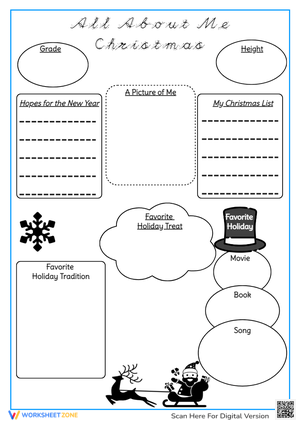
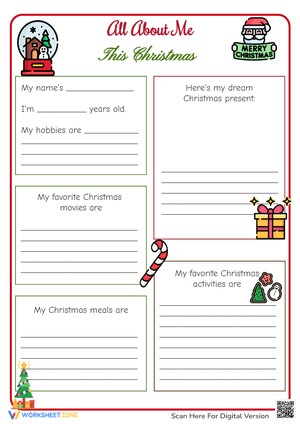
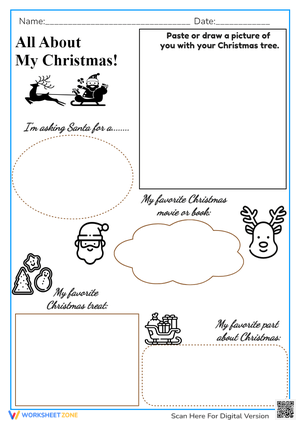
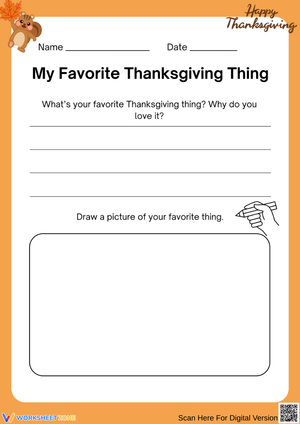
These my favorite things worksheets for 1st grade arrive at exactly the right moment in early writing instruction — when first graders have something urgent to say but not yet the mechanics to say it cleanly. Each worksheet pairs a drawing box with primary-ruled writing lines, giving students a way to plan their ideas visually before putting words on the page. Teachers get a set that functions as first-week writing assessment, ongoing morning work, and classroom community tool, all without any prep beyond printing.
The Skills Each Worksheet Targets
The topics stay tightly personal — favorite color, animal, food, season, game, book, place — which is the point. Because students already hold the content knowledge, their working memory stays free for the mechanics of print rather than splitting between what to say and how to write it. Each worksheet asks students to:
- Complete a sentence frame with a stated preference, practicing subject-predicate structure
- Apply opening capitalization and end punctuation with intention
- Spell familiar vocabulary phonetically — color words, animal names, food names — in a low-stakes context
- Use drawing as a pre-writing planning tool, not as decoration added after the fact
- Form letters on primary lines with appropriate sizing and spacing
The sentence frame ("My favorite ___ is ___") gives students the syntactic skeleton without removing the decision. Filling it in is where the real work happens.
Why Personal Topics Produce Better Writing Mechanics
When first graders write about an unfamiliar subject — the water cycle, say, or community helpers — they manage two cognitive loads simultaneously: retrieving content information and translating speech to print. Writing about their own favorites eliminates the first load entirely. A six-year-old who knows without question that her favorite food is macaroni and cheese still faces the full challenge of spelling "macaroni," capitalizing the opening word, and deciding whether a period or exclamation mark belongs at the end. That's already a significant set of decisions for a developing writer. Keeping the subject matter pre-loaded in long-term memory lets the writing lesson do its actual job.
This is the developmental logic behind personal narrative appearing earlier in the ELA progression than informational or opinion writing. It also reflects a real feature of six- and seven-year-old motivation: children at this stage want to be known by their peers and their teacher. A structured prompt that says "tell me your favorite thing" meets that desire directly, which makes the writing feel worth doing.
Mistakes Students Make That These Worksheets Help You Catch
The most consistent pattern in early first-grade writing: students treat the sentence frame as decoration and write only the noun. The page says "My favorite animal is ___" and a meaningful number of students write "dog" — and consider the task finished. They've answered the question, from their perspective. This is the same student who will later produce a "paragraph" that is a bulleted list. Catching it on a personal writing worksheet in September is far better than discovering it during October's first opinion piece.
A second recurring issue is mid-sentence capitalization. First graders who correctly capitalize proper nouns will write "My favorite food is Pizza" or "My favorite place is The Park" because they've absorbed the rule that important things get capitals — and their favorites feel very important. The repeated practice across several worksheets gives teachers multiple low-stakes opportunities to address this before it calcifies into habit.
A third pattern worth noting: end punctuation placed before the final word rather than after, particularly when a student runs out of room on the line. The period drifts mid-sentence. This reflects spatial planning difficulty more than conceptual confusion about punctuation — meaning the intervention is different. Less reteaching of the concept, more guided attention to pacing across the line.
How to Work These Worksheets Into Your Lesson Plans
The first week of school is the natural entry point. While you're taking attendance, establishing routines, and reading the room for baseline skills, a stack of printed worksheets on each desk handles those first eight minutes after the bell without requiring you to be in five places at once. Students who finish early add color to their drawings; students who need more time have a bounded, clear task that doesn't dead-end.
Beyond September, my favorite things worksheets for 1st grade work well in several recurring slots:
- Monday warm-up writing — the predictable sentence-frame format reduces re-entry friction after weekends, when some first graders need a familiar structure before they can engage with something new
- Writing center rotation — pairs naturally with a mentor sentence lesson on the structure "I like ___ because ___," so students see the expanded form modeled before they try it independently
- Baseline and mid-year comparison — collect one worksheet in September, one in January; the identical format makes growth in letter formation, phonetic spelling, and sentence completeness easy to see side by side
- Gallery walk — worksheets open on desks, students circulating with sticky notes to mark any classmate whose favorite matches their own, creating a genuine peer reading audience
The gallery walk version is worth naming specifically because it produces authentic peer reading for a real audience, which most first graders find far more motivating than writing for the teacher alone. Students who are reluctant writers for adults will often write more carefully when they know classmates will see the result.
Standard Alignment
These worksheets support CCSS.ELA-LITERACY.W.1.1, which asks first graders to write opinion pieces that name a topic, state a preference, supply a reason, and provide some sense of closure. A sentence like "My favorite animal is a dog because it is soft and friendly" hits every element of that standard in one sentence — topic named, preference stated, reason given, closure implied. The sentence frame supplies the syntactic structure; students supply the content and the reasoning.
They also address CCSS.ELA-LITERACY.L.1.2, which covers conventions including capitalization of the first word in a sentence, end punctuation, and spelling of grade-appropriate words. In the first quarter of first grade, these two standards typically run in parallel rather than in sequence — conventions instruction and beginning opinion writing happen side by side. A personal favorites prompt is one of the most direct ways to work both standards in a single ten-minute block.
Adjusting the Worksheets for a Range of Writers
For students not yet generating words independently, shift the emphasis to the drawing box. Have them illustrate their favorite thing in detail, then sit beside them and ask what they would want to write about it. Scribe their spoken sentence on a sticky note; they copy it onto the primary lines. This keeps letter formation and print directionality in the lesson without requiring independent text generation before the student is ready for it.
Students on grade level use the frame as written. The clear target — one complete sentence, one opening capital, one piece of end punctuation — gives both student and teacher a shared definition of done.
Above-grade-level writers often complete the sentence frame and stop, waiting. A second prompt written lightly at the bottom — "I like it because ___" — gives those students a natural extension without a separate assignment. Some will produce three or four sentences unprompted once given permission to continue. One honest tradeoff: students who are very perfectionistic about drawing can spend the entire work period on the illustration and never write a word. For those students, reverse the sequence — sentence first, drawing after.
Frequently Asked Questions
Do these worksheets work as back-to-school activities during the very first days of school?
Yes — and that's their clearest application. The topic requires no prior classroom knowledge, no established partnerships, and no group work. Students who don't yet know a single classmate have an immediate, concrete task. By lunch on day one, you have a writing sample from every student in the room and a first look at where each child is with sentences, spacing, and phonetic spelling.
What's the most efficient way to assess these without turning them into formal grades?
Scan each worksheet for three data points only: Did the sentence begin with a capital? Does it end with punctuation? Is there a complete sentence, or just a noun? That three-question read takes about ten seconds per student. Flag students who wrote only a noun with no sentence structure — that pattern is specific and tells you exactly where the next round of direct instruction needs to go. The my favorite things worksheets for 1st grade format is short enough that whole-class formative review is realistic, not aspirational.
How many different topics does the set include?
Each worksheet addresses a single category — color, animal, food, season, game, book, place, among others. Distributing one per day during the first week gives you five separate writing samples and a clearer picture of each student's writing consistency across topics than any single sample would.
Can these be used later in the year, or are they strictly a September resource?
Teachers use my favorite things worksheets for 1st grade successfully in January and February as well — particularly as a low-stakes writing warm-up after winter break, when students need a re-entry task with a familiar format but still require real writing. The personal topic stays fresh because students' favorites evolve; a child who picked "pizza" in September might pick "tacos" in January and notice that herself, which becomes its own small writing discovery.












 Interactive Worksheet Maker
 Quiz Maker
 Word Search Maker
 Crossword Puzzle Maker
 Word Scramble Generator
 Sentence Scramble Generator
 Handwriting Worksheet Generator
 Name Tracing Generator
 Fill In The Blank Generator