


























Views
Downloads
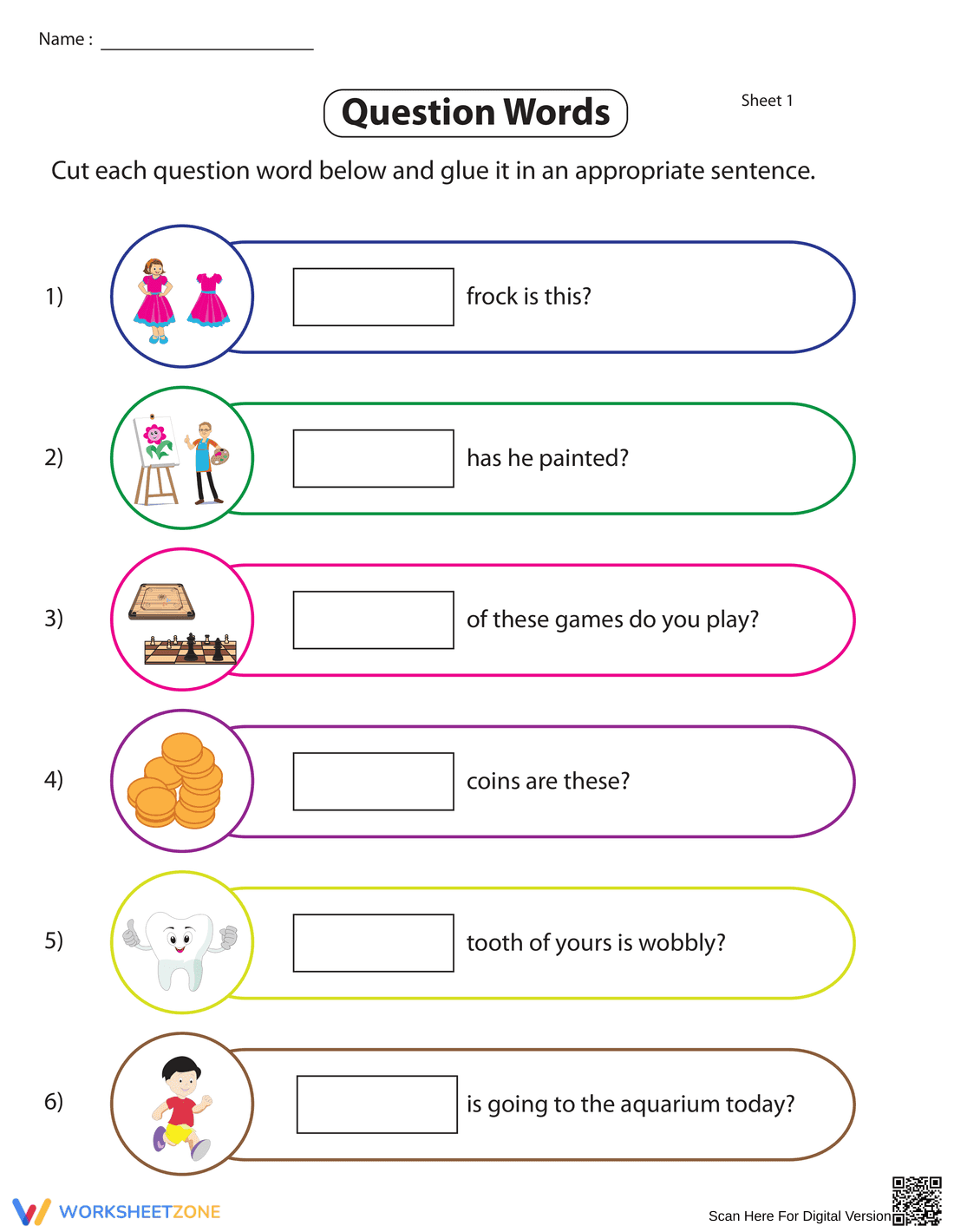


Essential Question Words Cut and Glue Worksheet | Grade 1-4
Paste this activity's link or code into your existing LMS (Google Classroom, Canvas, Teams, Schoology, Moodle, etc.).
Students can open and work on the activity right away, with no student login required.
You'll still be able to track student progress and results from your teacher account.
This interactive cut-and-glue worksheet helps students master essential question words by applying them to real-world sentence contexts. By matching "Wh" words like "which" and "whose" to specific scenarios, learners build foundational grammar skills and improve sentence construction. This activity ensures students can distinguish between different types of inquiries effectively.
At a Glance
- Grade: 1-4 · Subject: ELA · Sentences
- Standard:
CCSS.ELA-LITERACY.L.1.1.D— Use frequently occurring interrogatives like who, what, where, when, why, and how- Skill Focus: Question Word Application
- Format: 1 page · 6 problems · Answer key included · PDF
- Best For: Independent practice or literacy centers
- Time: 15–20 minutes
What's Inside
This single-page PDF features six interactive "cut and glue" tasks designed for hands-on learning. Students are presented with a series of illustrated sentences, each missing its primary interrogative word. A dedicated section at the bottom provides the corresponding question words for students to cut out and paste, reinforced by a complete answer key for quick grading.
Zero-Prep Workflow
Implementing this activity requires zero teacher preparation beyond simple printing. First, Print the worksheet in under 30 seconds. Next, Distribute it to students as a standalone sub plan or center activity (1 minute). Finally, Review student work using the included answer key (1 minute). Total teacher prep time is less than two minutes, making it ideal for busy mornings or unexpected transitions.
Standards Alignment
Aligned to CCSS.ELA-LITERACY.L.1.1.D, this resource focuses on using frequently occurring interrogatives such as who, what, where, when, why, and how. Students demonstrate their understanding of these words by placing them in grammatically correct positions within simple sentences. This standard code can be copied directly into lesson plans, IEP goals, or district curriculum mapping tools.
How to Use It
Assign this worksheet during the "Independent Practice" phase of a grammar lesson to verify students can apply question words accurately. It also serves as an excellent formative assessment tool; observe how students handle the visual cues (like the "whose" possessive context) to gauge their grasp of sentence logic. Completion typically takes 15 to 20 minutes.
Who It's For
Designed for students in Grades 1 through 4, this resource supports diverse learners with its visual prompts and kinesthetic "cut and glue" format. It is a natural pairing for an anchor chart on Wh-questions or a shared reading passage where students identify interrogative structures before practicing independently.
According to the Fisher & Frey (2014) framework for gradual release of responsibility, interactive sentence-building tasks like this CCSS.ELA-LITERACY.L.1.1.D worksheet are critical for moving students from guided instruction to independent mastery of question words. Research from ScienceDirect TpT Analysis suggests that kinesthetic activities—such as cut-and-glue formats—increase student engagement and retention of grammatical rules in early elementary grades. By requiring students to physically manipulate the question words "who", "what", "which", and "whose", the activity reinforces the semantic relationship between the interrogative and the sentence predicate. This worksheet provides a measurable way for educators to track student progress in sentence-level conventions, ensuring that learners can produce and expand interrogative sentences accurately across multiple contexts. The structured task count of 6 ensures a focused practice session without overwhelming the learner, making it a staple for any ELA curriculum.


