1st Grade Groundhog Day PDF Worksheets
These 1st grade groundhog day pdf worksheets give teachers a set of standalone, printable resources spanning reading comprehension, vocabulary, shadow-science observation, and opinion writing — all anchored to a February tradition that first graders find genuinely worth reading about. Each worksheet functions independently, so teachers can pull what fits the day's lesson without committing to a fixed sequence.
What's Inside the Set
Each worksheet targets a discrete skill, which makes it easy to match individual pieces to specific instructional goals rather than working through the set in order. The coverage includes:
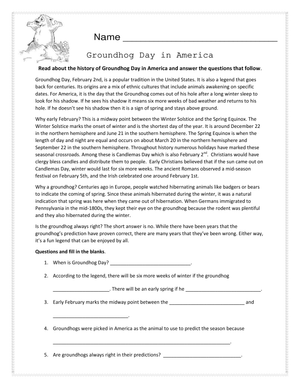
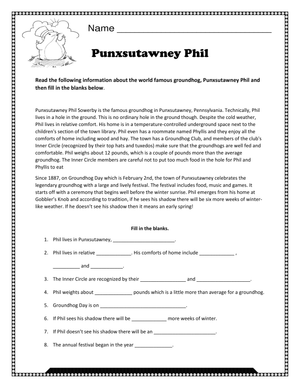
- Short informational passages about Punxsutawney Phil paired with key-detail comprehension questions, both multiple-choice and written-response
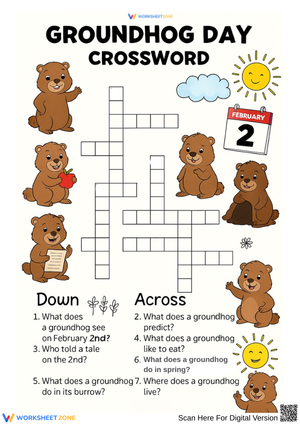
- Vocabulary matching and sentence-completion exercises built around terms like hibernation, burrow, prediction, and tradition
- A shadow-diagram worksheet where students draw and label the light source, the groundhog, and the resulting shadow, then write one observational sentence
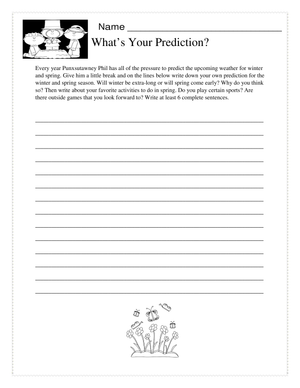
- An opinion-writing sheet asking students to choose winter or spring and supply two supporting reasons
- A class-prediction graphing worksheet for recording votes before Phil's emergence and revisiting the data afterward
- A creative-writing prompt written from the groundhog's point of view, with labeled illustration space
Why This Topic Lands Well With First Graders in February
Grade 1 is the year students transition from decoding words to reading for meaning, and informational texts on subjects that are familiar-but-not-fully-understood accelerate that shift. Groundhog Day sits in a useful position: students know the holiday exists, but they don't know why a groundhog is involved or what hibernation actually means, which creates genuine motivation to read and find out. That motivation matters in February, when attention has been flagging indoors for months.
The legend also sets up a valuable critical-thinking exercise. The contrast between the Punxsutawney folklore and the biological reality of groundhog hibernation gives students two distinct texts to compare — one narrative, one informational. Students begin to understand that a story can be compelling without being scientifically accurate, a distinction worth establishing in first grade and returning to throughout the year.
Student Mistakes Worth Watching For and Correcting Early
The 1st grade groundhog day pdf worksheets surface one error with unusual consistency: the prediction reversal. Students intuit that sunshine should mean warm weather and early spring, so when they encounter the legend, they invert it — a student will write "If Phil sees his shadow it means spring is coming" even immediately after a class read-aloud that covered the tradition clearly. Catching this during a quick share-out before independent work keeps the misconception from migrating onto the written-response lines.
The opinion-writing worksheet produces a second predictable gap. Students choose winter or spring without hesitation, but when asked to supply reasons, they restate their preference in different words: "I like spring because spring is nice and warm." The problem isn't reluctance — first graders often don't yet have a mental model for what a reason is, as distinct from a feeling. Modeling two or three complete examples with a think-aloud, specifically naming the difference between restating and explaining, closes that gap more reliably than the sentence frame alone.
Fitting These Worksheets Into Your Weekly Lesson Plans
The most reliable placement is as independent work during the small-group reading rotation. While the teacher works with a leveled group, remaining students complete whichever worksheet matches the day's focus — vocabulary work one or two days before the holiday to pre-teach key terms, comprehension questions once the passage is familiar, opinion writing last after class discussion. That sequence respects cognitive load: students write from knowledge they've already built rather than encountering new content and a writing demand at the same time.
The graphing worksheet earns its best results as a whole-class opener on February 2nd: poll the room, tally votes publicly on the chart, then return to the data after watching coverage of Phil's result. When students have made a public prediction, they're invested in the follow-up writing. The 1st grade groundhog day pdf worksheets covering shadow-science observation pair naturally with a five-minute desk-lamp demonstration — hold the light at three different angles relative to a small object, let students sketch the shadow each time, then move to the labeling task on their worksheet with something concrete to reference.
Standard Alignment
The reading-comprehension worksheets align with CCSS.ELA-LITERACY.RI.1.1 (ask and answer questions about key details in an informational text) and CCSS.ELA-LITERACY.RI.1.3 (describe the connection between two individuals, events, or pieces of information in a text). In the classroom, these standards show up when students underline the passage line that tells where Phil lives, or when they explain in writing why groundhogs hibernate rather than migrate. The opinion-writing worksheet targets CCSS.ELA-LITERACY.W.1.1, which asks first graders to state a topic, supply a reason, and provide some sense of closure — a structure most students need the entire year to internalize, and a clear February choice between winter and spring gives it a low-stakes context to practice. Vocabulary work across the set connects to CCSS.ELA-LITERACY.L.1.4, specifically using context clues and familiar word parts to determine the meaning of terms like hibernation and burrow.
Adjusting the Set Across Different Student Levels
Students still working toward grade-level decoding get the most traction starting with the vocabulary-matching and diagram-labeling worksheets before attempting the reading passages. The word bank embedded in the diagram task gives them a reference they can carry forward mentally into the passage work. For students who move through the passage independently and fluently, remove the word bank and ask them to generate diagram labels from memory — a low-prep retrieval exercise that adds genuine challenge without a different resource.
The opinion-writing worksheet is the most adaptable piece in the set. Students not yet writing full sentences can draw their response and dictate to a teacher or aide. Students at grade level write two reasons using the sentence frame. Students writing fluently above expectation can be asked to address a counterargument — "Some people might prefer ___, but I think ___" — which pushes into second-grade opinion structure without requiring a separate activity. The 1st grade groundhog day pdf worksheets work as printed for the middle of a typical first-grade class; students at either end of the range need only a small instructional adjustment, not a different worksheet entirely.
Frequently Asked Questions
Do I need to pre-teach the shadow science before using the diagram worksheet?
A brief desk-lamp demonstration is enough. Position the lamp at two or three angles relative to a small object, let students observe how the shadow shifts in size and direction, and then hand out the worksheet. First graders don't need formal physics instruction — they need a concrete reference point they just experienced. The worksheet builds vocabulary and written description from that observation.
Can I spread these worksheets across several days instead of using them all on February 2nd?
Yes, and most teachers find that approach more effective. The vocabulary worksheet works best one or two days before the holiday to introduce key terms early. The reading-comprehension worksheet lands well on February 2nd or the day after, once students have heard the story. The opinion-writing worksheet comes last, after class discussion, when students have enough context to support their position with actual reasons rather than restated feelings.
How long should I budget for each worksheet in a first-grade class?
Vocabulary and diagram worksheets typically take twelve to fifteen minutes for most students. The reading-comprehension worksheet runs closer to twenty minutes depending on passage length. Budget the most time for the opinion-writing sheet — fifteen to twenty-five minutes when the drawing component is included, and longer the first time students work through the two-reason structure. Keeping a modeled example visible on the board while they write reduces the number of students who stall after the first sentence.
Clear All