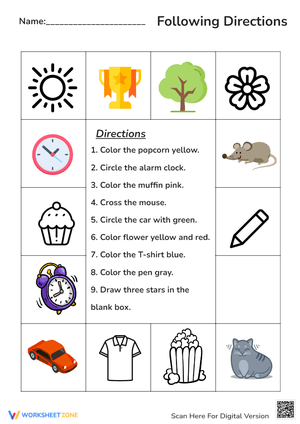
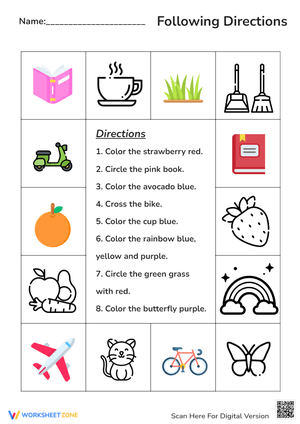
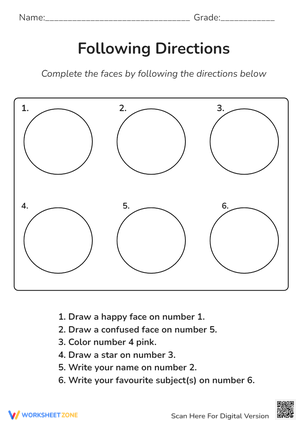
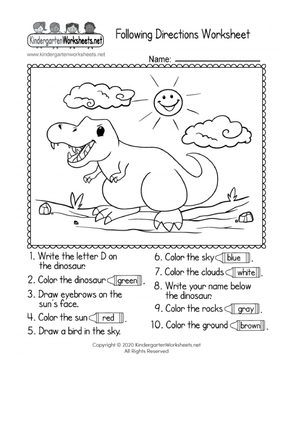
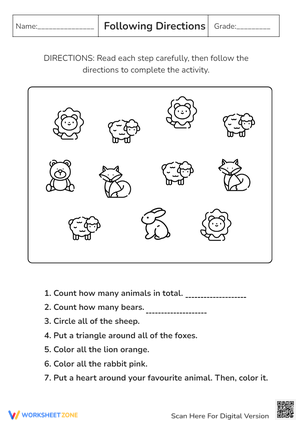
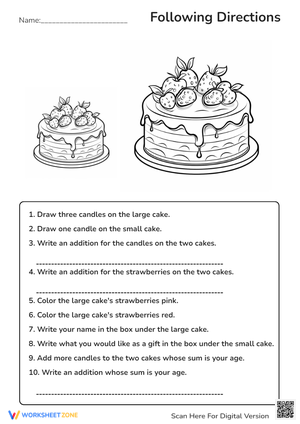
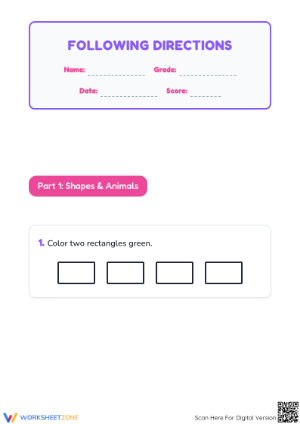
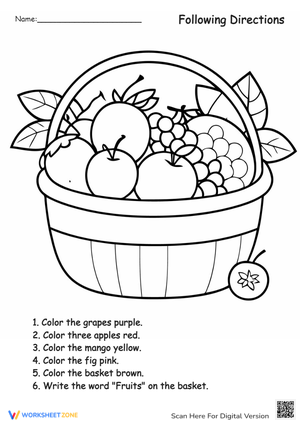
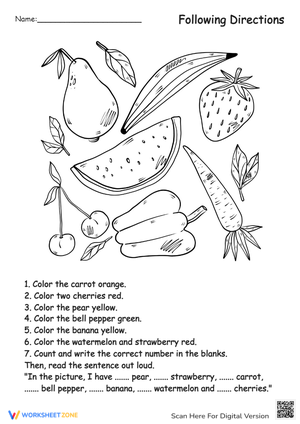
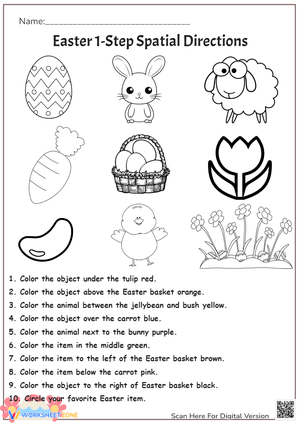
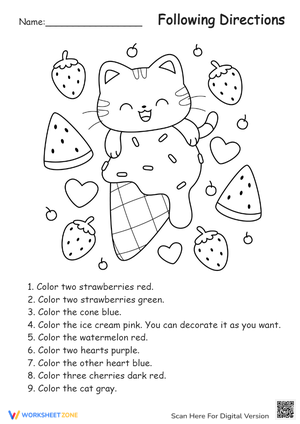
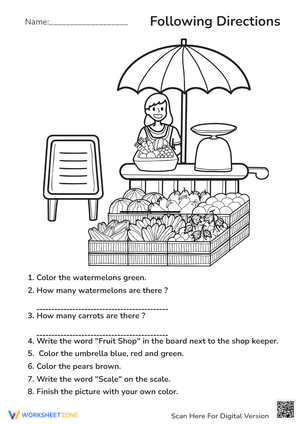
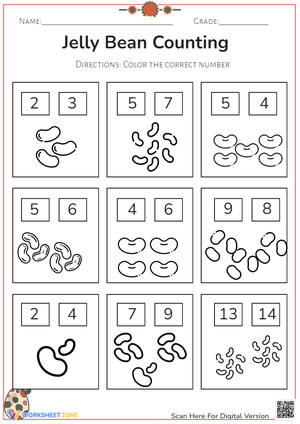
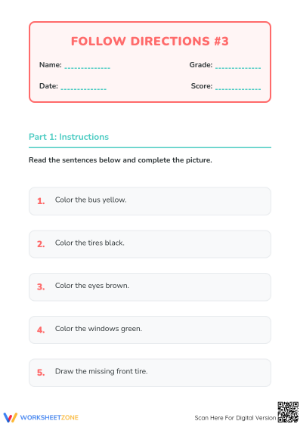
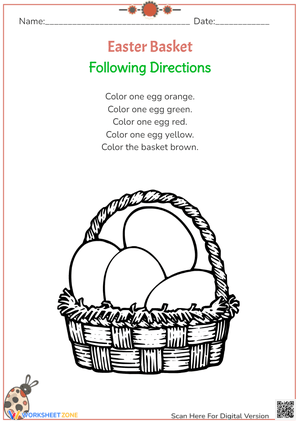
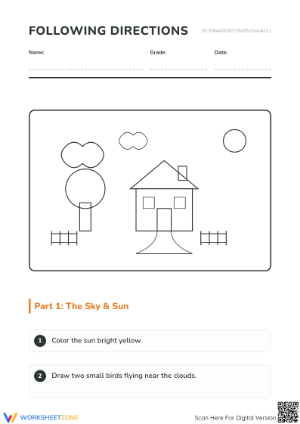
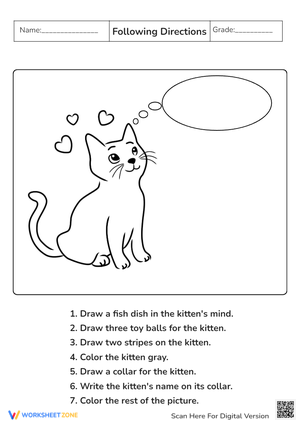
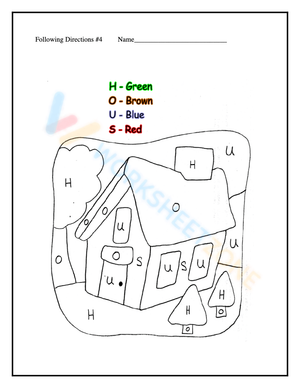
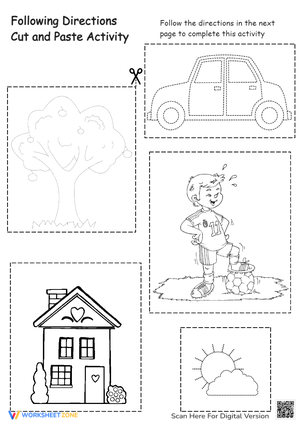
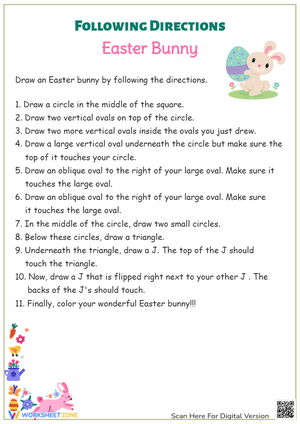
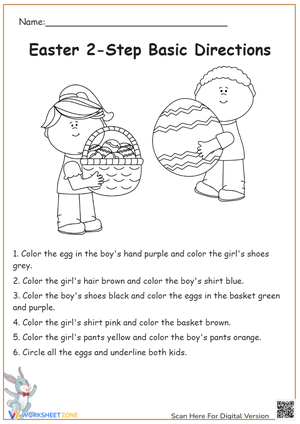
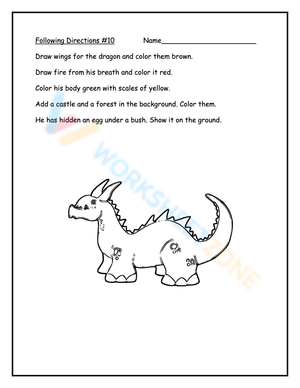
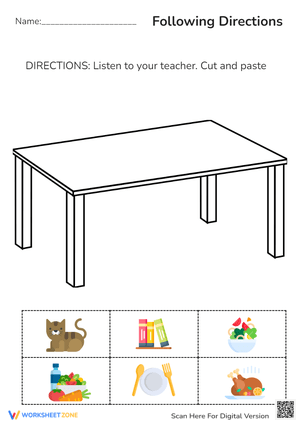
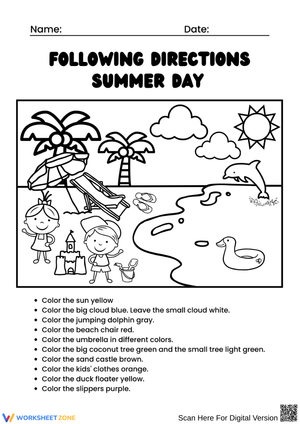
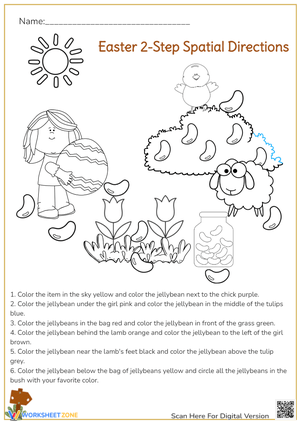
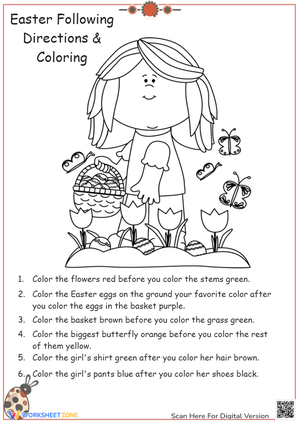
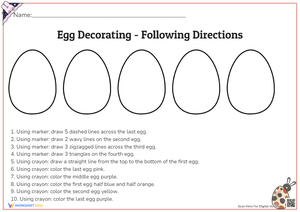
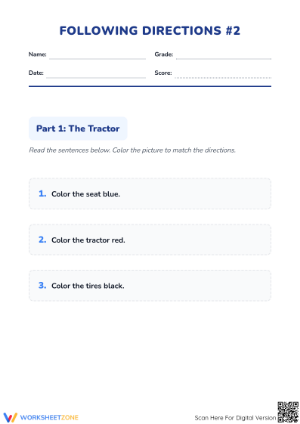
Following directions worksheets for 1st grade give teachers a direct window into how students process written language under task conditions — not just whether they can decode words, but whether they can hold multi-step meaning long enough to act on it. The set targets this specific skill in a format that keeps six- and seven-year-olds anchored to the page: read a sentence, then do the thing the sentence says. Teachers walk away with visible, immediate evidence of where comprehension breaks down.
The Specific Skills Targeted
Each worksheet works on a cluster of competencies that rarely appear in isolation during a real lesson. Spatial and positional vocabulary gets the heaviest workout — words like above, between, beside, and to the left of appear frequently because Grade 1 students have inconsistent exposure to them in running text. Reading a story will get a student to "next to" once; a targeted worksheet returns to it six or eight times in a single sitting.
Sequential processing is the second major focus. When a worksheet says "First, circle the dog. Then, draw a bone above its head. Last, color the fence brown," students must track all three parts before marking anything. The transition words first, next, then, and last do double duty: they signal order in task-based exercises and in narrative structure, so students building this skill are simultaneously preparing to retell stories and write their own sequential paragraphs.
Fine motor integration rounds out the skill set. Drawing, coloring within boundaries, and tracing specific paths based on written instructions give the paper a built-in checking mechanism — a student who misread "color the small apple red" and instead colors the large one has produced visible proof of the error before the teacher walks over.
Why Grade 1 Is the Right Moment for This Practice
The Grade 1 developmental window is specific: students arrive knowing how to follow a single spoken command from a familiar adult, but written multi-step instructions are genuinely new territory. The cognitive demand triples — decoding, comprehension, and execution running simultaneously, without the prosodic cues that make spoken directions easier to parse. This is exactly where teachers see the split between students who can read words and students who can read for meaning. A student who decodes perfectly but acts only on the last instruction given has a comprehension gap that a story-reading activity might mask entirely. Task-based practice surfaces it.
There is also a self-monitoring component that matters at this age. Working through following directions worksheets for 1st grade trains students to check their picture against the written sentence before moving on — a habit that transfers directly to reading comprehension work later in the year. First graders are still learning that re-reading is a normal part of understanding, not a sign of failure, and repeated task-based practice builds that expectation into the routine.
Mistakes Students Make That These Worksheets Help You Catch
The single most common error pattern: students read the noun and act immediately, before processing the modifying information. A worksheet that says "draw a small triangle on top of the house" produces large triangles from students who saw triangle and started drawing. The adjective registered, but not before the hand moved. Slowing students down to underline the action verb and circle any describing words before they pick up a crayon interrupts this reflex reliably.
Left/right confusion shows up with consistent frequency even when students answer left/right questions correctly in isolation. The moment they shift from a verbal quiz to a spatial task on paper, roughly a third of first graders mark the wrong side. Students who were recently corrected away from left-hand dominance are particularly prone to this reversal. Watching which students hesitate before marking a direction gives teachers early, low-effort data for targeted support.
A subtler pattern: students substitute a color or shape word they know for one that stumps them. A student who does not instantly recognize "violet" will color the item purple, blue, or simply leave it blank — rarely raising a hand. Teachers who score these worksheets without reading the instructions alongside the student miss the pattern entirely. A brief one-on-one debrief of even two or three items surfaces vocabulary gaps that written marks alone cannot reveal.
Smart Ways to Work These Worksheets Into Your Week
The most effective placement is the first five to eight minutes after morning meeting, before whole-group instruction begins. Students are seated, attention is settling, and the task is self-contained enough that they can start without whole-class setup. Teachers can circulate and observe who re-reads versus who acts on the first word — that behavior, visible in real time, produces more useful formative data than a formal assessment would.
During small-group reading rotations, one worksheet as an independent task keeps the rest of the class anchored without requiring teacher presence. The visual, task-completion format holds attention better than open-ended journal prompts for students working independently, because the endpoint is clear — students know when they are done.
On Fridays, using a completed worksheet as a brief class share creates natural discussion about reading strategy. Ask one student to read an instruction aloud and explain what they looked for first. That narration — articulating the decision in words — is a metacognitive move that carries over into the reading work the following week.
Differentiating These Worksheets Across Ability Levels
Following directions worksheets for 1st grade work across a wide skill range with minimal preparation. For students still building decoding fluency, read the first instruction aloud and have the student point to each word as you read — the comprehension and execution practice still happens even when decoding support is present. The goal is to ensure the comprehension work is not blocked by a decoding wall.
Advanced readers can complete each worksheet and then write one additional instruction of their own that fits the image — "then" language extending what they drew. This pushes the task into production without requiring a separate worksheet. Students ready for that extension self-identify quickly: they finish the assigned work early and start decorating the margins anyway.
For students who freeze when asked to manage more than two instructions simultaneously, cover the lower instructions with a folded strip of paper and reveal one sentence at a time. The task content is identical; the visual load is reduced. This format is particularly useful for students with attention challenges because the paper itself enforces the read-then-act rhythm rather than relying on the student to self-regulate it.
Standard Alignment
These worksheets align most directly to two CCSS English Language Arts standards at Grade 1. CCSS.ELA-LITERACY.L.1.1.I expects students to use frequently occurring prepositions — a standard most classrooms address through grammar exercises alone. Task-based worksheets give the same standard a functional context: every time a student reads "draw a line from the cat to the box" and executes it correctly, they are demonstrating working command of prepositional language, not just identifying it in a decontextualized drill.
CCSS.ELA-LITERACY.RF.1.4 covers reading with sufficient accuracy and fluency to support comprehension. Task-based practice is a genuine measure of this standard: reading the words is not enough — only correct execution confirms that comprehension actually occurred. Teachers can use student work on these worksheets as informal RF.1.4 documentation without adding a separate assessment event to the week.
Frequently Asked Questions
At what point in Grade 1 should students be reading worksheet instructions independently?
Most first graders are ready to attempt independent reading of single-step instructions by mid-October, and multi-step instructions by January, though the range varies by cohort. The signal to watch for is not a benchmark score but task performance: if a student reads independently and produces a correct result two or three consecutive times, they are ready to work without read-aloud support. If accuracy only appears when directions are read aloud, decoding fluency — not comprehension of the task format — is still the bottleneck.
How do these worksheets differ from regular coloring pages?
A coloring page gives students a pre-assigned color scheme or no directions at all. These following directions worksheets for 1st grade require students to decode written sentences and make decisions based on the specific language in each instruction — which animal, which color, which location on the page. A student who ignores the instructions and colors freely will produce a completed-looking page with no evidence of reading comprehension, which is precisely the error pattern the format is built to catch.
Do these worksheets work for English language learners?
With targeted vocabulary preview, yes. The positional and color vocabulary in these tasks is generally manageable, but compound instructions like "draw a circle around the animal that is not next to the barn" carry significant language load for students still acquiring English. A brief five-minute vocabulary walk before distributing each worksheet — pointing to actual spatial positions using classroom objects — reduces that load without changing the task itself. Pairing an ELL student with a proficient English speaker for the first read-through preserves the comprehension challenge while reducing language anxiety.












 Interactive Worksheet Maker
 Quiz Maker
 Word Search Maker
 Crossword Puzzle Maker
 Word Scramble Generator
 Sentence Scramble Generator
 Handwriting Worksheet Generator
 Name Tracing Generator
 Fill In The Blank Generator