These rainbow worksheets for 1st grade give teachers a cross-curricular set covering color-word spelling, rainbow addition, ordinal number sequence, and basic weather science—each worksheet targeting one discrete skill so you can assign one as morning work, drop one into a math center, or use one to anchor a science-and-writing block without rethinking the rest of your week.
What's Inside the Set
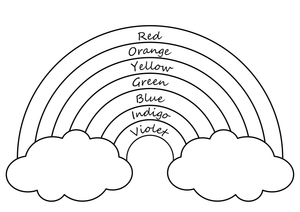
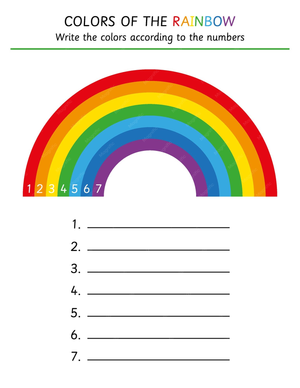
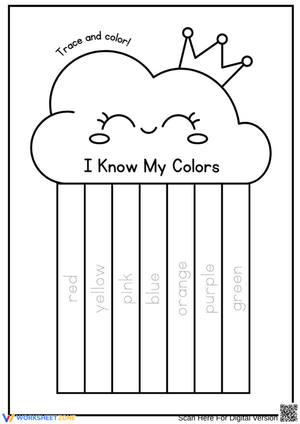
The ELA worksheets move from recognition to independent production across three separate tasks. The first asks students to read each color word in a word bank, match it to its band on a blank arc, and write the word beneath the correct stripe. The second removes the word bank entirely: students write all seven color words from memory and color each band to confirm the match. The third extends into sentence writing, where students complete frames like "The ___ band is ___" and then add a second sentence of their own. Because red and blue appear on the Dolch sight-word lists while orange and violet follow no phonics pattern a first grader has typically encountered, working through all seven words in this sequence gives students explicit exposure to both decodable and irregular word types within the same context.
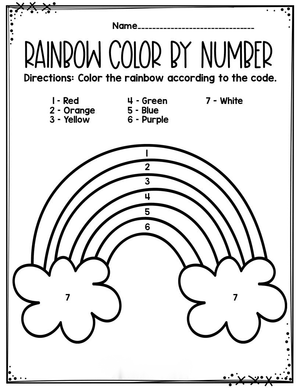
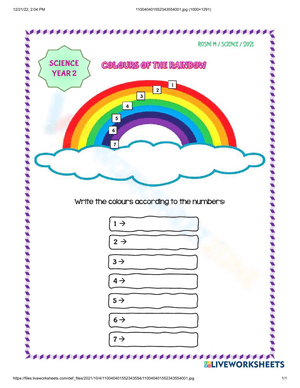
The math worksheets in this rainbow worksheets for 1st grade set use the arc shape to represent number bonds to ten: a number sits at one end of a color band, its complement at the other, and the sum appears at the peak. Students fill in missing addends, write the complete addition sentence below the arc, and shade each band. A second math worksheet uses ordinal vocabulary—first through seventh—to number the bands in sequence from the inside of the arc outward, tying the ROYGBIV order to positional language that appears in both math and ELA standards at grade one.
The science worksheet presents a simplified diagram of sunlight entering a raindrop, refracting inside, and separating into colored bands on exit. Students label the diagram using a word bank that includes refraction, spectrum, and prism, then sequence the colors in order and respond to two teacher-read prompts: "What makes the light split?" and "Where does the sunlight come from?" Keeping the reading demand low while requiring vocabulary labeling is deliberate—six-year-olds can engage with grade-appropriate scientific concepts long before they can decode the terminology independently.
Why the Arc Format Builds Retention at This Grade
First graders are mid-transition from picture-supported word reading to reading words in isolation. Color words are an unusual instructional case because they are not uniformly decodable: red follows phonics rules reliably, but orange and yellow do not map onto any pattern a first grader has met. The arc format creates a dual-coding moment—the motor memory of coloring the orange band while writing "orange" beneath it builds retention that a plain spelling list cannot replicate. The arc also functions as a self-correction tool: a student who writes "yellow" in the green position sees immediately that the coloring is wrong and fixes the label without teacher involvement. That self-correction loop is worth something in a room of twenty-two students.
Predictable Student Mistakes Worth Addressing Before They Settle In
Indigo disappears in almost every batch of completed ELA worksheets. Students consistently produce a six-color sequence—red, orange, yellow, green, blue, violet—with indigo omitted or collapsed into blue. This happens because most picture-book rainbows skip indigo entirely, and the word itself is unfamiliar to most six-year-olds. Address it before the labeling worksheet by showing a photograph where indigo is clearly visible and asking students to count the bands aloud with you before they pick up a pencil. That thirty-second count gives the seventh band a physical reality that the abstract word alone does not.
On the addition worksheet, a different pattern emerges. Students who grasp that pairs must sum to ten will correctly write 3 + 7 when prompted, but when both addends are blank and only the sum is given at the peak, some students write 5 + 5 for every single band. They find one reliable pair and stop generating alternatives. During center rotations, catch this by asking the student to find the pair that includes the number 3—which immediately breaks the doubles-only loop and gets them working through the full range of complements.
Where These Worksheets Fit in Your Lesson Planning
The three ELA worksheets build naturally across a week inside a weather unit. Use the word-bank version on Monday when students first encounter the ROYGBIV sequence, the from-memory version on Wednesday after the color words have gone up on the word wall, and the sentence-writing version on Friday as a low-stakes formative check. That three-day arc—introduction, supported practice, independent production—follows a gradual-release structure without requiring any extra planning time. The rainbow worksheets for 1st grade set is organized to support that progression from the first worksheet to the last.
The science diagram worksheet earns its best results when it follows a brief classroom demonstration rather than a teacher explanation alone. On a sunny morning, position a glass of water near a window and hold a sheet of white paper behind it until the spectrum appears. Students then return to their seats and reconstruct the diagram from memory. Requiring them to encode the sequence right after the demonstration—rather than copy it from a board—is the difference between transcription and retrieval, and that distinction shows up when you check in a week later.
Standard Alignment
The color-word ELA worksheets address CCSS.ELA-LITERACY.RF.1.3, decoding using phonics and word patterns, and CCSS.ELA-LITERACY.L.1.2d, conventional spelling of words with common patterns. Because several color words are irregular, teachers can use these worksheets to draw an explicit contrast between decodable words and those that require whole-word memorization—a metacognitive distinction the standard supports but that few commercial materials at this level name directly. The sentence-writing worksheet also touches CCSS.ELA-LITERACY.W.1.3, narrative writing that includes at least one detail about the event or topic.
The rainbow addition worksheet aligns with CCSS.MATH.CONTENT.1.OA.C.6, adding and subtracting within 20 using strategies including making ten. The arc is a physical representation of the make-ten strategy—the same concept that ten-frames and number bond diagrams target—so this worksheet reinforces an approach students are building across multiple representations rather than introducing a new visual format in isolation.
Adapting the Set for a Wide Range of First-Grade Learners
For students still developing letter formation or who find the writing volume of the full color-word worksheet frustrating, limit the from-memory task to the four most decodable words—red, green, blue, violet—and provide tracing lines for the remaining three. This reduces demand without removing the arc-completion task, so those students still build the full seven-band visual sequence. The same adjustment works as a re-entry activity for students who missed the opening lesson of the unit.
Students who finish the addition worksheet quickly and accurately can extend the task with a blank arc and the prompt: "Make your own rainbow addition with a sum that is not 10." Most will attempt 12 or 15; a few try 20, which is worth noting for the anchor chart and tends to generate genuine curiosity from nearby students. At the other end, students who cannot yet hold two addends in working memory benefit from having linking cubes at the table—one color per band—so they can build each pair physically before writing the equation. The physical-to-written step keeps those students working within the same task structure as their classmates without requiring a separate worksheet.
Frequently Asked Questions
Do students need background knowledge about rainbows before starting these worksheets?
No prior knowledge is required, but a two-minute introduction makes a real difference. Showing one clear photograph of a rainbow and reading the color names aloud while pointing to each band gives students enough context to engage with the labeling and writing tasks independently. The science worksheet includes a labeled word bank precisely for this reason—the task is sequencing and labeling, not retrieving facts from memory.
Can these worksheets be used outside of a weather or seasons unit?
A rainbow worksheets for 1st grade fits most naturally inside a weather unit, but the math worksheets have no dependence on that context. The arc format for number bonds works as standalone addition practice any time in the first half of the year, and many teachers continue using the ordinal-number worksheet well after the weather unit ends because students already recognize the visual and retrieve the color sequence quickly. The ELA and science worksheets make more instructional sense within a thematic unit, but the math component transfers cleanly.
How do I prevent students from spending the entire period coloring and skipping the writing tasks?
Set the sequence verbally before distributing worksheets: writing tasks first, coloring after all blanks are complete. For the labeling worksheet, every word must be written before a crayon comes out. Building that direction into your standard distribution routine—"pencil in hand, write the color words first, then color the bands"—takes thirty seconds and eliminates the problem in most cases. The coloring remains a genuine part of the task because it reinforces the word-color link, but it becomes the completion step rather than the default mode.












 Interactive Worksheet Maker
 Quiz Maker
 Word Search Maker
 Crossword Puzzle Maker
 Word Scramble Generator
 Sentence Scramble Generator
 Handwriting Worksheet Generator
 Name Tracing Generator
 Fill In The Blank Generator