Blends and Digraphs Printable Worksheets for 1st Grade
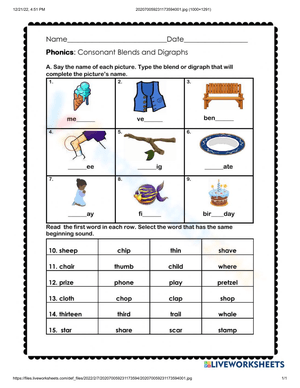
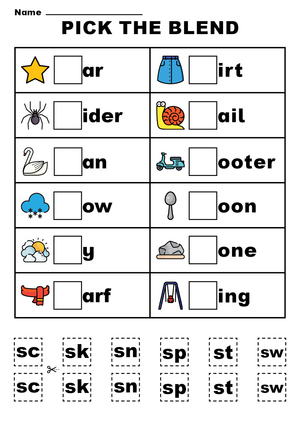
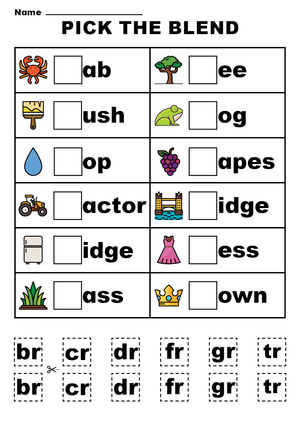
These blends and digraphs printable worksheets for 1st grade give teachers a focused set of phonics practice activities built around two concepts that look similar on paper but work very differently in a child's mouth. Each worksheet isolates one pattern family — a single L-blend group, one digraph, or a paired contrast like sh versus ch — so students get the repeated exposure needed to internalize a pattern before moving on. The set covers both initial and final positions, and the activity formats include picture-word matching, fill-in-the-blank, cut-and-sort, and open word building.
The Phonics Patterns the Set Addresses
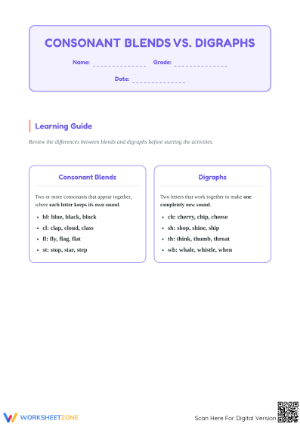
Consonant blends are two or three consecutive consonants where each letter's sound is still pronounced separately. In flag, a student hears both /f/ and /l/; in strip, all three sounds — /s/, /t/, /r/ — remain audible and distinct. The worksheets cover L-blends (bl, cl, fl, gl, pl, sl), R-blends (br, cr, dr, fr, gr, pr, tr), and S-blends (sc, sk, sm, sn, sp, st, sw), along with the most common final blends: -nd, -st, -lk, and -mp. Students practice initial blends first, since that's where they appear in the short decodable texts most 1st graders read in September and October.
Digraphs are categorically different: two letters that fuse into a single phoneme that neither letter makes on its own. The sh in ship is not /s/ followed by /h/ — it's one new sound. The five digraphs in the set are sh, ch, th, wh, and ph, each appearing at word beginnings and ends. These two concepts belong in the same phonics unit precisely because both involve letter combinations that must be recognized as a chunk rather than decoded letter by letter — but the underlying logic is different, and worksheets that make that distinction explicit give students a cleaner mental model than ones that treat both as simply "two letters working together."
Patterns of Confusion Worth Addressing Before They Solidify
The error that shows up most consistently is students applying blend logic to digraphs. A child who has learned to stretch out two consonant sounds will look at sh and produce /s/ + /h/ separately — then either freeze or land on a word that's close but wrong. In student writing, this looks like "sip" for ship or "tin" for thin. This isn't a memory gap; it's a conceptual error, and additional drilling on the same blends won't correct it. The worksheets that ask students to sort words by whether they hear one sound or two at the beginning target this distinction directly at the level where the confusion lives.
A second reliable trouble spot is the three-letter S-blend. Students who handle st and tr individually will sometimes drop the middle consonant when the two merge: strip becomes srip or stip in their writing. This error stays hidden in journal entries — there's too much going on in a full sentence for teachers to catch it in real time. Fill-in-the-blank worksheets that require students to write all three consonants explicitly bring the error into the open, where it can be addressed before it becomes a habitual misspelling.
Where These Worksheets Fit in the Daily Literacy Block
The most reliable entry point is the five to eight minutes at the start of the phonics lesson, before new instruction begins. A single-focus matching worksheet — pictures to blends, or words sorted under digraph headers — primes students' attention without demanding the kind of effortful retrieval that belongs later in the block. Monday mornings are a particularly good fit: students return from the weekend with softened phonics recall, and a quick warm-up reactivates the prior week's patterns before new ones are introduced.
Cut-and-sort worksheets belong in small-group instruction, where a teacher can observe the decisions students make in real time. The physical act of sorting reveals reasoning that a circled answer on a written activity doesn't — a student who moves church under the ch column without hesitation understands something that a correct mark on a multiple-choice item can't confirm. Fill-in-the-blank worksheets move into literacy centers once the target pattern has been introduced whole-group, since students can complete them independently once the routine is established. These blends and digraphs printable worksheets for 1st grade also translate cleanly to homework: the picture-support formats are self-explanatory enough that caregivers can assist without knowing phonics terminology themselves.
Standard Alignment
These worksheets align directly with CCSS RF.1.3b, which requires Grade 1 students to decode regularly spelled one-syllable words containing consonant digraphs, and with RF.1.3c, which addresses two-letter consonant blends. In classroom terms, these sub-standards sit at the center of the reading foundational skills sequence from roughly October through March in most Grade 1 programs — the window when students are transitioning from single-letter decoding into multi-letter pattern recognition. Documenting this alignment in lesson plans supports phonics coverage conversations during instructional coaching cycles and curriculum walkthroughs.
Adjusting the Work for a Range of Learners
For students still consolidating single-letter consonant sounds, the entry point into blends is the ear, not the page. Use worksheets that pair pictures with spoken prompts and ask students to tap the sounds they hear at the beginning of each word — the written component follows once auditory discrimination is solid. Reducing the number of answer choices on a matching worksheet from six to three lowers the working memory demand without removing the phonics challenge itself. These blends and digraphs printable worksheets for 1st grade are most effective for students who need additional support when the teacher works through the first two or three items aloud before releasing students to finish independently — that brief guided opening is often enough to make the task accessible.
Students who have already internalized basic patterns need formats that require generation, not recognition. Word-building tasks — where students construct their own blend or digraph words around a given vowel chunk — push beyond matching and circling into encoding, which is a significantly harder cognitive demand. Pairing these students with a partner to explain why a word belongs under one header and not another turns a worksheet into a brief oral language task, strengthening both their phonics knowledge and their ability to articulate the reasoning behind it.
Frequently Asked Questions
What is the difference between a blend and a digraph, and why does it matter for 1st graders?
A blend preserves both sounds — you can hear /b/ and /l/ separately in blue. A digraph collapses two letters into one new sound — the sh in shop is neither /s/ nor /h/. The distinction matters because a student who applies blend logic to a digraph will misread the word every time. Teaching the two concepts separately, with distinct labels, gives students the right decoding strategy before they encounter unfamiliar words in text.
In what order should blends and digraphs be introduced across the year?
Most structured phonics programs introduce initial blends before final blends, and both before digraphs. Within initial blends, L-blends and R-blends come first because they appear in the simple decodable texts students read early in the year. S-blends follow, with three-letter blends last. Digraphs typically enter the sequence in late fall, with sh and ch first since students encounter them in common words like she, chin, and fish within their earliest readers.
How do I know whether a student genuinely understands the patterns or is only recognizing them on familiar worksheets?
Ask the student to decode a word they haven't seen before that contains the target pattern. If they work through it correctly and can tell you how many sounds they heard, the understanding is transferring to new material. If they stall or revert to whole-word guessing, the practice hasn't yet connected to the decoding process itself. The blends and digraphs printable worksheets for 1st grade in this set include word-building tasks specifically because production — generating a new word — is a stronger signal of genuine understanding than selecting a correct answer from a list.
Can these worksheets serve kindergarten or 2nd grade students?
Kindergarten students who have strong phonemic awareness and know all single-letter consonant sounds can handle an introduction to L-blends and the digraphs sh and ch toward the end of the year — but the full progression is paced for Grade 1 instruction. In 2nd grade, the worksheets work well as targeted review for students who moved through 1st grade with phonics gaps, or as a quick diagnostic to identify which specific patterns still need attention before students advance into more complex vowel and syllable work.
Clear All