


























Views
Downloads

Irregular Past Tense Verbs Printable | Grade 1 ELA
Paste this activity's link or code into your existing LMS (Google Classroom, Canvas, Teams, Schoology, Moodle, etc.).
Students can open and work on the activity right away, with no student login required.
You'll still be able to track student progress and results from your teacher account.
This Grade 1 irregular past tense verbs worksheet helps students identify and use non-standard verb forms in their writing. By practicing common exceptions like saw, went, and taught, learners build the grammatical foundation necessary for fluent reading and clear communication. Students will transition from simple recognition to independent sentence construction through structured practice.
At a Glance
- Grade: 1 · Subject: ELA
- Standard:
CCSS.ELA-LITERACY.L.1.1.E— Use verbs to convey a sense of past, present, and future- Skill Focus: Irregular Past Tense Verbs
- Format: 4 pages · 17 problems · Answer key included · PDF
- Best For: Grammar centers and independent practice
- Time: 15–20 minutes
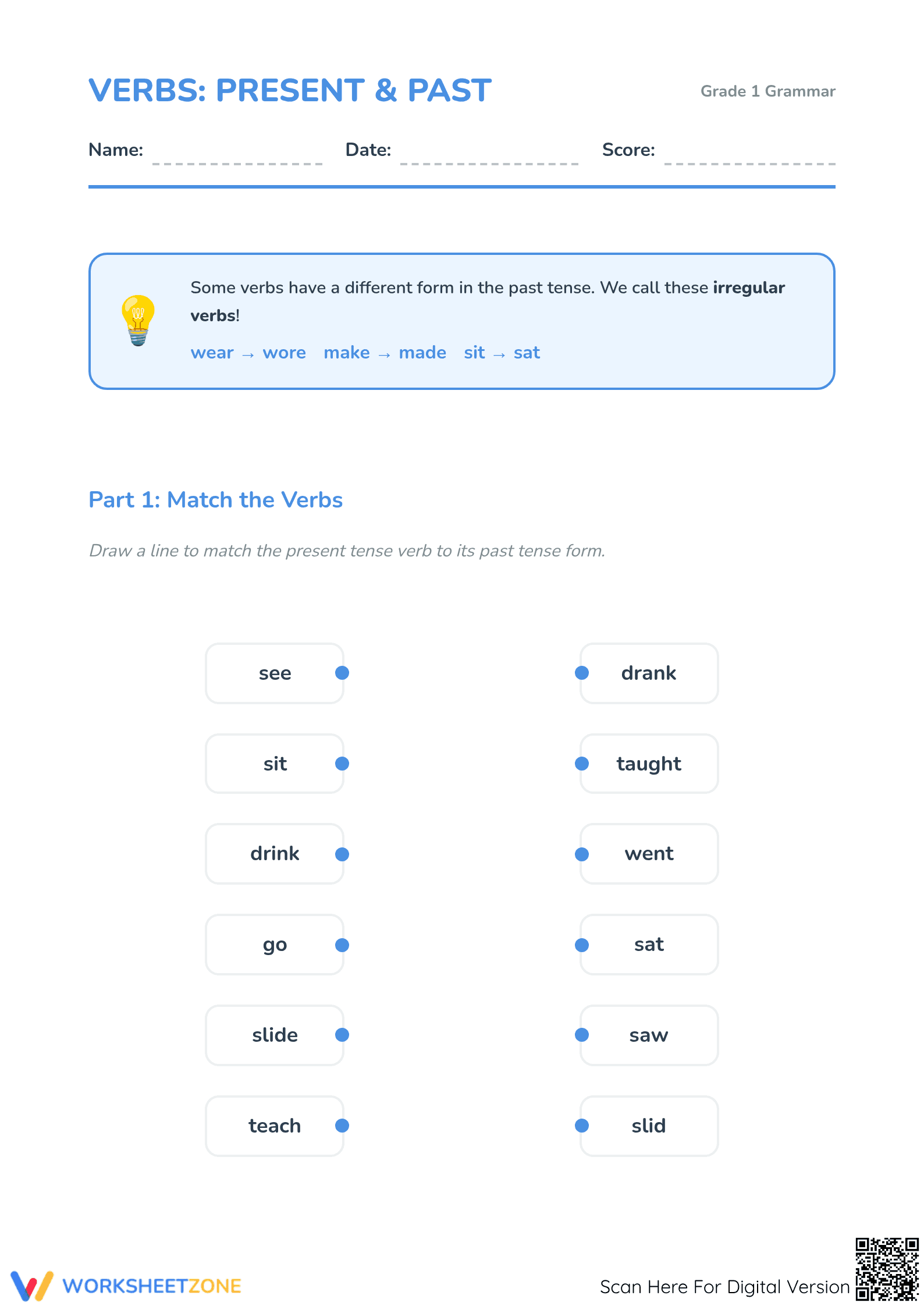
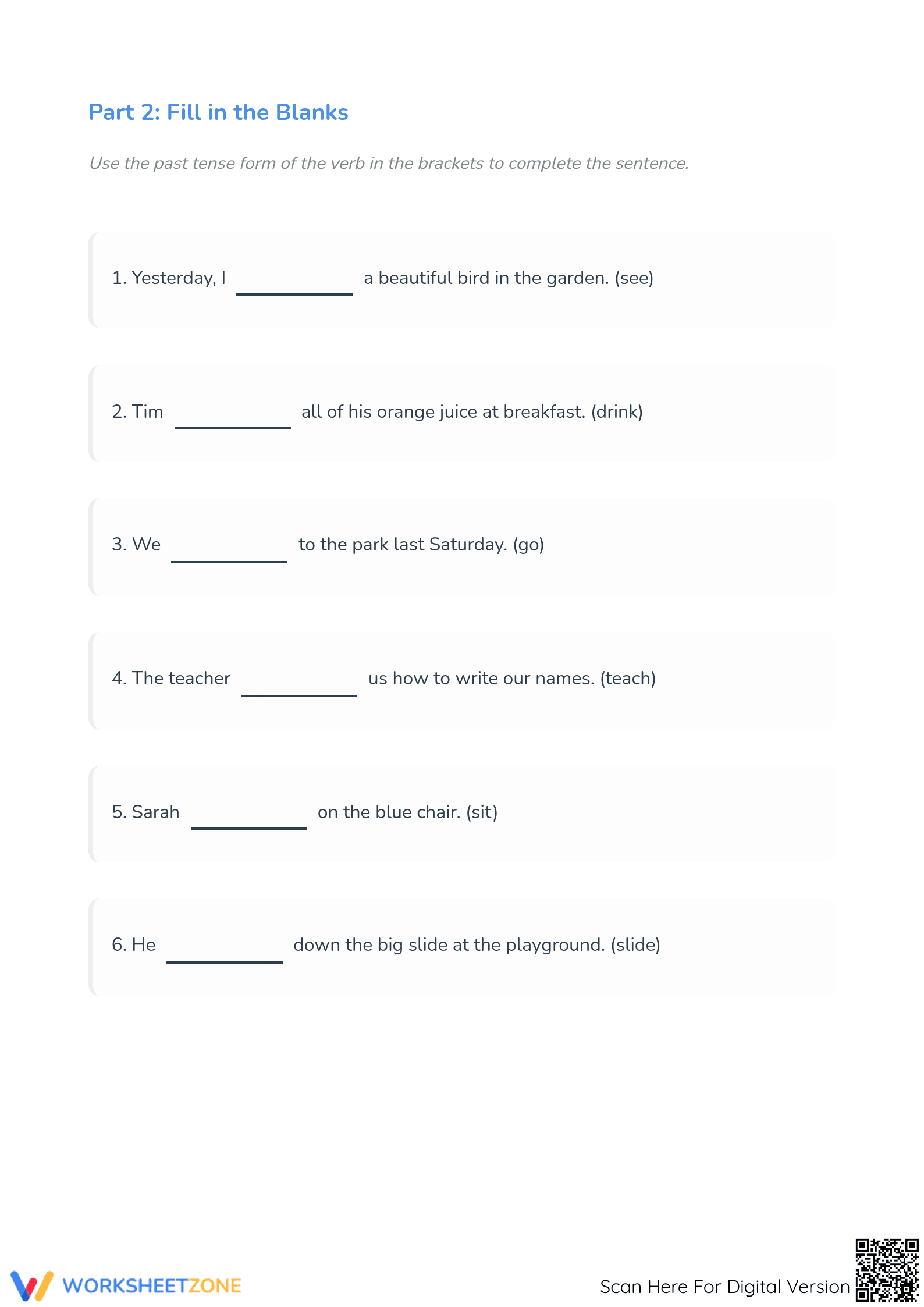
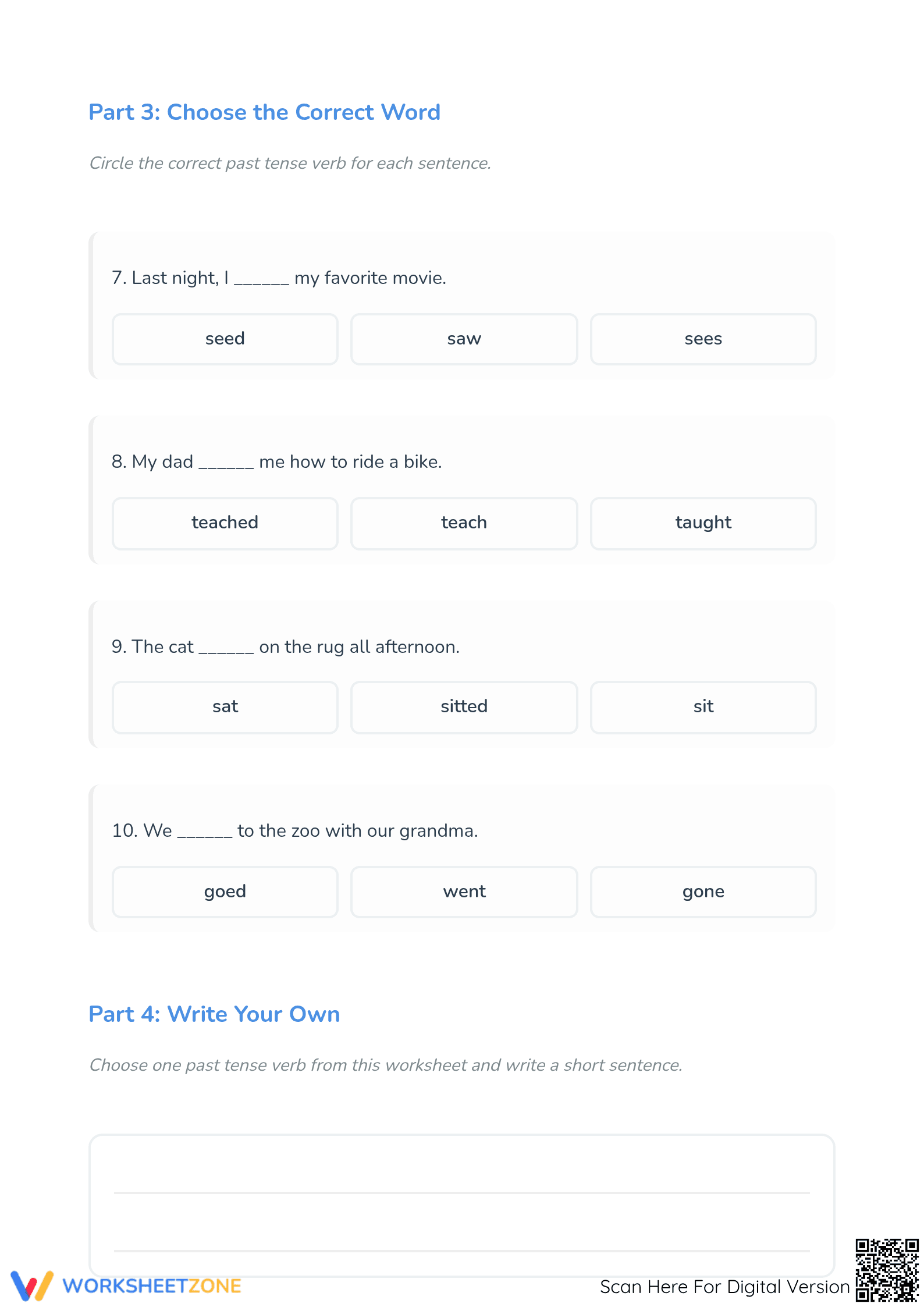
This comprehensive 4-page resource includes a visual matching section, six sentence-level fill-in-the-blank exercises, and four multiple-choice questions to reinforce correct usage. It concludes with an open-ended writing prompt. A full answer key is provided for quick grading or student self-correction, ensuring immediate feedback on irregular forms that do not follow standard conjugation rules.
Skill Progression
- Guided practice: Students begin with a 6-item matching task that provides visual anchors between present and past tense forms, reducing cognitive load during initial exposure.
- Supported practice: The middle section features 10 contextualized problems where students choose or generate the correct verb form within a specific sentence frame.
- Independent practice: The final task requires students to select one irregular verb and compose an original sentence, demonstrating full mastery of the concept.
This gradual-release model ensures students move confidently from recognition to application using the I Do, We Do, You Do instructional framework.
Standards Alignment
The content is directly aligned with `CCSS.ELA-LITERACY.L.1.1.E`, which requires students to use verbs to convey a sense of past, present, and future. It specifically targets the mastery of irregular forms that do not follow the standard suffix rule. Both standard codes can be copied directly into lesson plans, IEP goals, or district curriculum mapping tools.
How to Use It
Assign this worksheet during the independent practice phase of a grammar lesson after introducing the concept of irregular verbs. It works effectively as a formative assessment to check for understanding before moving to more complex narrative writing. Teachers can observe student performance on the multiple-choice section to identify specific verbs that require further direct instruction. Expect completion in 20 minutes.
Who It's For
This resource is designed for first-grade students, English Language Learners (ELL) who are learning verb conjugation patterns, and older students requiring remedial grammar support. It pairs naturally with a classroom anchor chart listing common irregular verbs or a mentor text focused on past-tense storytelling to provide a complete instructional experience.
According to the RAND AIRS 2024 report on foundational literacy, explicit instruction in morphological exceptions, such as irregular past tense verbs, is critical for early writing development. This worksheet addresses CCSS.ELA-LITERACY.L.1.1.E by providing 17 targeted opportunities for students to practice high-frequency irregular forms like went and saw. Research from Fisher & Frey (2014) emphasizes that scaffolded practice—moving from matching to sentence generation—supports the long-term retention of linguistic rules. By isolating these lexical challenges, the resource helps prevent the overgeneralization of the suffix rule, a common hurdle in Grade 1 language acquisition. This structured approach ensures that students can accurately convey temporal relationships in their writing, a key indicator of early literacy proficiency as measured by national standards. The inclusion of a writing prompt allows for the application of these skills in a generative context, bridging the gap between grammar drills and authentic composition.


