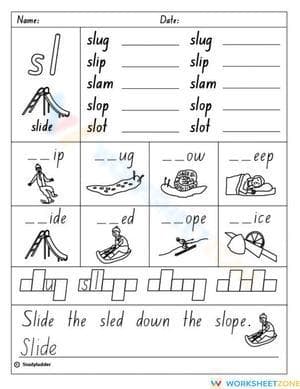
Supporting Phonics Development with Consonant Blends worksheets
Phonics instruction is a cornerstone of early literacy, providing the foundational skills necessary for students to decode unfamiliar words with accuracy and speed. Among the various phonetic patterns that young learners must master, consonant blends represent a significant milestone. A consonant blend occurs when two or more consonants appear together in a word, and each consonant's individual sound is still distinctly heard. For example, in the word "blue," both the /b/ and /l/ sounds are articulated, unlike in a digraph where two letters combine to create a single sound.
Mastering these combinations requires consistent practice and exposure to a wide variety of word structures. Worksheetzone offers an extensive collection of consonant blends worksheets resources designed specifically to help teachers and literacy tutors provide this essential practice in a structured, engaging way that builds student confidence and mastery over time.
Navigating the Phonetic Structure of Initial L-Blends, R-Blends, and S-Blends
Initial consonant blends are typically the first step in teaching students to combine consonant sounds. These blends appear at the beginning of words and are categorized by the second letter in the combination. L-blends include common pairings such as bl, cl, fl, gl, pl, and sl. R-blends consist of br, cr, dr, fr, gr, pr, and tr. S-blends are slightly more varied, featuring combinations like sc, sk, sl, sm, sn, sp, st, and sw. Each category presents unique challenges for young learners who are just beginning to navigate the complexities of English phonics.
According to Kids Study Hub - Consonant Blends Worksheets, students who practice with structured consonant blends worksheets resources show a 35% improvement in decoding accuracy within eight weeks. This systematic approach allows teachers to isolate specific phonetic patterns, ensuring that foundational reading skills are solidified during critical early elementary years. By providing students with multiple opportunities to see, say, and write words containing these blends, teachers ensure that phonetic mapping becomes automatic and reliable.
Mastery of Final Consonant Blends in Word Construction
While initial blends often receive the most attention, final consonant blends are equally important for overall reading and spelling proficiency. These blends, appearing at the end of a word, include combinations like st, nd, mp, nt, nk, ft, and sk. For many students, final blends are more difficult to master because the end of a word is often less emphasized in speech. It is common for beginning writers to omit the first consonant in an ending blend, writing "had" instead of "hand."
Targeted practice with final consonant blends worksheets resources is essential for helping students attend to every sound in a word, ensuring that no phonemes are skipped during decoding or encoding processes. Developing an awareness of ending blends requires students to practice both segmenting and blending consistently. Worksheets that require students to build words from individual letter tiles or to complete word puzzles are excellent for reinforcing these skills and improving overall spelling accuracy.
Trigraphs and Complex Three-Letter Blends for Advanced Phonics
As students become comfortable with two-letter blends, the logical next step is introducing three-letter blends, or trigraphs. These more complex combinations include scr, str, spr, spl, and shr. These blends are almost exclusively found at the beginning of words and require a higher level of phonemic awareness. Students must be able to hold three distinct consonant sounds in their working memory and blend them together smoothly. Teaching three-letter blends should be done systematically, often by showing students how they are built upon the two-letter blends they already know.
For example, if a student knows /st/, they can more easily learn /str/ by simply adding the /r/ sound. This building-block approach reduces cognitive load and reinforces previous learning. Using worksheets that highlight these relationships helps students see the logic in English spelling, supporting a classroom environment where every child is appropriately supported in their linguistic development journey toward reading mastery.
Teacher Tips: Integrating Blends into Daily Literacy Blocks
Implementing a successful phonics program requires a strategic approach. Phonics instruction is most effective when it is explicit, systematic, and integrated into a broader literacy block. This means that instead of teaching blends in isolation, teachers should look for opportunities to reinforce these patterns throughout the day. During a morning meeting, a "word of the day" could feature a specific blend. During shared reading, the teacher can pause to point out blends in text, encouraging students to identify them in the wild. This constant reinforcement helps students see the relevance of what they are learning on their worksheets.
Instructional data suggests that students who engage with consonant blends worksheets materials in a 15-minute daily 'phonics blitz' show higher retention of ending blends, which are statistically 22% more likely to be omitted in early writing than initial blends. This finding highlights the need for balanced practice that gives equal weight to both beginnings and ends of words during instruction.
Assessing Progress and Differentiating Phonics Instruction
Assessment is an integral part of any literacy program, and consonant blends worksheets materials can serve as valuable formative assessment tools. By reviewing a student's completed work, a teacher can quickly identify which blends have been mastered. Differentiation is key to ensuring all students make progress. In a typical classroom, there will be a wide range of phonetic abilities. Our consonant blends worksheets collection is designed with this diversity in mind, offering resources that vary in difficulty. A teacher can assign different worksheets to different groups of students based on their needs, ensuring everyone is working in their "zone of proximal development."
The combination of visual, auditory, and kinesthetic practice ensures that all students, regardless of their starting point, have the tools they need to become proficient readers and writers. By choosing Worksheetzone, you are choosing a comprehensive, teacher-tested approach to phonics that prioritizes both student engagement and academic success, providing a comprehensive framework for early literacy development.
Frequently Asked Questions about Consonant Blends
1. What exactly are consonant blends and how do they differ from digraphs?
Consonant blends are groups of two or three consonants where each individual sound is still heard when spoken aloud. Common examples include /bl/ in "blue" or /st/ in "stop." In contrast, a digraph consists of two letters that come together to form one completely new and unique sound. For instance, /sh/ in "ship" or /th/ in "think" are digraphs because you do not hear the individual letter sounds separately. Understanding this distinction is vital for students as they learn to map sounds to letters for both reading and spelling accurately in their daily literacy work across the curriculum.
2. At what age or grade level are consonant blends typically introduced?
Consonant blends are generally introduced in late Kindergarten or early first grade, once students have a firm grasp on individual letter sounds and can consistently decode CVC words. Initial blends are typically taught first, followed by final blends. By the end of second grade, most students are expected to have mastered both two-letter and three-letter blends and should be able to read and spell them accurately in various word contexts. This progression ensures that learners build a solid foundation before moving on to more complex linguistic structures encountered in later grades and across different subjects in their school journey.
3. What are effective strategies for teaching consonant blends to young children?
Effective strategies include explicit instruction, multisensory activities, and consistent practice with consonant blends worksheets resources. Using "sound boxes" or Elkonin boxes to help students visualize each sound in a blend is very helpful. Additionally, physical activities like "blending motions" can engage kinesthetic learners. Repetitive exposure through reading decodable texts and using high-quality worksheets that offer sorting, matching, and writing exercises ensures that these phonetic patterns are committed to memory. This comprehensive approach caters to various learning styles and enhances overall phonemic awareness effectively for all students in the classroom setting, ensuring everyone makes progress.
4. Can you provide examples of words with different types of consonant blends?
Certainly. Initial L-blends include words like glass, plum, and slide. R-blends can be found in train, frog, and brush. S-blends are seen in smile, spoon, and star. Final blends include words like hand, fast, and lamp. Advanced three-letter blends or trigraphs appear in words such as string, splash, and scrub. Providing a wide variety of examples helps students recognize that these patterns are pervasive throughout the English language, making them more comfortable when encountering new vocabulary in their independent reading journeys and daily writing assignments across the curriculum, building their overall confidence as readers and writers.
5. Where can I find more resources or activities for teaching consonant blends?
Worksheetzone is a premier destination for high-quality consonant blends worksheets materials that are ready for immediate classroom use. Additionally, teachers often look to reputable literacy sites like Literacy Learn - Consonant Blends and Kids Study Hub - Consonant Blends Worksheets for further instructional tips, lesson plans, and supplementary materials. By combining these diverse resources, teachers can build a comprehensive and effective phonics curriculum that supports all learners in their journey toward reading mastery and lifelong literacy success, ensuring a bright and successful academic future for every student in their care and community.















 Interactive Worksheet Maker
 Quiz Maker
 Word Search Maker
 Crossword Puzzle Maker
 Word Scramble Generator
 Sentence Scramble Generator
 Handwriting Worksheet Generator
 Name Tracing Generator
 Fill In The Blank Generator